



Stephen Hawking
A brilliant theoretical physicist and cosmologist renowned for his groundbreaking work on black holes and relativity.
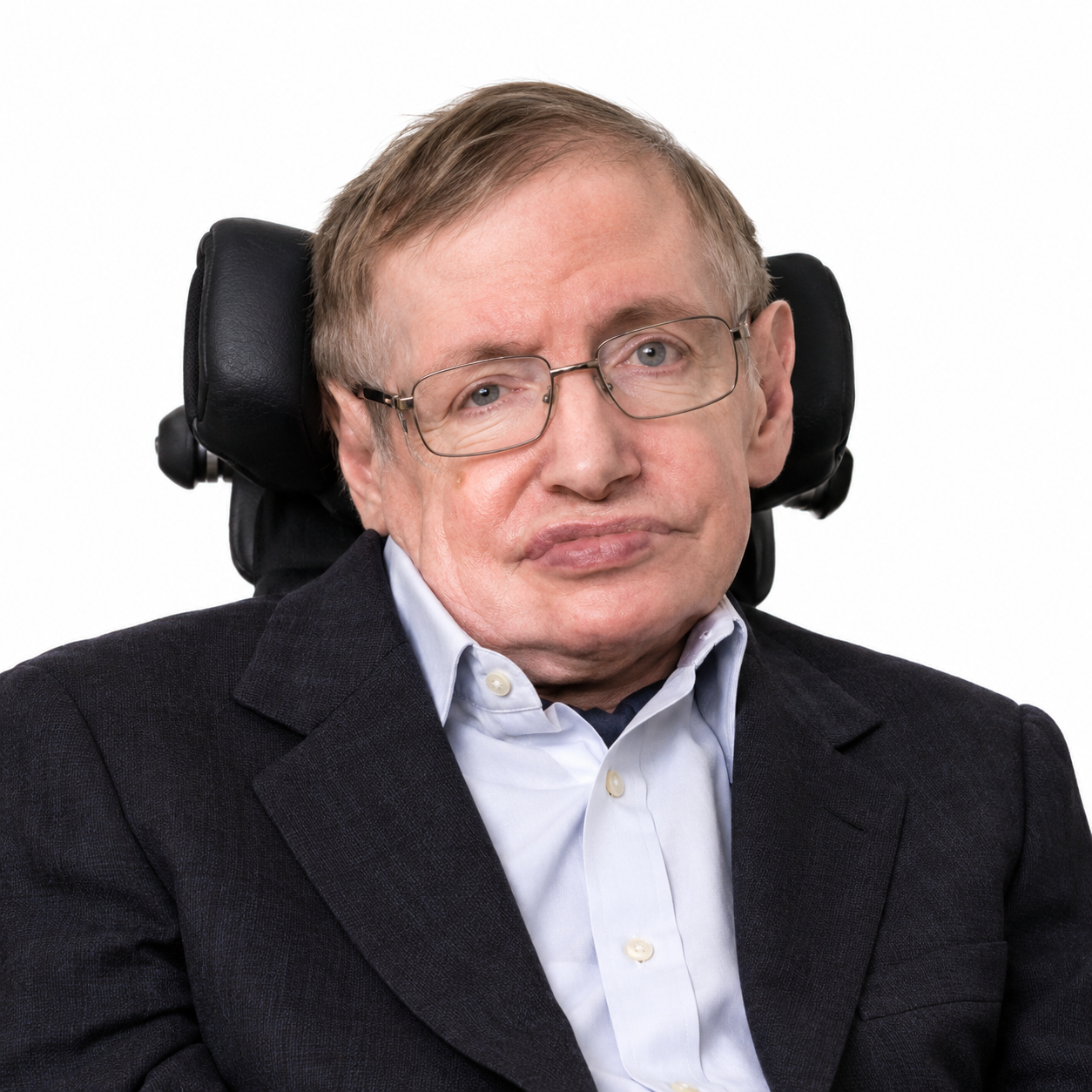
At a glance
- Born
- 1942 CE
- Died
- 2018 CE
- Era classification
- 76
- Homeland
- United Kingdom
- Period
- 1942–2018 CE
- Field
- Science, Medicine & Engineering
- Language
- English
- Religion
- Atheist
- Gender
- male
Biography
Stephen William Hawking was born on January 8, 1942, in Oxford, England. He developed an early passion for science and mathematics, eventually studying physics at University College, Oxford. After receiving his first-class BA degree, he began his graduate work at Trinity Hall, Cambridge, where he focused on cosmology and general relativity.
At the age of 21, Hawking was diagnosed with an early-onset, slow-progressing form of motor neurone disease (ALS) that gradually paralyzed him over the decades. Given only a few years to live, he defied medical expectations and plunged into his research with renewed vigor. He would go on to serve as the Lucasian Professor of Mathematics at the University of Cambridge for over thirty years, a prestigious academic post once held by Isaac Newton.
Hawking's scientific legacy is defined by his groundbreaking work on the fundamental laws of the universe. In collaboration with Roger Penrose, he showed that Einstein's General Theory of Relativity implied space and time would have a beginning in the Big Bang and an end in black holes. His most famous discovery, combining quantum mechanics with general relativity, was the theoretical prediction that black holes emit radiation, a phenomenon now universally known as Hawking radiation.
Beyond his academic achievements, Hawking was a passionate communicator of science. His 1988 book, 'A Brief History of Time,' became an international bestseller, making complex cosmological concepts accessible to millions. Despite losing his speech and relying on a computer-generated voice synthesizer, his wit, resilience, and intellectual brilliance made him a global icon of human perseverance until his death on March 14, 2018.
Portrayal characteristics
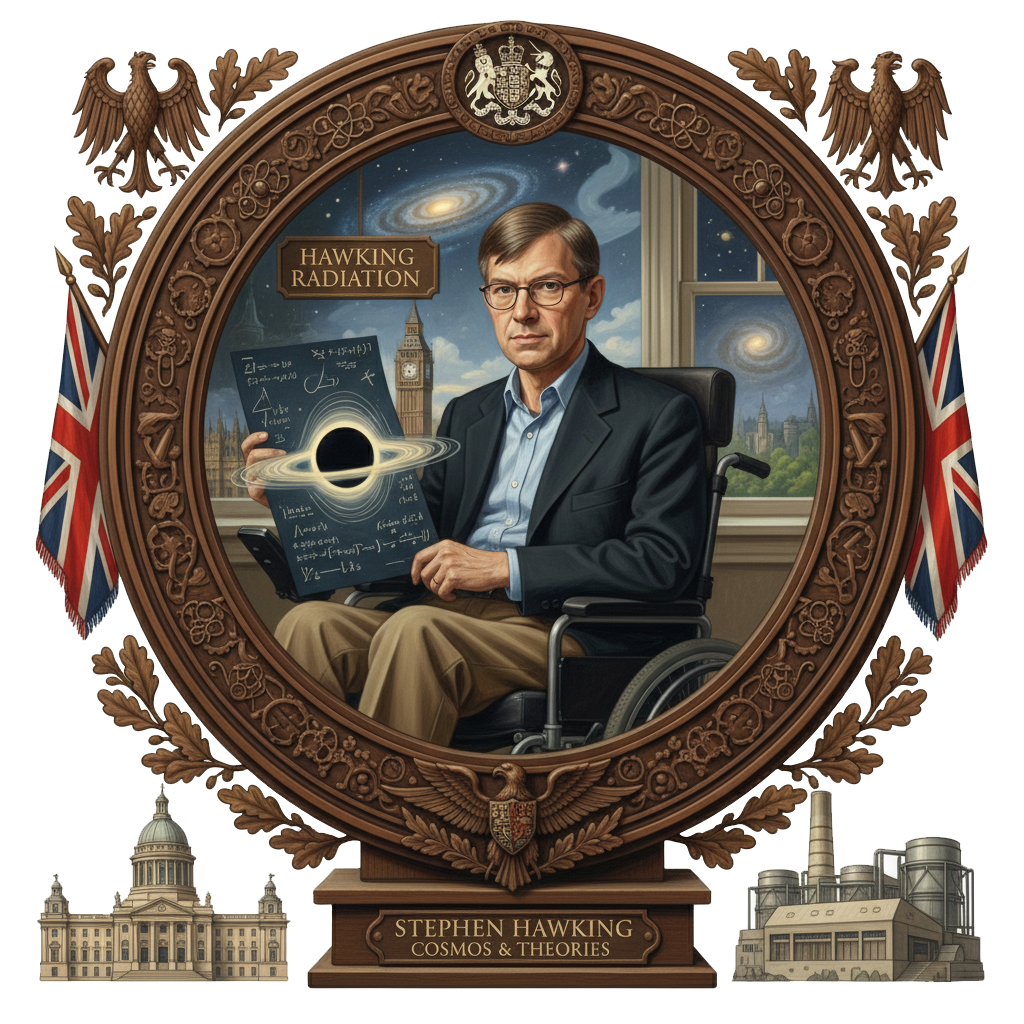
Saved editorial descriptions used for the reconstruction; these are not authenticated statements by the depicted person.
- Brilliant
- Resilient
- Visionary
- Determined
- Witty
- Curious
Images & artwork 4


Connections
Albert Einstein
Scientific Successor
Hawking's work on black holes and the Big Bang was a direct mathematical extension of Einstein's General Relativity.
Hawking utilized Einstein's field equations to prove the existence of singularities. His career was dedicated to reconciling Einstein's theory of the large-scale universe with the quantum mechanics that Einstein famously questioned.
Albert Einstein
Scientific Successor
Hawking's work on black holes and the Big Bang was a direct extension and challenge to Einstein's General Theory of Relativity.
Hawking utilized Einstein's equations to prove the existence of singularities and spent his career trying to reconcile relativity with quantum mechanics.
Isaac Newton
Lucasian Professor Successor
Hawking held the Lucasian Chair of Mathematics at Cambridge, the same prestigious position once held by Isaac Newton.
Hawking frequently referenced Newton's legacy in his writing, seeing himself as part of a long lineage of British physicists who transformed our understanding of gravity and the cosmos.
Galileo Galilei
Symbolic Connection
Hawking was born on the 300th anniversary of Galileo's death, a coincidence he often noted with pride.
Hawking felt a deep connection to Galileo's role as the father of modern science and his willingness to challenge established dogma through observation and mathematics.
Known for
- Hawking radiation
- Penrose-Hawking singularity theorems
- A Brief History of Time
- Advancing the theory of general relativity
- Pioneering quantum cosmology
Episodes featuring or mentioning this figure
No eligible published episode featuring this figure is currently in the library.