



Thomas Edison
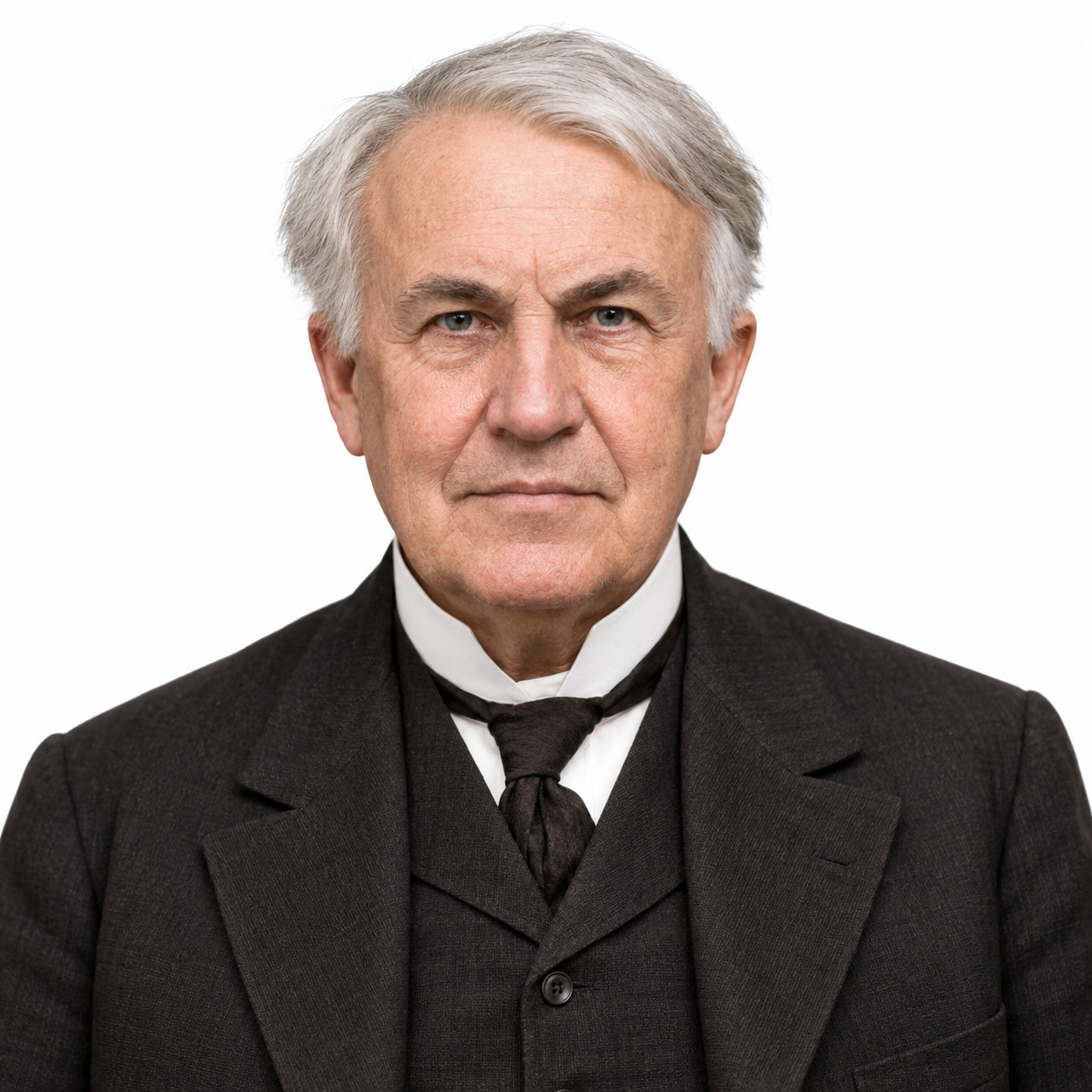
American inventor and businessman who developed the phonograph, motion picture camera, and practical electric light bulb.
At a glance
- Born
- February 11, 1847 CE
- Died
- October 18, 1931 CE
- Era classification
- 84
- Homeland
- USA
- Period
- 1847–1931 CE
- Field
- Science, Medicine & Engineering
- Language
- English
- Religion
- Deist
- Gender
- male
Biography
Thomas Alva Edison was born in Milan, Ohio, and grew up in Port Huron, Michigan. Receiving very little formal education, he was primarily taught by his mother and became an avid reader. Early in life, he developed severe hearing loss, a trait that profoundly influenced his solitary working style and concentration. He began his career as a telegraph operator, a profession that inspired his earliest inventions, including the automatic telegraph and other communication devices.
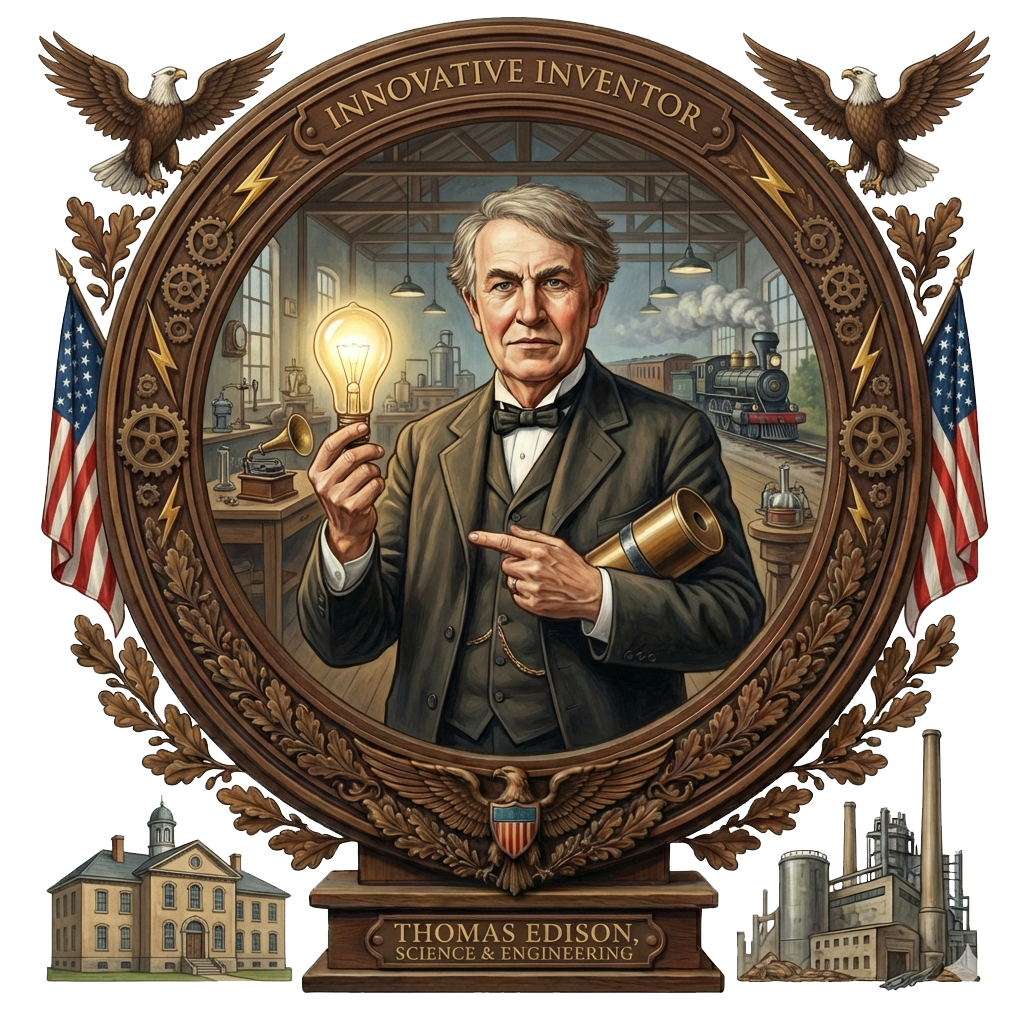
In 1876, Edison established his first laboratory facility in Menlo Park, New Jersey. This site is widely recognized as the first industrial research laboratory, pioneering the concept of applying teamwork and large-scale engineering to the process of invention. It was here that he achieved international fame by inventing the phonograph in 1877. Two years later, in 1879, he developed the first commercially practical incandescent light bulb, revolutionizing indoor lighting and paving the way for the widespread use of electricity.
Beyond his inventive genius, Edison was a formidable entrepreneur who founded numerous companies, including the Edison Electric Illuminating Company, which later became part of General Electric. During the 1880s, he famously engaged in the 'War of the Currents' against George Westinghouse and Nikola Tesla, stubbornly defending his direct current (DC) system against the ultimately victorious alternating current (AC). Despite this setback, he continued to innovate, making critical contributions to the development of motion pictures with his invention of the Kinetoscope.
Holding 1,093 US patents in his name, Edison remains one of the most prolific inventors in history. His true legacy lies not just in his individual inventions, but in his creation of the modern research and development laboratory, which transformed innovation from a solitary pursuit into a systematic, collaborative enterprise. He died of complications of diabetes in 1931 at his home in West Orange, New Jersey.
Portrayal characteristics
Saved editorial descriptions used for the reconstruction; these are not authenticated statements by the depicted person.
- Innovative
- Persistent
- Entrepreneurial
- Pragmatic
- Driven
- Methodical
Images & artwork 5
Connections
Henry Ford
Close Friends & Mentors
Ford and Edison shared a lifelong friendship and a mutual passion for innovation and engineering.
Ford worked for the Edison Illuminating Company, where Edison encouraged his early experiments with the gasoline engine. The two later became famous for their joint 'Vagabonds' camping trips and maintained adjacent winter estates in Florida.
Igor Sikorsky
Contemporary Admirer
Sikorsky met Thomas Edison and was deeply influenced by the American inventor's approach to innovation.
After immigrating to the United States, Sikorsky met Edison, whose success in industrial research served as a model for Sikorsky's own aviation company. He admired Edison's persistence and the way he bridged the gap between scientific theory and commercial application.
Mark Twain
Acquaintances
Twain and Edison were prominent contemporaries who interacted through the burgeoning world of early motion pictures.
In 1909, Edison's film crew visited Twain at his home, 'Stormfield,' to record the only known moving footage of the author. While they were not as close as Twain and Tesla, they shared a mutual interest in the commercial potential of new technologies.
Nikola Tesla
Professional Rivals
Tesla and Edison were the primary antagonists in the 'War of Currents' over the future of electricity.
Tesla briefly worked for Edison but left after a dispute over promised payments. Their rivalry intensified as Tesla's Alternating Current (AC) system competed against Edison's Direct Current (DC) system for dominance in the global power grid.
Nikola Tesla
Professional Rivals
Edison and Tesla were the primary figures in the 'War of Currents' to determine the standard for electrical power distribution.
Edison championed direct current (DC) and attempted to discredit Tesla's alternating current (AC) through public demonstrations. Despite their rivalry, Tesla briefly worked for Edison's company before their professional split.
Henry Ford
Close Friends & Collaborators
Edison and Ford shared a deep mutual admiration and a long-standing friendship that spanned decades.
Ford worked as an engineer at the Edison Illuminating Company and received Edison's encouragement for his automobile designs. Later in life, they went on famous annual camping trips together as part of a group called 'The Vagabonds'.
Mark Twain
Contemporary Acquaintances
Edison and Twain were prominent American figures who admired each other's work and interacted on several occasions.
Edison famously filmed Mark Twain at his home in 1909, creating the only surviving footage of the author. Twain was also an early adopter of Edison's inventions, including the phonograph.
Known for
- Practical incandescent light bulb
- The phonograph
- Motion picture camera (Kinetoscope)
- First industrial research laboratory
- Direct current (DC) electrical distribution
Episodes featuring or mentioning this figure
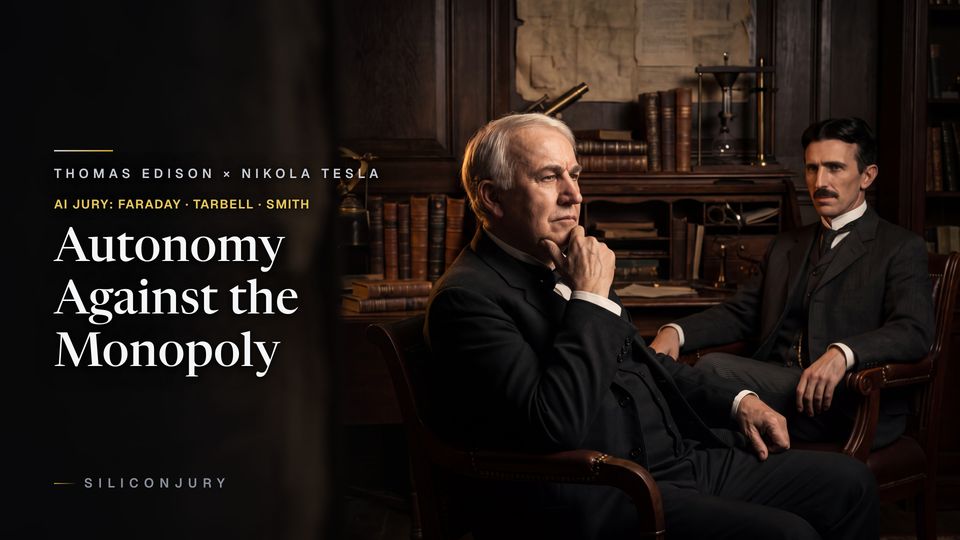
The Architecture of Electrical Power: Edison vs Tesla
AI jury: 3 members
Does the future of electrical infrastructure belong to localized direct-current microgrids or vast, interconnected alternating-current networks?