



Mark Twain
An iconic American writer and humorist, often called the father of American literature.
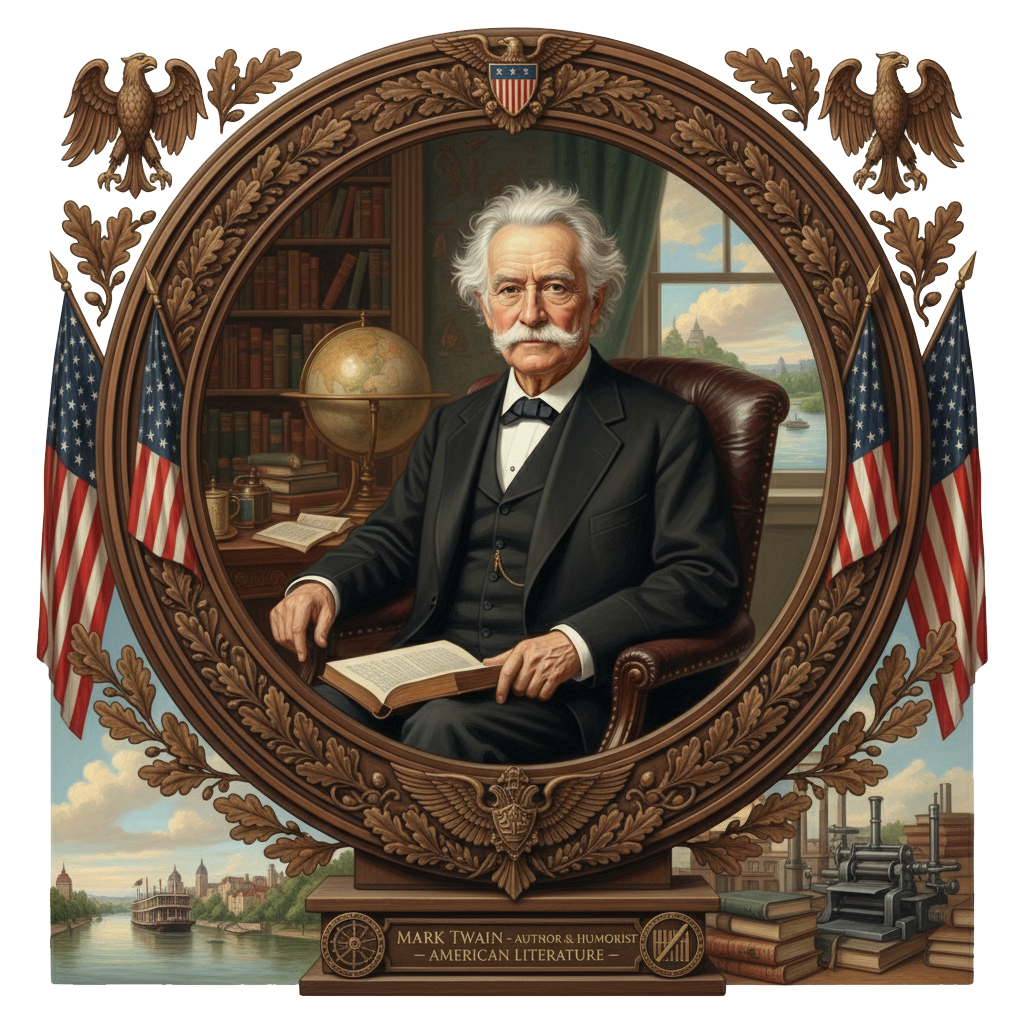
At a glance
- Born
- 1835 CE
- Died
- 1910 CE
- Era classification
- Modern
- Homeland
- United States
- Period
- 19th Century
- Field
- Poetry, Art & Ethics
- Language
- English
- Religion
- Deism
- Gender
- male
Biography
Born Samuel Langhorne Clemens in Missouri, Mark Twain grew up along the Mississippi River, which would later serve as the vibrant backdrop for his most famous works. Before achieving literary fame, he worked as a printer's apprentice, a riverboat pilot, and a miner, gathering a wealth of experiences and colorful characters.
He achieved massive success with novels like 'The Adventures of Tom Sawyer' and 'Adventures of Huckleberry Finn'. The latter is often celebrated as the Great American Novel, noted for its rich vernacular, deep social commentary, and unflinching critique of racism and hypocrisy in the antebellum South.
Known for his sharp wit and satire, Twain became a prominent public figure and a highly sought-after lecturer. In his later years, his writings grew darker and more cynical, reflecting personal tragedies and his growing disillusionment with imperialism and human nature. Nevertheless, his legacy as a foundational pillar of American literature remains secure.
Portrayal characteristics
Saved editorial descriptions used for the reconstruction; these are not authenticated statements by the depicted person.
- Humorous
- Satirical
- Observant
- Cynical
- Imaginative
Images & artwork 3


Connections
Nikola Tesla
Close Friends
Twain and Tesla shared a long-standing and well-documented friendship based on a mutual fascination with science and technology.
Twain was a frequent visitor to Tesla's laboratory, where he often participated in experiments and witnessed Tesla's latest inventions. Tesla, in turn, credited Twain's books with helping him recover from a serious illness during his youth in Europe.
Thomas Edison
Acquaintances
Twain and Edison were prominent contemporaries who interacted through the burgeoning world of early motion pictures.
In 1909, Edison's film crew visited Twain at his home, 'Stormfield,' to record the only known moving footage of the author. While they were not as close as Twain and Tesla, they shared a mutual interest in the commercial potential of new technologies.
Theodore Roosevelt
Political Critics
Twain was a vocal critic of President Roosevelt's imperialist foreign policies.
As a leader of the Anti-Imperialist League, Twain frequently used his platform to lampoon Roosevelt's actions in the Philippines. Despite their political enmity, both men were towering figures of the American 'Gilded Age' and shared a rugged, individualistic public persona.
Frederick Douglass
Friends & Allies
Twain was a friend and financial supporter of the abolitionist leader Frederick Douglass.
Twain helped pay for the education of Black students and was a key supporter of Douglass's efforts to publish his memoirs. Their relationship reflected Twain's deep commitment to racial justice, a theme that permeated his most famous literary works.
Abraham Lincoln
Contemporary Influence
Twain's early career and literary voice were shaped by the era of the American Civil War defined by Lincoln.
Although they never met, Twain's writing often grappled with the social and political shifts Lincoln initiated. Twain's transition from a young man in the South to a national literary icon mirrored the country's transformation during and after Lincoln's presidency.
Nikola Tesla
Close Friends
Tesla and Mark Twain shared a long and deep friendship based on a mutual fascination with science and technology.
Twain was a frequent visitor to Tesla's laboratory, where he participated in experiments and witnessed Tesla's high-frequency demonstrations. Tesla, in turn, credited Twain's books with helping him recover from a childhood illness.
Theodore Roosevelt
Political Antagonists
Roosevelt and Twain were prominent contemporaries who clashed sharply over the issue of American imperialism.
Twain, a leader of the Anti-Imperialist League, frequently satirized Roosevelt's 'Big Stick' diplomacy and the American annexation of the Philippines, representing the era's internal debate over global expansion.
Thomas Edison
Contemporary Acquaintances
Edison and Twain were prominent American figures who admired each other's work and interacted on several occasions.
Edison famously filmed Mark Twain at his home in 1909, creating the only surviving footage of the author. Twain was also an early adopter of Edison's inventions, including the phonograph.
Known for
- The Adventures of Tom Sawyer
- Adventures of Huckleberry Finn
- American literary realism
Episodes featuring or mentioning this figure
No eligible published episode featuring this figure is currently in the library.