



Theodore Roosevelt
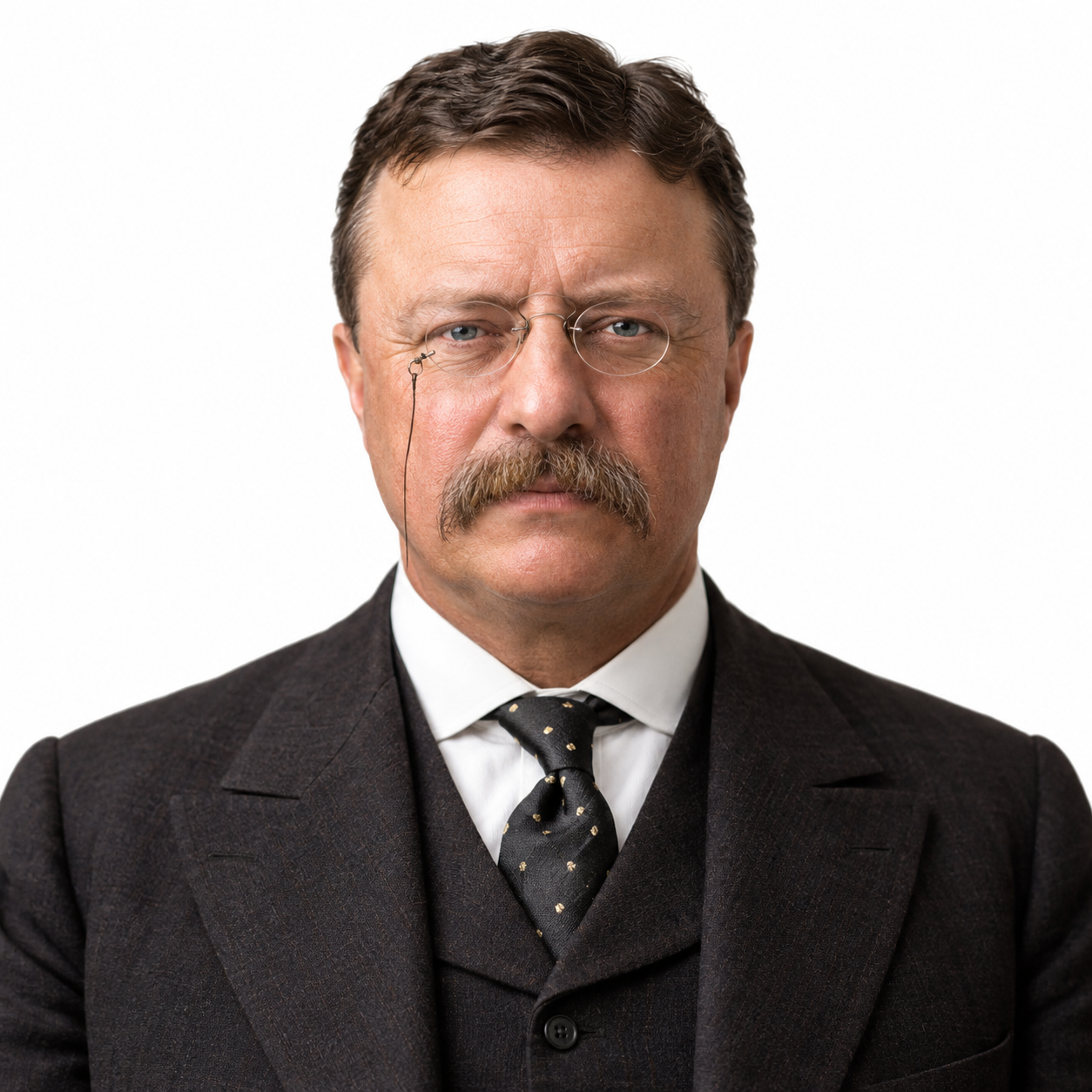
The 26th U.S. President, celebrated for his vigorous persona, progressive reforms, and championing of conservation.
At a glance
- Born
- October 27, 1858 CE
- Died
- January 6, 1919 CE
- Era classification
- 60
- Homeland
- USA
- Period
- 1858–1919
- Field
- Politics, Leadership & War
- Language
- English
- Religion
- Reformed Dutch
- Gender
- male
Biography
Theodore Roosevelt Jr. was an American statesman, conservationist, naturalist, and writer who served as the 26th President of the United States from 1901 to 1909. Born into a wealthy family in New York, he was a sickly child suffering from debilitating asthma. To overcome his physical weaknesses, he embraced a 'strenuous life' of vigorous exercise and outdoor activity, a philosophy that would define his public persona. After serving as Assistant Secretary of the Navy, he resigned to form the 'Rough Riders,' a volunteer cavalry regiment that gained fame during the Spanish-American War.
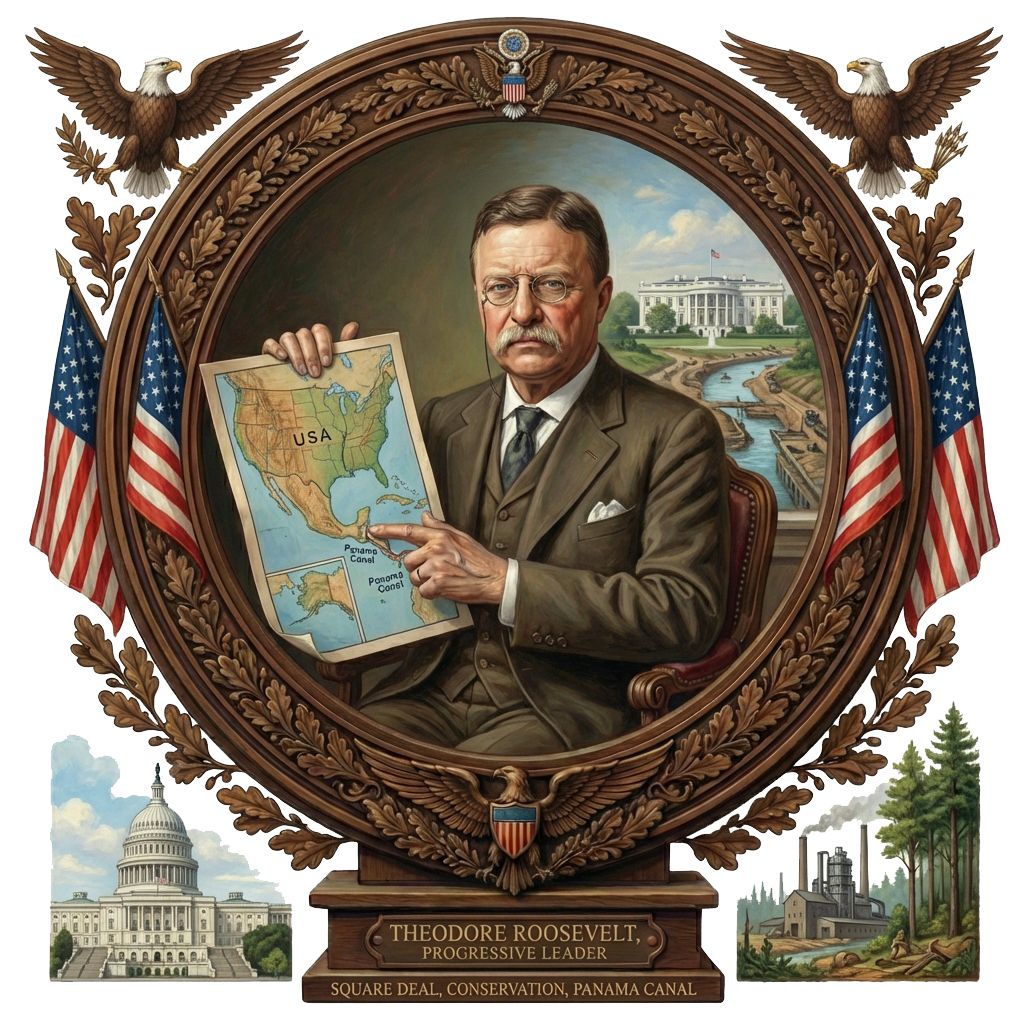
Roosevelt ascended to the presidency at age 42 following the assassination of William McKinley in 1901, becoming the youngest person to ever assume the office. As president, he championed his 'Square Deal' domestic policies, promising average citizens fairness, breaking up monopolistic trusts, and regulating railroads. He also successfully pushed for the Pure Food and Drug Act, fundamentally changing the federal government's role in protecting consumers.
In foreign policy, Roosevelt operated under the motto, 'Speak softly and carry a big stick.' He aggressively expanded American naval power, spearheaded the construction of the Panama Canal, and projected U.S. influence globally. In 1906, he became the first American to win the Nobel Peace Prize for his successful mediation to end the Russo-Japanese War.
Perhaps his most enduring legacy is his dedication to conservation. Roosevelt established the United States Forest Service and signed into law the creation of five national parks, 18 national monuments, and millions of acres of protected public lands. After leaving office, he mounted a third-party presidential bid in 1912 for the Progressive 'Bull Moose' Party and later undertook a perilous expedition into the Amazon basin, cementing his legacy as one of America's most dynamic and consequential leaders.
Portrayal characteristics
Saved editorial descriptions used for the reconstruction; these are not authenticated statements by the depicted person.
- Energetic
- Progressive
- Resolute
- Charismatic
- Outdoorsy
- Bold
Images & artwork 4


Connections
Abraham Lincoln
Posthumous Influence
Theodore Roosevelt deeply admired Lincoln, viewing him as the ultimate model for presidential leadership and moral courage.
As a young boy, Roosevelt witnessed Lincoln's funeral procession in New York City, an event that left a lasting impression on him. During his own presidency, Roosevelt frequently cited Lincoln as his greatest political hero and modeled his expansive view of executive power on Lincoln's wartime leadership. Roosevelt even wore a ring containing a lock of Lincoln's hair, gifted to him by Lincoln's former secretary John Hay, during his 1905 inauguration.
Eleanor Roosevelt
Family (Uncle)
Theodore Roosevelt was Eleanor's uncle and a major influence on her early life.
Theodore Roosevelt was the brother of Eleanor's father, Elliott. He gave Eleanor away at her wedding to her distant cousin, Franklin D. Roosevelt, in 1905, and her sense of public duty was deeply influenced by the Roosevelt family's tradition of service.
Mark Twain
Political Critics
Twain was a vocal critic of President Roosevelt's imperialist foreign policies.
As a leader of the Anti-Imperialist League, Twain frequently used his platform to lampoon Roosevelt's actions in the Philippines. Despite their political enmity, both men were towering figures of the American 'Gilded Age' and shared a rugged, individualistic public persona.
Abraham Lincoln
Political Idol
Roosevelt viewed Lincoln as his greatest political role model and often sought to emulate his leadership style.
Roosevelt famously wore a ring containing a lock of Lincoln's hair during his inauguration and frequently invoked Lincoln's legacy to justify his own 'Square Deal' and the expansion of federal power.
Eleanor Roosevelt
Uncle & Niece
Theodore was the uncle of Eleanor Roosevelt and gave her away at her wedding to Franklin D. Roosevelt.
Theodore's energetic public service and progressive ideals deeply influenced Eleanor's own path as a social activist and her eventual role as a transformative First Lady.
Mark Twain
Political Antagonists
Roosevelt and Twain were prominent contemporaries who clashed sharply over the issue of American imperialism.
Twain, a leader of the Anti-Imperialist League, frequently satirized Roosevelt's 'Big Stick' diplomacy and the American annexation of the Philippines, representing the era's internal debate over global expansion.
Winston Churchill
Contemporary Peers
The two met in 1900, though Roosevelt initially found the young Churchill to be somewhat arrogant.
Both men shared a passion for naval history and imperial strategy; their early interactions and mutual interests foreshadowed the 'Special Relationship' between their nations that would define the 20th century.
Known for
- 26th President of the United States
- The Square Deal domestic program
- Construction of the Panama Canal
- Nobel Peace Prize (1906)
- Establishing U.S. National Parks and Forests
- Leading the Rough Riders
Episodes featuring or mentioning this figure
No eligible published episode featuring this figure is currently in the library.