



Eleanor Roosevelt
The longest-serving First Lady of the United States and a globally recognized advocate for human rights.
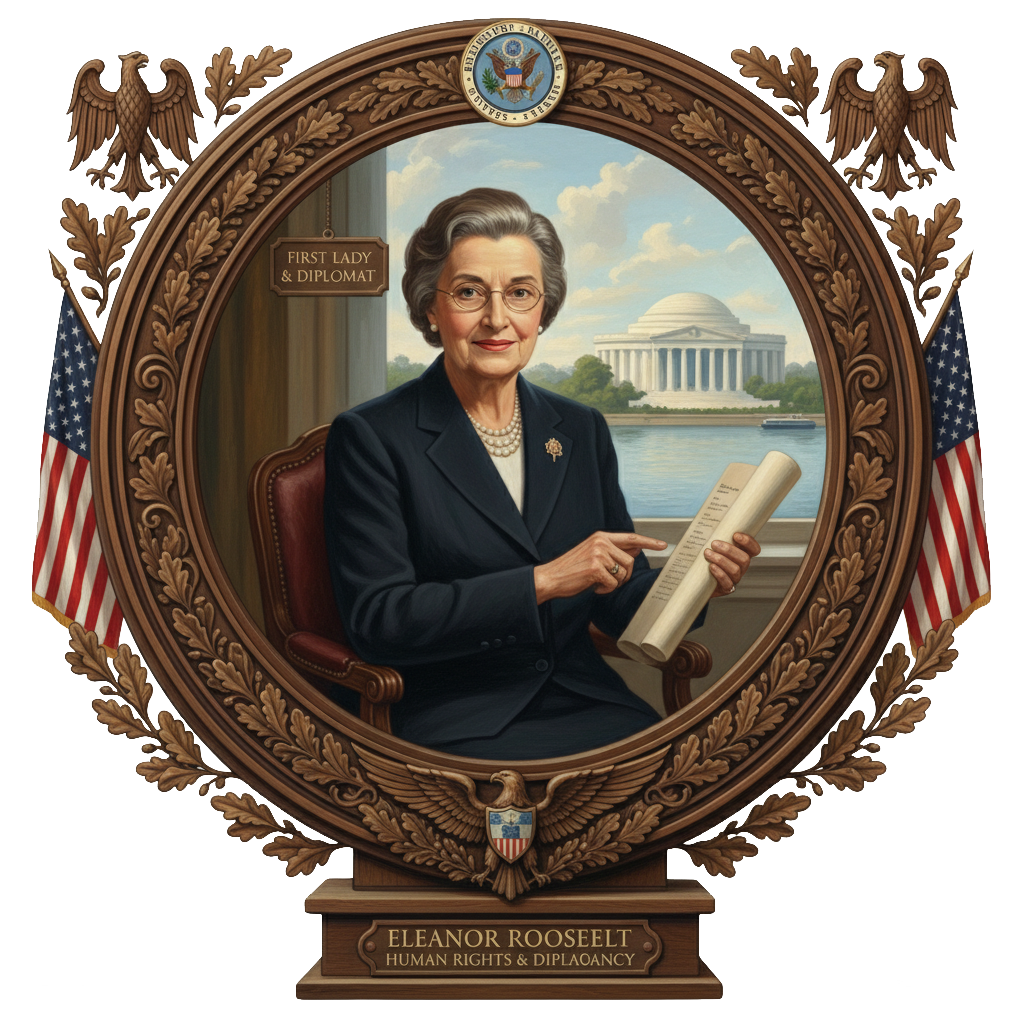
At a glance
- Born
- 1884 CE
- Died
- 1962 CE
- Era classification
- Modern
- Homeland
- United States
- Period
- 20th Century
- Field
- Politics & Leadership
- Language
- English
- Religion
- Christianity (Episcopalian)
- Gender
- female
Biography
Anna Eleanor Roosevelt was born into a prominent New York family but experienced a difficult childhood marked by the early deaths of her parents. She married her distant cousin, Franklin D. Roosevelt, in 1905. When Franklin was stricken with polio, Eleanor became his political surrogate, traveling extensively and reporting back to him.
As First Lady during her husband's unprecedented four terms, she transformed the role from a ceremonial hostess to an active political participant. She held press conferences, wrote a syndicated newspaper column called 'My Day', and fiercely advocated for civil rights, women's rights, and the rights of workers and the poor.
Following her husband's death, President Harry S. Truman appointed her as a delegate to the United Nations General Assembly. There, she played an instrumental role in drafting and passing the Universal Declaration of Human Rights in 1948, cementing her legacy as the 'First Lady of the World'.
Portrayal characteristics
Saved editorial descriptions used for the reconstruction; these are not authenticated statements by the depicted person.
- Compassionate
- Tireless
- Progressive
- Empathetic
- Influential
Images & artwork 3


Connections
Theodore Roosevelt
Family (Uncle)
Theodore Roosevelt was Eleanor's uncle and a major influence on her early life.
Theodore Roosevelt was the brother of Eleanor's father, Elliott. He gave Eleanor away at her wedding to her distant cousin, Franklin D. Roosevelt, in 1905, and her sense of public duty was deeply influenced by the Roosevelt family's tradition of service.
Winston Churchill
War-Time Allies
Eleanor worked closely with Churchill during his frequent visits to the White House during WWII.
As First Lady, Eleanor hosted Churchill multiple times during the war. While they occasionally clashed over social policies and the future of colonialism, they maintained a respectful relationship centered on the Allied effort to defeat the Axis powers.
Martin Luther King Jr.
Civil Rights Allies
Eleanor was an early supporter of King and the Southern Christian Leadership Conference.
Roosevelt used her newspaper column and public platform to support the Civil Rights Movement. She met with King on several occasions and was a vocal advocate for the non-violent protests he led, often pushing the Democratic Party to take a stronger stance on racial equality.
Mahatma Gandhi
Mutual Admirers
Eleanor Roosevelt deeply admired Gandhi's philosophy of non-violence and corresponded with him.
Though they never met in person, Eleanor was a student of Gandhi's methods. After his assassination, she visited India in 1952 to pay her respects and meet with his successors, continuing to champion his ideals of peace and human rights at the United Nations.
Rosa Parks
Mutual Admirers
Eleanor Roosevelt was an early supporter of Parks and the Montgomery Bus Boycott.
Roosevelt used her 'My Day' newspaper column to praise Parks' courage and the discipline of the Montgomery protesters. The two women met in the 1950s at the Highlander Folk School, an integrated training center for social activists.
Theodore Roosevelt
Uncle & Niece
Theodore was the uncle of Eleanor Roosevelt and gave her away at her wedding to Franklin D. Roosevelt.
Theodore's energetic public service and progressive ideals deeply influenced Eleanor's own path as a social activist and her eventual role as a transformative First Lady.
Charles de Gaulle
Diplomatic Intermediary & Mutual Skeptics
Eleanor Roosevelt shared her husband Franklin D. Roosevelt's deep skepticism of de Gaulle's authoritarian tendencies, though she interacted with him during and after WWII in her capacity as a diplomat and human rights advocate.
The relationship between Charles de Gaulle and the Roosevelt administration was notoriously bitter. President Franklin D. Roosevelt viewed de Gaulle as an arrogant, dictatorial figure and repeatedly tried to sideline him in favor of other French leaders. Eleanor Roosevelt largely shared her husband's distrust, viewing de Gaulle's intense nationalism and rigid demeanor as antithetical to the cooperative, democratic internationalism she championed. During WWII, she observed the friction he caused among the Allies with concern. After the war, when Eleanor served at the United Nations and helped draft the Universal Declaration of Human Rights, she continued to navigate the complex legacy of Gaullist France. While de Gaulle prioritized French sovereignty and colonial retention (until the Algerian crisis forced his hand), Eleanor advocated for rapid decolonization and international human rights, placing their post-war worldviews in frequent ideological tension.
Known for
- Universal Declaration of Human Rights
- Redefining the role of First Lady
- Civil rights advocacy
Episodes featuring or mentioning this figure
No eligible published episode featuring this figure is currently in the library.