



Rosa Parks
American civil rights activist whose refusal to give up her bus seat sparked the Montgomery bus boycott.
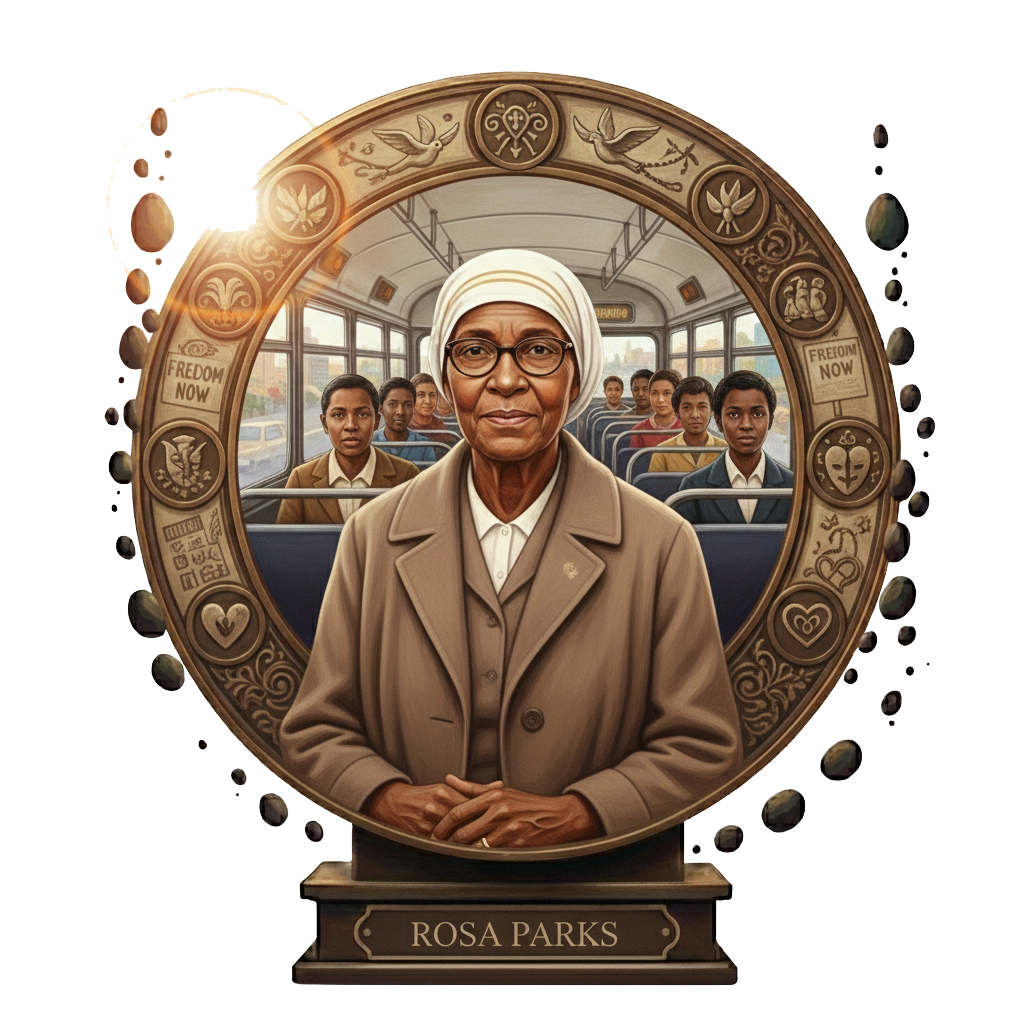
At a glance
- Born
- February 4, 1913 CE
- Died
- October 24, 2005 CE
- Era classification
- 92
- Homeland
- USA
- Period
- 1913–2005 CE
- Field
- Politics & Leadership
- Language
- English
- Religion
- African Methodist Episcopal (AME) Church
- Gender
- female
Biography
Rosa Parks was an American civil rights activist best known for her pivotal role in the Montgomery bus boycott. On December 1, 1955, in Montgomery, Alabama, Parks rejected a bus driver's order to relinquish her seat in the "colored section" to a white passenger after the whites-only section was filled. Her defiance and subsequent arrest sparked a successful city-wide boycott of the bus system, led by a young Martin Luther King Jr., which became a foundational event in the civil rights movement.
Before her famous arrest, Parks was already an established activist. She served as the secretary of the Montgomery chapter of the NAACP, working closely with chapter president Edgar Nixon. She had also attended the Highlander Folk School, an education center for activism in workers' rights and racial equality. Her action was not merely a spontaneous moment of fatigue, but a deliberate act of resistance grounded in years of civil rights advocacy and a deep commitment to justice.
Following the boycott, Parks faced severe backlash, including losing her job and receiving death threats, which prompted her to move to Detroit, Michigan. There, she continued her activism, working for U.S. Representative John Conyers and fighting against housing segregation and police brutality. Recognized globally as the "mother of the civil rights movement," Parks received numerous accolades during her lifetime, including the Presidential Medal of Freedom and the Congressional Gold Medal, cementing her legacy as an enduring symbol of courage and dignity.
Portrayal characteristics
Saved editorial descriptions used for the reconstruction; these are not authenticated statements by the depicted person.
- Courageous
- Resilient
- Principled
- Defiant
- Dignified
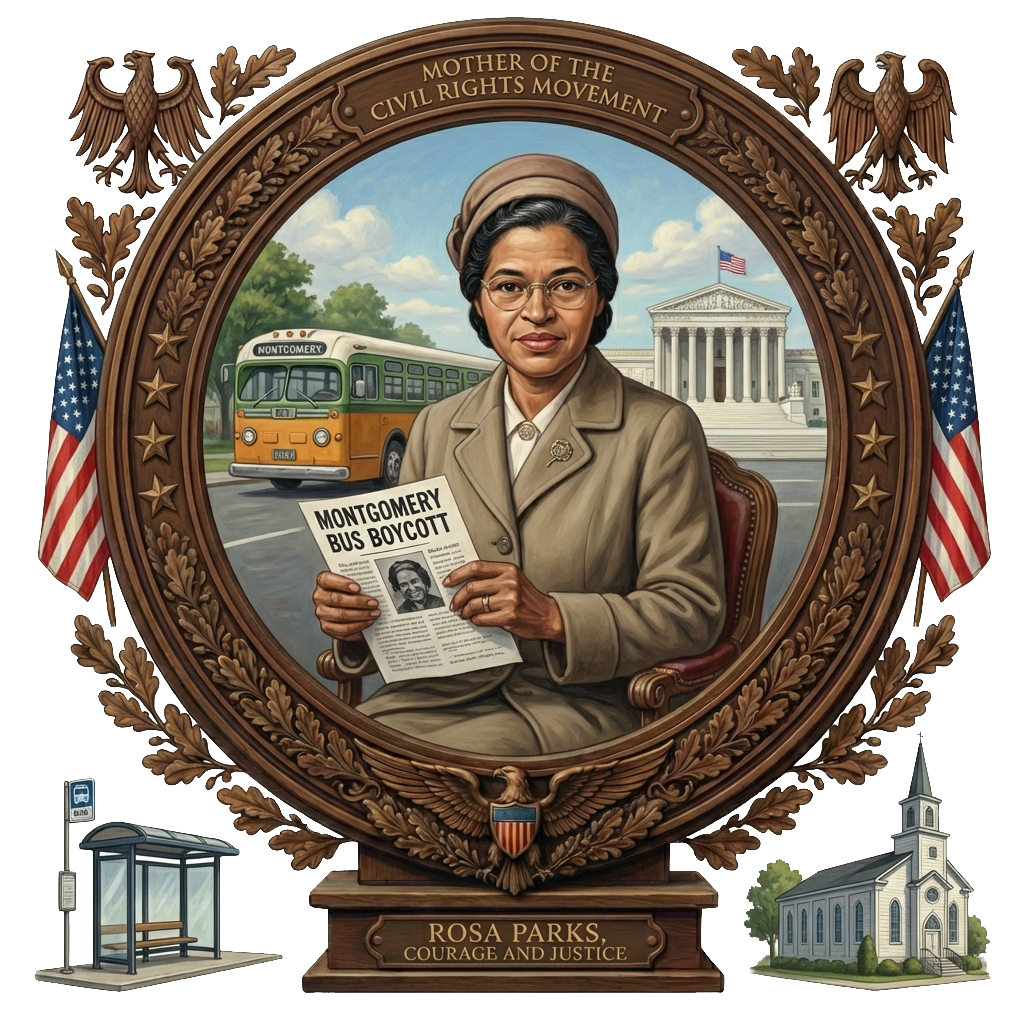
Images & artwork 4


Connections
Malcolm X
Civil Rights Contemporaries
Both were iconic figures in the fight against racial segregation and systemic oppression in the United States.
While Parks is most associated with the non-violent Montgomery Bus Boycott, she expressed deep respect for Malcolm X's courage and his emphasis on Black pride. They moved in similar activist circles, particularly after Malcolm X's departure from the Nation of Islam.
Martin Luther King Jr.
Civil Rights Allies
Parks' refusal to give up her bus seat led to the Montgomery Bus Boycott, which King was chosen to lead.
The 1955 boycott launched King into the national spotlight as a leader. Throughout the movement, Parks and King remained symbols of the grassroots and leadership wings of the struggle.
Martin Luther King Jr.
Civil Rights Allies
Parks' arrest for refusing to give up her bus seat led to the Montgomery Bus Boycott, which King led.
The 1955 Montgomery Bus Boycott was the event that brought both Parks and King to national prominence. They worked closely within the Montgomery Improvement Association to sustain the 381-day protest that eventually ended segregation on public buses.
Malcolm X
Civil Rights Contemporaries
Parks and Malcolm X met on several occasions and shared a mutual respect for their different roles in the movement.
Though they represented different philosophies—non-violence versus 'by any means necessary'—Parks expressed admiration for Malcolm X's courage. They were photographed together in 1965, shortly before his assassination, during a period when Parks was becoming more involved in the Black Power movement's discourse.
Eleanor Roosevelt
Mutual Admirers
Eleanor Roosevelt was an early supporter of Parks and the Montgomery Bus Boycott.
Roosevelt used her 'My Day' newspaper column to praise Parks' courage and the discipline of the Montgomery protesters. The two women met in the 1950s at the Highlander Folk School, an integrated training center for social activists.
Known for
- Sparking the Montgomery bus boycott
- NAACP activism
- Pioneering the American civil rights movement
- Presidential Medal of Freedom recipient
- Congressional Gold Medal recipient
Episodes featuring or mentioning this figure
No eligible published episode featuring this figure is currently in the library.