



Malcolm X
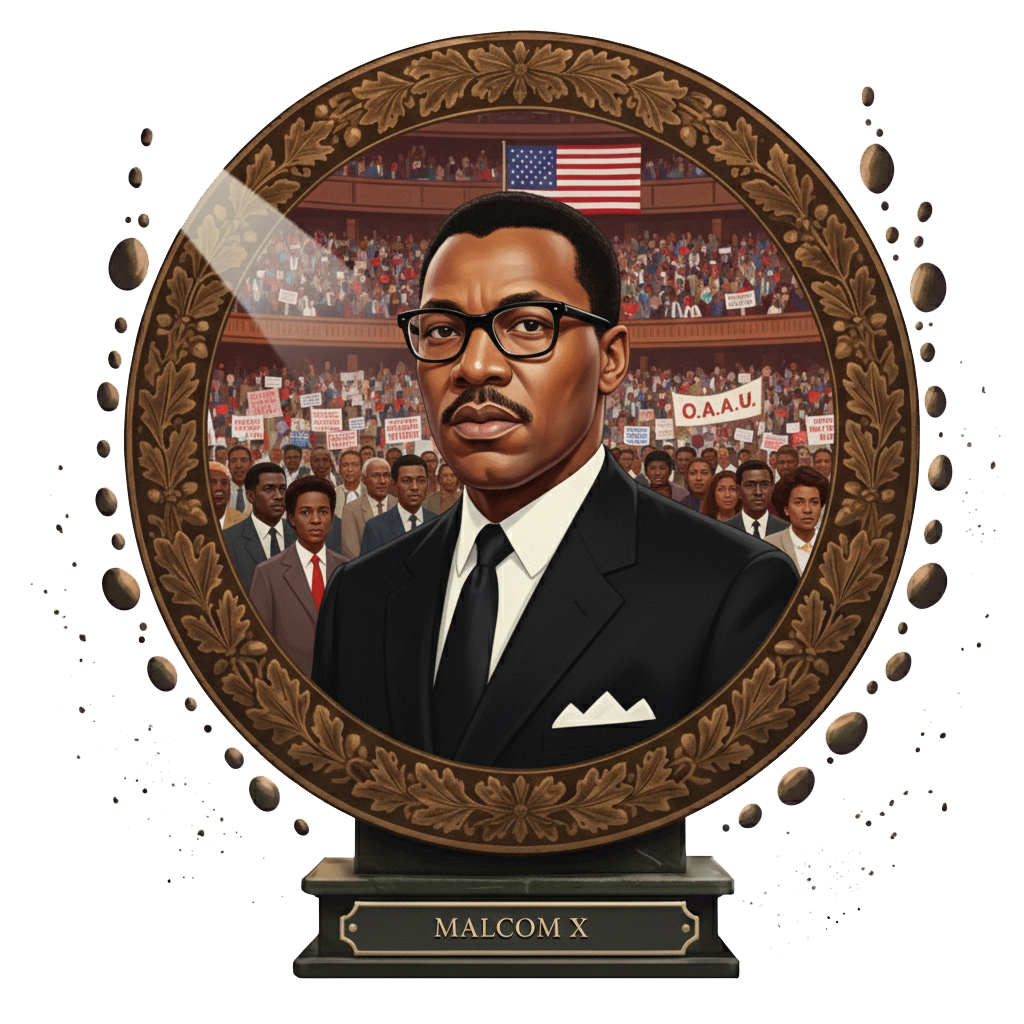
A prominent African American Muslim minister and human rights activist who fiercely advocated for Black empowerment.
At a glance
- Born
- May 19, 1925 CE
- Died
- February 21, 1965 CE
- Era classification
- 39
- Homeland
- USA
- Period
- 1925–1965 CE
- Field
- Politics & Leadership
- Language
- English
- Religion
- Islam
- Gender
- male
Biography
Born Malcolm Little in Omaha, Nebraska, Malcolm X experienced the brutal realities of systemic racism early in life. After his father's death—widely believed to be at the hands of white supremacists—and his mother's subsequent institutionalization, he fell into a life of petty crime. During a prison sentence for burglary, he underwent a profound intellectual and spiritual awakening, converting to the Nation of Islam (NOI) and replacing his surname with an 'X' to symbolize his lost African ancestral name.
Upon his release, Malcolm X quickly rose to become the charismatic chief spokesman for the Nation of Islam. He articulated a powerful message of Black pride, economic self-reliance, and self-defense, sharply contrasting with the mainstream civil rights movement's emphasis on nonviolent integration. His fiery oratory and uncompromising stance on racial justice made him both a beacon of hope for marginalized Black Americans and a highly controversial figure in the eyes of the white establishment.
In 1964, disillusioned by the moral failings of NOI leader Elijah Muhammad, Malcolm severed ties with the organization. He subsequently undertook the Hajj pilgrimage to Mecca, where he embraced mainstream Sunni Islam and adopted the name el-Hajj Malik el-Shabazz. This transformative journey broadened his perspective, leading him to disavow the NOI's racial separatism in favor of a global, anti-imperialist human rights struggle that recognized the possibility of cross-racial solidarity.
Tragically, his evolving vision was cut short when he was assassinated by members of the Nation of Islam in February 1965. Published shortly after his death, 'The Autobiography of Malcolm X' became a foundational text of the 20th century. Today, he is remembered as a towering intellectual and revolutionary whose relentless pursuit of truth and justice left an indelible mark on the global fight against oppression.
Portrayal characteristics
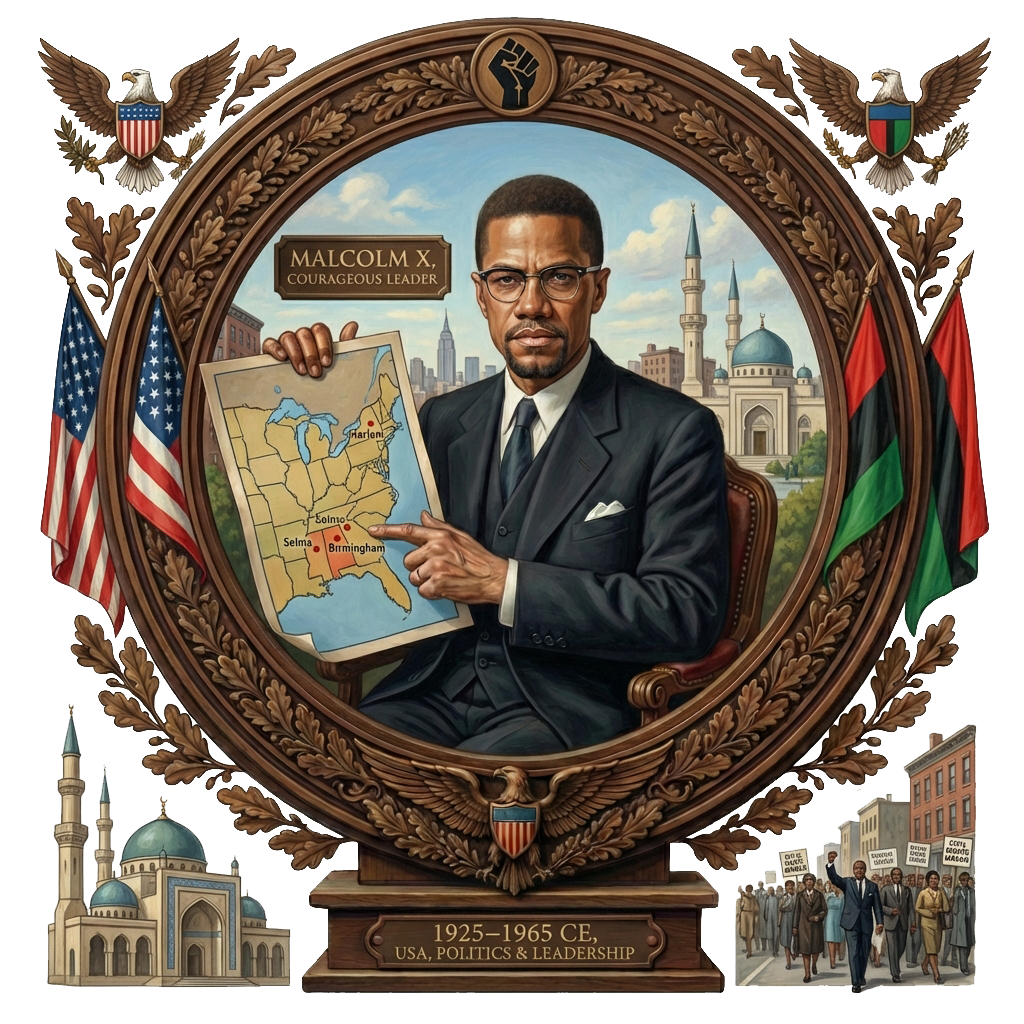
Saved editorial descriptions used for the reconstruction; these are not authenticated statements by the depicted person.
- Charismatic
- Uncompromising
- Articulate
- Courageous
- Visionary
- Passionate
Images & artwork 4


Connections
Martin Luther King Jr.
Civil Rights Contemporaries
Malcolm X and King were the two most influential leaders of the 1960s Black freedom struggle, representing different ideological paths.
Though they met only once briefly in 1964, their legacies are inextricably linked as they debated the merits of non-violence versus self-defense. Toward the end of their lives, their positions began to converge, with Malcolm X moving toward global human rights and King becoming more radical in his critique of economic injustice.
Rosa Parks
Civil Rights Contemporaries
Both were iconic figures in the fight against racial segregation and systemic oppression in the United States.
While Parks is most associated with the non-violent Montgomery Bus Boycott, she expressed deep respect for Malcolm X's courage and his emphasis on Black pride. They moved in similar activist circles, particularly after Malcolm X's departure from the Nation of Islam.
Martin Luther King Jr.
Contemporary Rivals
The two most prominent leaders of the Civil Rights Movement represented contrasting philosophies of integration versus black nationalism.
Though they only met briefly once in 1964, their public discourse and differing tactics—King's non-violence versus Malcolm's 'by any means necessary'—defined the era's struggle for racial justice.
Rosa Parks
Civil Rights Contemporaries
Parks and Malcolm X met on several occasions and shared a mutual respect for their different roles in the movement.
Though they represented different philosophies—non-violence versus 'by any means necessary'—Parks expressed admiration for Malcolm X's courage. They were photographed together in 1965, shortly before his assassination, during a period when Parks was becoming more involved in the Black Power movement's discourse.
Known for
- Spokesman for the Nation of Islam
- Advocacy for Black nationalism and self-defense
- The Autobiography of Malcolm X
- Founding the Organization of Afro-American Unity
- Popularizing the phrase 'By any means necessary'
Episodes featuring or mentioning this figure
No eligible published episode featuring this figure is currently in the library.