



Winston Churchill
British Prime Minister who led the UK to victory in WWII with his inspiring rhetoric and steadfast leadership.
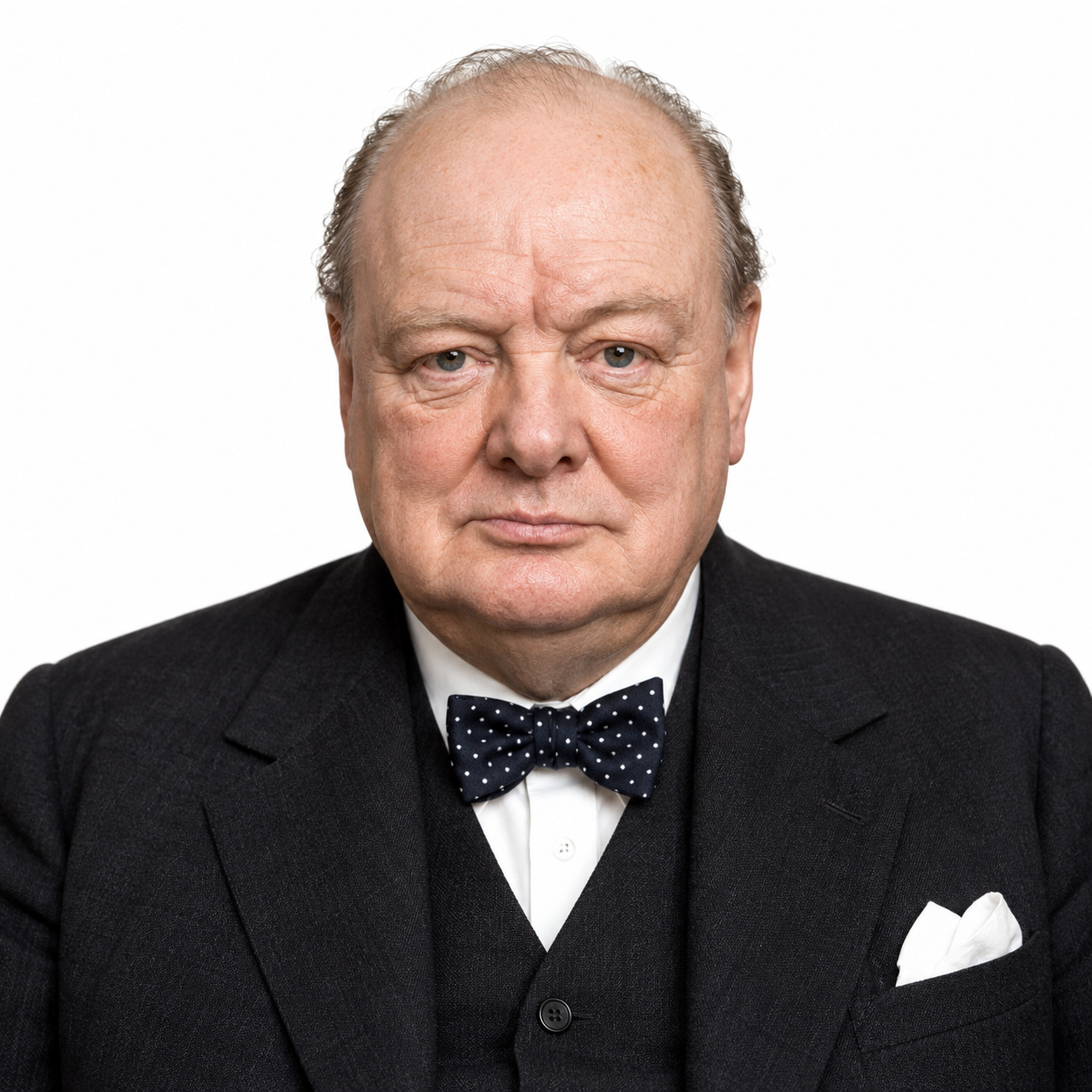
At a glance
- Born
- 30 November 1874 CE
- Died
- 24 January 1965 CE
- Era classification
- 90
- Homeland
- United Kingdom
- Period
- 1874–1965
- Field
- Politics, Leadership & War
- Language
- English
- Religion
- Anglican
- Gender
- male
Biography
Sir Winston Leonard Spencer Churchill was born in 1874 into an aristocratic British family. Before his ascent to the highest levels of government, he served as a cavalry officer and a celebrated war correspondent. Entering Parliament in 1900, his early political career was dynamic and turbulent, marked by shifting party allegiances and prominent cabinet roles. As First Lord of the Admiralty during World War I, he championed the disastrous Gallipoli campaign, which temporarily derailed his political trajectory.
During the 1930s, Churchill endured his political 'wilderness years,' during which he persistently warned against the rising threat of Nazi Germany and the dangers of appeasement. When World War II broke out, his foresight was vindicated, and he was appointed Prime Minister in May 1940. Facing the imminent threat of invasion, Churchill's defiant speeches and absolute refusal to surrender rallied the British populace during their 'darkest hour' and the relentless bombings of the Blitz.
Though he was unexpectedly voted out of office in 1945 shortly after the Allied victory, Churchill's influence as a global statesman endured. He famously coined the term 'Iron Curtain' to describe the Soviet division of Europe, setting the ideological stage for the Cold War. He returned for a second term as Prime Minister from 1951 to 1955. Also a prolific historian and writer, he was awarded the Nobel Prize in Literature in 1953, cementing his legacy as one of the most consequential figures of the 20th century.
Portrayal characteristics
Saved editorial descriptions used for the reconstruction; these are not authenticated statements by the depicted person.
- Resolute
- Eloquent
- Defiant
- Visionary
- Stubborn
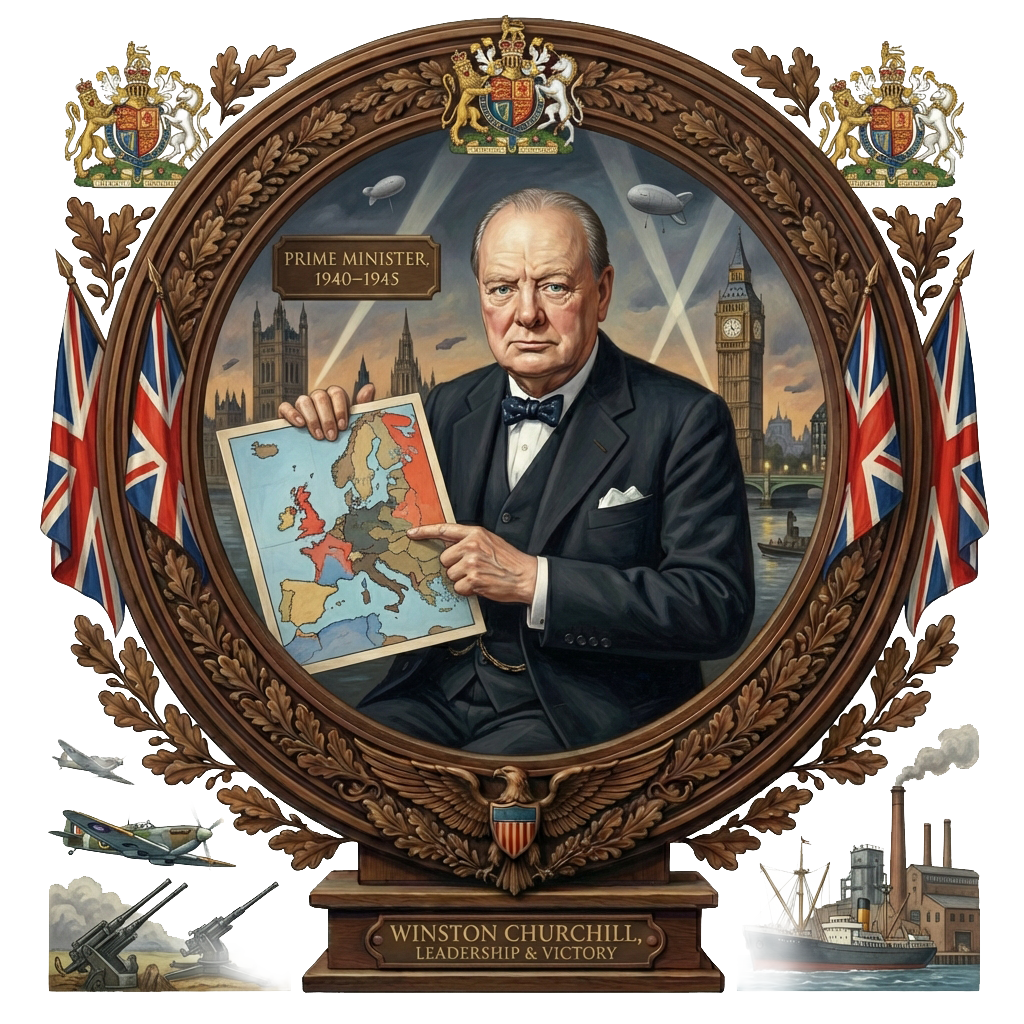
Images & artwork 4
Connections
Anwar El Sadat
Political Inspiration
Sadat was a great admirer of Churchill's leadership style and strategic thinking, often citing him as an influence.
In his autobiography, Sadat noted how he studied Churchill's wartime speeches and resolve, which influenced his own bold decision-making during the 1973 October War and the subsequent peace process.
Eleanor Roosevelt
War-Time Allies
Eleanor worked closely with Churchill during his frequent visits to the White House during WWII.
As First Lady, Eleanor hosted Churchill multiple times during the war. While they occasionally clashed over social policies and the future of colonialism, they maintained a respectful relationship centered on the Allied effort to defeat the Axis powers.
Mahatma Gandhi
Political Opponents
Churchill was a staunch opponent of Gandhi and the Indian independence movement.
Churchill famously expressed contempt for Gandhi, once referring to him as a 'half-naked fakir.' Their relationship represented the fundamental clash between British imperial interests and the rising tide of Indian nationalism during the mid-20th century.
Theodore Roosevelt
Contemporary Peers
The two met in 1900, though Roosevelt initially found the young Churchill to be somewhat arrogant.
Both men shared a passion for naval history and imperial strategy; their early interactions and mutual interests foreshadowed the 'Special Relationship' between their nations that would define the 20th century.
Alan Turing
Wartime Leader & Strategist
Churchill recognized the vital importance of Turing's code-breaking work at Bletchley Park during World War II.
When Turing and his colleagues wrote directly to Churchill about a lack of resources, Churchill famously ordered 'Action This Day,' ensuring the Enigma-breaking team had everything they needed to succeed.
Mustafa Kemal Atatürk
Military Opponents & Mutual Respect
Churchill was the primary architect of the Gallipoli campaign, where he was defeated by the forces led by Mustafa Kemal Atatürk.
Despite being adversaries during WWI, Churchill later expressed great admiration for Atatürk’s transformation of Turkey into a modern secular state, viewing him as a 'man of destiny'.
Albert Einstein
Contemporary Correspondents
Churchill and Einstein corresponded regarding the rise of Nazi Germany and the potential for nuclear weapons.
Churchill was one of the first British politicians to recognize the threat of Nazi Germany, a concern shared by Einstein, who eventually sought Churchill's help in assisting Jewish scientists fleeing persecution.
Napoleon Bonaparte
Historical Subject & Critic
As a historian and biographer, Churchill frequently analyzed Napoleon’s military campaigns and political legacy.
Churchill often drew parallels between the threat posed by Napoleon and the threat of Hitler, using the historical resistance of Britain against Napoleon as a rhetorical tool to inspire the British public during WWII.
Mohammad Reza Pahlavi
Geopolitical Allies & Imperial Interveners
Winston Churchill played a decisive role in both the beginning and the consolidation of the Shah's reign. As UK Prime Minister, Churchill oversaw the 1941 invasion that put the Shah on the throne, and later backed the 1953 coup that secured his absolute power.
The political destiny of Mohammad Reza Pahlavi was inextricably linked to the strategic decisions of Winston Churchill. In 1941, during World War II, Prime Minister Churchill and Soviet leader Joseph Stalin ordered the Anglo-Soviet invasion of Iran to secure oil fields and Allied supply lines. This invasion forced the abdication of Reza Shah, who was deemed too sympathetic to the Axis, and placed the young, more pliable Mohammad Reza Pahlavi on the throne. A decade later, their paths crossed again during Churchill's second premiership. When Iranian Prime Minister Mohammad Mosaddegh nationalized the British-owned Anglo-Iranian Oil Company, Churchill viewed it as a severe blow to British imperial prestige and economy. Churchill's government, alongside the American CIA, orchestrated Operation Ajax in 1953. This covert coup d'état overthrew the democratically elected Mosaddegh and restored absolute power to the Shah, who had briefly fled the country. Churchill's interventions thus bookended the early phases of the Shah's rule, transforming him from a weak constitutional monarch into a staunchly pro-Western autocrat.
Charles de Gaulle
WWII Allies & Complex Rivals
Churchill provided de Gaulle with asylum and a broadcasting platform in 1940, making the Free French movement possible. However, their relationship was famously tempestuous, marked by profound clashes of ego, national pride, and strategic vision.
After the fall of France in 1940, Churchill allowed de Gaulle to broadcast his famous 'Appeal of 18 June' from London, effectively launching the Free French resistance. Despite this foundational support, their relationship was incredibly fraught. De Gaulle, lacking formal power, used sheer intransigence to assert French sovereignty, often infuriating Churchill, who famously remarked that the heaviest cross he had to bear was the Cross of Lorraine (de Gaulle's symbol). They clashed over military strategy, the administration of liberated territories, and relations with Roosevelt, who actively disliked de Gaulle. Yet, beneath the bitter arguments lay a deep mutual respect; Churchill recognized de Gaulle's indomitable spirit as essential for France's resurrection, and de Gaulle acknowledged that without Churchill, France might have perished.
Known for
- Leading the UK during World War II
- Inspiring wartime speeches
- Coining the term 'Iron Curtain'
- Nobel Prize in Literature
- Warning against Nazi appeasement
Episodes featuring or mentioning this figure
No eligible published episode featuring this figure is currently in the library.