



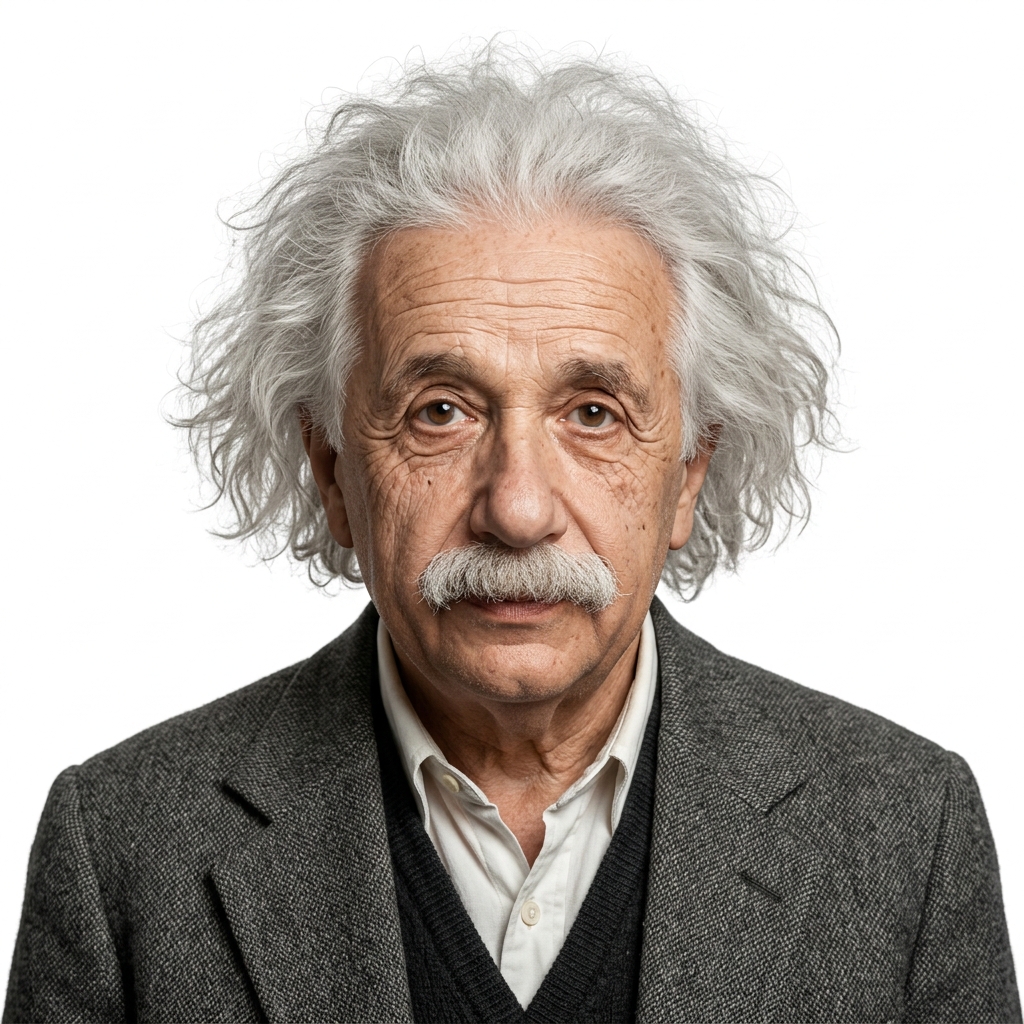
Albert Einstein
A theoretical physicist who revolutionized our understanding of space, time, and gravity.
At a glance
- Born
- 1879 CE
- Died
- 1955 CE
- Era classification
- 76
- Homeland
- Germany / USA
- Period
- 1879–1955
- Field
- Science, Medicine & Engineering
- Language
- German
- Religion
- Jewish (Pantheist)
- Gender
- male
Biography
Born in Ulm, Germany in 1879, Albert Einstein showed an early fascination with mathematics and physics. Despite early struggles with the rigid educational system of his time, he graduated from the Swiss Federal Polytechnic School in Zurich. He eventually secured a job at the Swiss Patent Office in Bern, where he spent his free time developing his groundbreaking scientific theories.
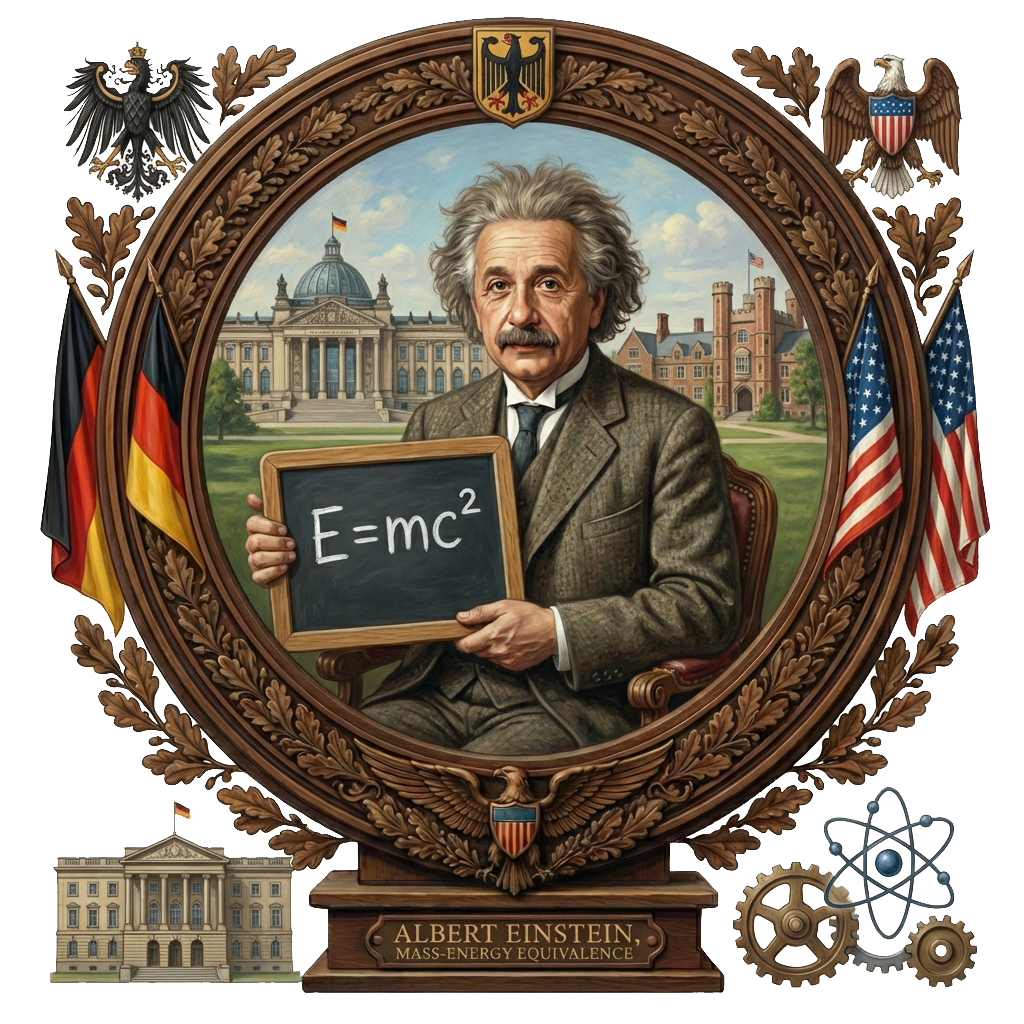
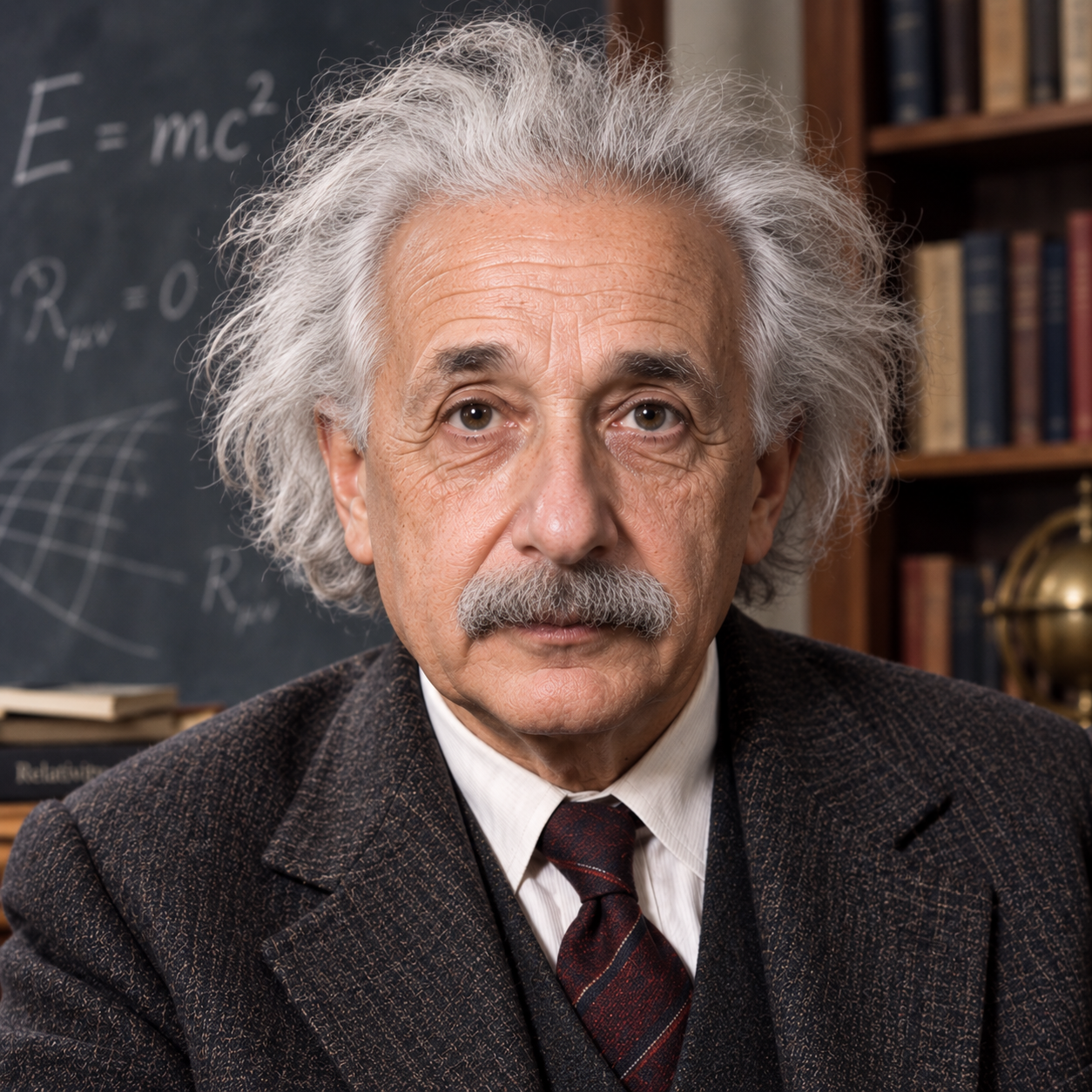
In 1905, known as his 'Annus Mirabilis' (miracle year), Einstein published four seminal papers that laid the foundation of modern physics. These papers introduced the theory of special relativity and the famous mass-energy equivalence equation, E=mc². A decade later, in 1915, he completed his general theory of relativity, fundamentally altering the Newtonian understanding of gravity by describing it as a geometric curvature of spacetime.
Einstein was awarded the 1921 Nobel Prize in Physics for his discovery of the law of the photoelectric effect, a pivotal step in the development of quantum theory. Fleeing the rise of the Nazi party in Germany, he emigrated to the United States in 1933, joining the Institute for Advanced Study in Princeton. He spent his final decades searching for a unified field theory and passionately advocating for pacifism, civil rights, and global cooperation until his death in 1955.
Portrayal characteristics
Saved editorial descriptions used for the reconstruction; these are not authenticated statements by the depicted person.
- Imaginative
- Curious
- Nonconformist
- Analytical
- Humanitarian
- Philosophical
Images & artwork 6


Connections
Alan Turing
Contemporary
Turing and Einstein were both residents at the Institute for Advanced Study in Princeton during the late 1930s.
While their fields of study were different, they shared the same intellectual environment at Princeton between 1936 and 1938. Turing was completing his PhD while Einstein was already a world-renowned figure at the Institute.
Max Planck
Colleague & Mentor
Planck was one of the first to recognize the importance of Einstein's 1905 papers and helped bring him to Berlin.
As the father of quantum theory, Planck's support was crucial for Einstein's early career. They worked together at the Kaiser Wilhelm Institute and remained close friends and colleagues, representing the two pillars of 20th-century physics.
Marie Curie
Contemporary & Friend
Einstein and Curie were colleagues in the Solvay Conferences and shared a deep mutual respect.
Einstein famously defended Curie during her personal scandals in France, and they spent time hiking together in the Alps discussing physics. He admired her integrity and once remarked that she was the only person he knew who was not corrupted by fame.
Isaac Newton
Scientific Successor
Einstein's General Relativity fundamentally transformed the understanding of gravity established by Newton.
Einstein's work showed that gravity is not a force acting at a distance as Newton proposed, but a curvature of spacetime. Despite this, Einstein held Newton in the highest regard, keeping a portrait of him in his study and acknowledging that his own work was only possible because of the foundations Newton laid.
Mahmoud Hessabi
Teacher & Student
Professor Hessabi was a student of Einstein and collaborated with him on advanced physical theories.
Hessabi met Einstein at Princeton and worked with him on the Unified Field Theory. Einstein was reportedly impressed by Hessabi's intellect, and Hessabi later returned to Iran to establish modern physics education in the country based on these experiences.
Stephen Hawking
Scientific Successor
Hawking's work on black holes and the Big Bang was a direct mathematical extension of Einstein's General Relativity.
Hawking utilized Einstein's field equations to prove the existence of singularities. His career was dedicated to reconciling Einstein's theory of the large-scale universe with the quantum mechanics that Einstein famously questioned.
Baruch Spinoza
Theological Influence
Einstein famously stated that he believed in 'Spinoza's God,' who reveals Himself in the orderly harmony of what exists.
Einstein rejected the idea of a personal God and instead embraced Spinoza's pantheistic view of a universe governed by immutable laws. He often cited Spinoza as the philosopher who best expressed his own spiritual and scientific worldview.
Galileo Galilei
Scientific Legacy
Einstein credited Galileo as the father of modern physics and the pioneer of the principle of relativity.
Einstein's Special Theory of Relativity is an extension of 'Galilean Relativity,' the idea that the laws of physics are the same in any inertial frame. Einstein frequently praised Galileo for insisting that the laws of nature must be determined through observation and mathematical description rather than dogma.
Isaac Newton
Scientific Successor
Einstein's theory of General Relativity eventually superseded Newton's law of universal gravitation.
While Newtonian mechanics remains accurate for most everyday applications, Einstein demonstrated that gravity is the curvature of spacetime rather than a direct force, resolving anomalies in Newton's model like the orbit of Mercury.
James Clerk Maxwell
Scientific Inspiration
Einstein considered Maxwell's work on electromagnetism the most profound and fruitful that physics had experienced since the time of Newton.
Maxwell's equations provided the theoretical foundation for Einstein's theory of special relativity. Einstein famously kept a framed photograph of Maxwell on his study wall alongside portraits of Newton and Faraday.
John von Neumann
Colleagues
They were both original faculty members at the Institute for Advanced Study (IAS) in Princeton.
As colleagues at the IAS, they frequently interacted within the same intellectual circles, though their primary research focuses—quantum mechanics and relativity for Einstein, and game theory and computing for von Neumann—differed significantly.
Mahatma Gandhi
Mutual Admirers
Einstein and Gandhi maintained a correspondence and held each other in the highest regard.
Einstein famously said of Gandhi that 'generations to come will scarce believe that such a one as this ever in flesh and blood walked upon this earth.' They shared a commitment to pacifism and the belief that moral force was superior to physical violence.
Mahmoud Hessabi
Student & Colleague
Hessabi was a student and later a collaborator of Einstein at Princeton University.
Hessabi is noted for his research on the 'Infinitely Extended Particles' theory, which he discussed extensively with Einstein. Their collaboration is a point of significant pride in Iranian scientific history, representing a bridge between Persian academia and global theoretical physics.
Marie Curie
Scientific Colleagues
Curie and Einstein were close friends and colleagues within the elite circle of early 20th-century physicists.
Einstein was a vocal supporter of Curie, famously writing a letter of encouragement to her during a period of intense public scrutiny in France. They frequently met at the Solvay Conferences to discuss the burgeoning field of quantum mechanics and radioactivity.
Max Planck
Scientific Colleagues
Planck was one of the first prominent physicists to recognize the importance of Einstein's special theory of relativity.
Planck recruited Einstein to the Prussian Academy of Sciences in Berlin in 1914. Despite their later disagreements over the philosophical implications of quantum mechanics, they remained close lifelong friends.
Nikola Tesla
Scientific Contemporaries
Tesla and Einstein were the two most famous scientists of their era, though they disagreed on fundamental physics.
Tesla was a vocal critic of Einstein's theory of relativity, which he dismissed as 'a magnificent mathematical garb' that obscured physical reality. Despite their theoretical differences, they corresponded occasionally, and Einstein sent Tesla a congratulatory letter on his 75th birthday.
Rabindranath Tagore
Intellectual Dialogue
Tagore and Einstein met in 1930 to discuss the intersections of science, philosophy, and religion.
Their recorded conversations explored whether truth exists independently of humanity, representing a historic meeting of Eastern mysticism and Western scientific rationalism.
Stephen Hawking
Scientific Successor
Hawking's work on black holes and the Big Bang was a direct extension and challenge to Einstein's General Theory of Relativity.
Hawking utilized Einstein's equations to prove the existence of singularities and spent his career trying to reconcile relativity with quantum mechanics.
Winston Churchill
Contemporary Correspondents
Churchill and Einstein corresponded regarding the rise of Nazi Germany and the potential for nuclear weapons.
Churchill was one of the first British politicians to recognize the threat of Nazi Germany, a concern shared by Einstein, who eventually sought Churchill's help in assisting Jewish scientists fleeing persecution.
Known for
- Theory of General Relativity
- Theory of Special Relativity
- Mass-energy equivalence (E=mc²)
- Law of the photoelectric effect
- Brownian motion explanation
Episodes featuring or mentioning this figure
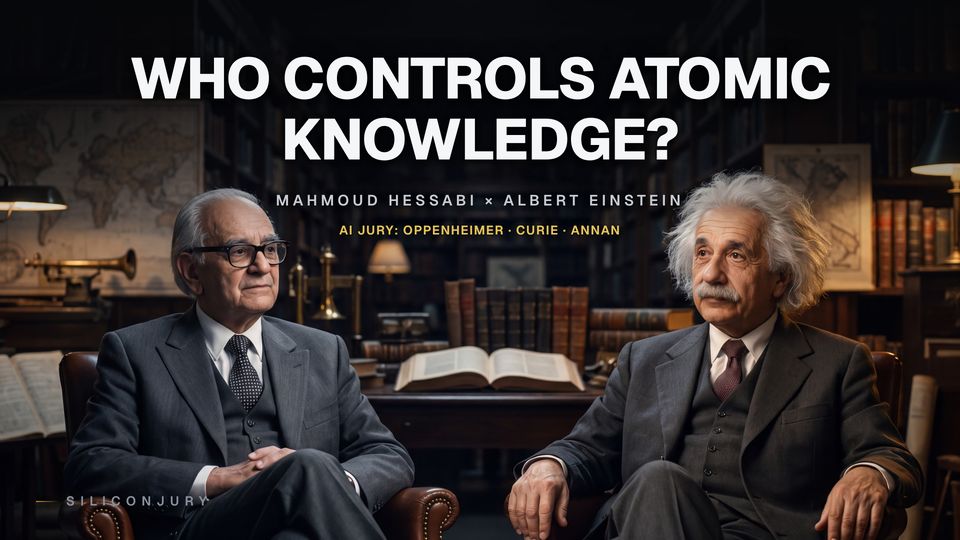
Mahmoud Hessabi vs Albert Einstein: Nuclear Access and Scientific Sovereignty
AI jury: 3 members
Should developing nations have unrestricted access to peaceful nuclear technology, or do the attendant geopolitical and safety risks demand strict limits?