



James Clerk Maxwell
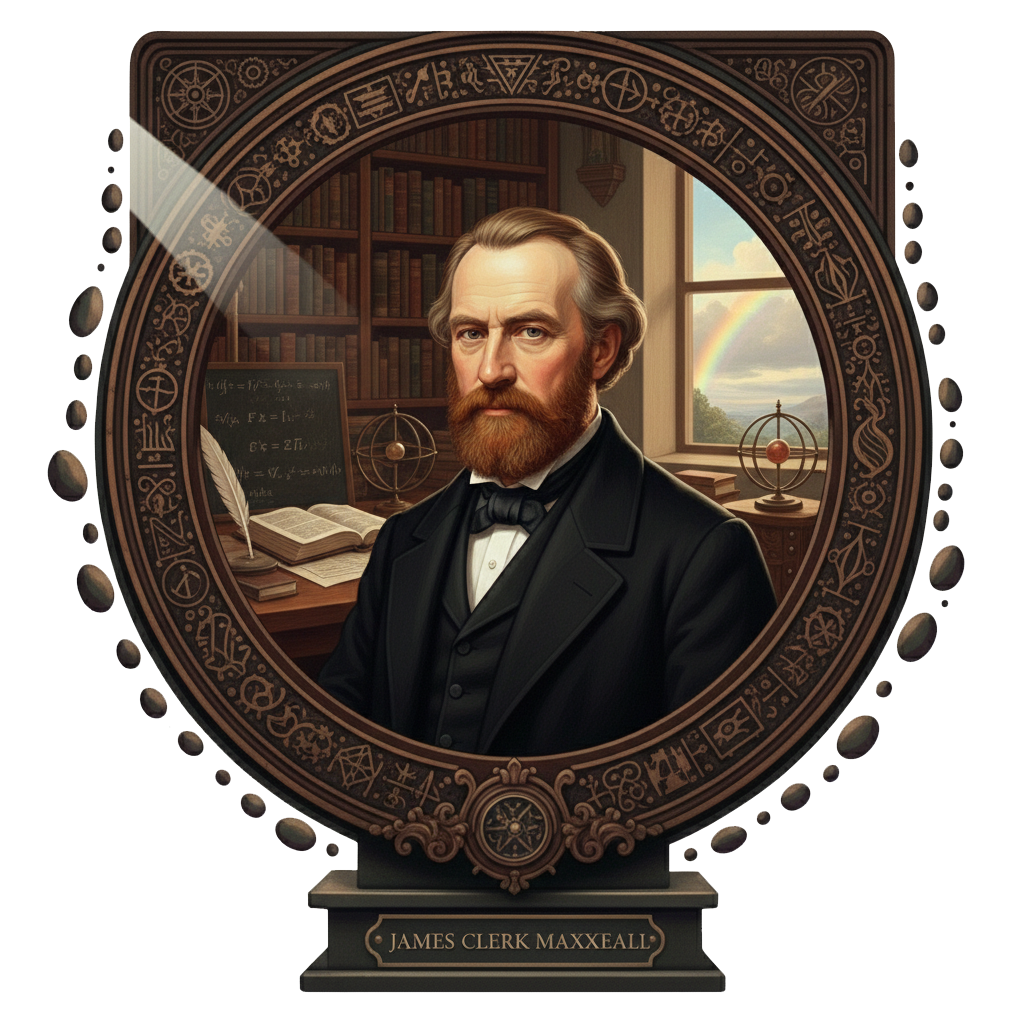
A Scottish physicist who unified electricity and magnetism into the theory of electromagnetism.
At a glance
- Born
- 1831 CE
- Died
- 1879 CE
- Era classification
- 48
- Homeland
- United Kingdom
- Period
- 1831–1879
- Field
- Science, Medicine & Engineering
- Language
- English
- Religion
- Presbyterian
- Gender
- male
Biography
Born in Edinburgh, Scotland in 1831, James Clerk Maxwell displayed an extraordinary curiosity from a young age. He attended the Edinburgh Academy, where he published his first scientific paper at the age of 14, and later studied at the University of Edinburgh and Trinity College, Cambridge. His exceptional mathematical abilities and profound physical intuition quickly set him apart among his peers in the scientific community.
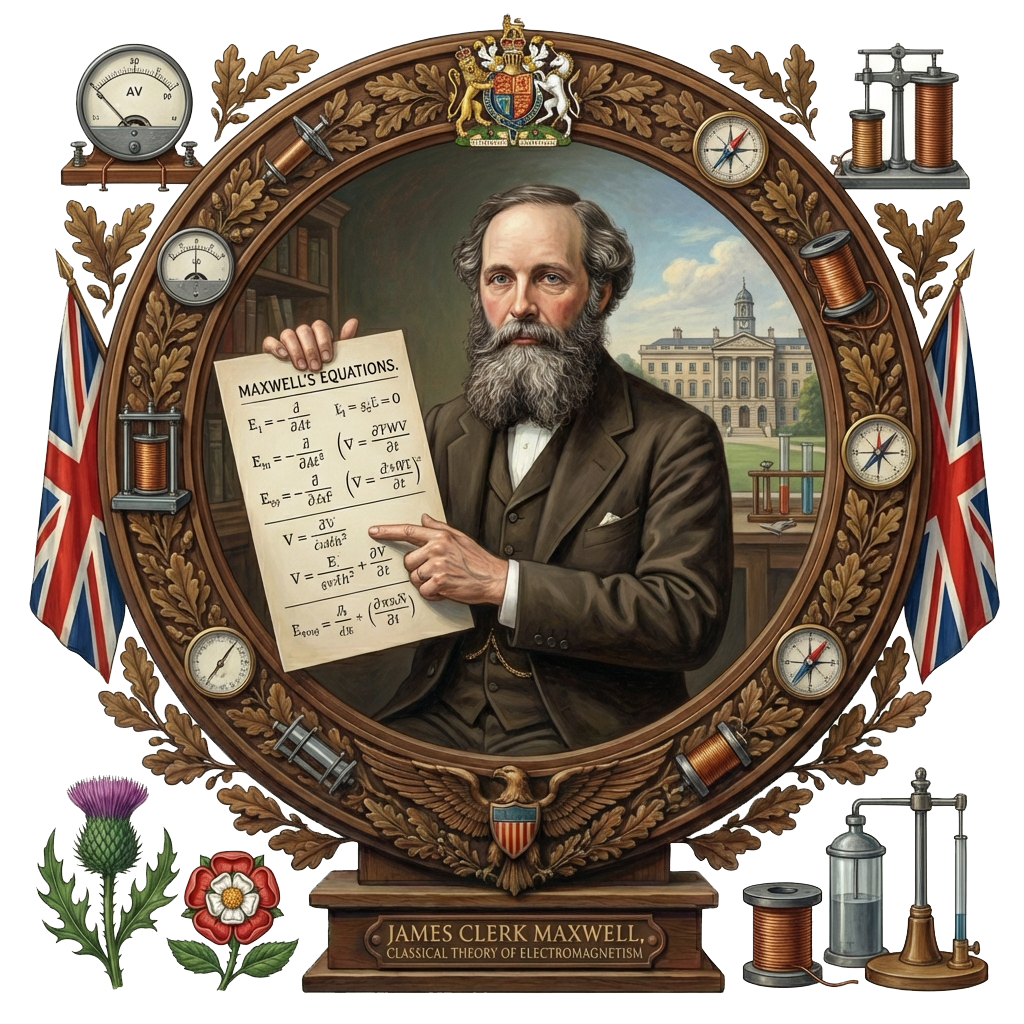
Maxwell's most profound contribution to science was the formulation of the classical theory of electromagnetic radiation. By bringing together electricity, magnetism, and light as different manifestations of the same phenomenon, his set of equations—now known as Maxwell's equations—revolutionized physics. He mathematically demonstrated that electric and magnetic fields travel through space as waves moving at the speed of light, fundamentally altering humanity's understanding of the universe.
Beyond electromagnetism, Maxwell made significant strides in several other fields. He helped develop the Maxwell-Boltzmann distribution, a fundamental aspect of the kinetic theory of gases, which laid the groundwork for statistical mechanics. He also created the first durable color photograph in 1861 by projecting three black-and-white images through red, green, and blue filters, and made crucial mathematical discoveries regarding the stability of Saturn's rings.
Maxwell's work paved the way for modern physics, deeply influencing the development of both quantum mechanics and Albert Einstein's theory of special relativity. Einstein himself famously kept a photograph of Maxwell on his study wall, alongside Michael Faraday and Isaac Newton. Though he died of stomach cancer at the relatively young age of 48, Maxwell's enduring legacy cements him as one of the greatest scientific minds in history.
Portrayal characteristics
Saved editorial descriptions used for the reconstruction; these are not authenticated statements by the depicted person.
- Analytical
- Curious
- Imaginative
- Modest
- Devout
- Visionary
Images & artwork 4


Connections
Albert Einstein
Scientific Inspiration
Einstein considered Maxwell's work on electromagnetism the most profound and fruitful that physics had experienced since the time of Newton.
Maxwell's equations provided the theoretical foundation for Einstein's theory of special relativity. Einstein famously kept a framed photograph of Maxwell on his study wall alongside portraits of Newton and Faraday.
Isaac Newton
Scientific Successors
Maxwell's unification of electricity, magnetism, and light is regarded as the second great unification in physics after Newton's work.
While Newton unified terrestrial and celestial mechanics under the law of universal gravitation, Maxwell's field equations unified the previously separate forces of electricity and magnetism into a single electromagnetic theory.
Nikola Tesla
Theoretical Foundation
Maxwell's electromagnetic theory provided the mathematical basis for Tesla's practical inventions in alternating current and radio.
Tesla's development of high-frequency currents and wireless transmission was a direct application of the electromagnetic wave theories first predicted and mathematically formulated by Maxwell.
Max Planck
Influenced By
Maxwell's work on thermodynamics and the statistical distribution of molecular velocities influenced Planck's early research.
Planck's journey toward the discovery of the quantum of action began with an intensive study of Maxwell's theories on heat and electromagnetism, which defined the classical limits Planck eventually transcended.
Nikola Tesla
Scientific Foundation
Tesla's inventions in radio and wireless power were built upon the electromagnetic theories of James Clerk Maxwell.
Tesla studied Maxwell's equations extensively and viewed his own work as the practical realization of Maxwell's theoretical predictions regarding electromagnetic waves and the ether.
Known for
- Maxwell's equations
- Classical theory of electromagnetism
- Maxwell-Boltzmann distribution
- First durable color photograph
- Analysis of Saturn's rings
Episodes featuring or mentioning this figure
No eligible published episode featuring this figure is currently in the library.