



James Dewey Watson
American molecular biologist and geneticist who co-discovered the double helix structure of the DNA molecule.
At a glance
- Born
- 1928 CE
- Era classification
- 96
- Homeland
- USA
- Period
- 1928 CE – Present
- Field
- Science, Medicine & Engineering
- Language
- English
- Religion
- Atheist
- Gender
- male
Biography
James Dewey Watson was born on April 6, 1928, in Chicago, Illinois. A highly gifted student, he enrolled at the University of Chicago at the age of 15. He later earned his Ph.D. in zoology from Indiana University in 1950, where he was deeply influenced by the work of geneticists Hermann Muller and T.M. Sonneborn. His early fascination with the physical nature of the gene led him to shift his focus from ornithology to genetics and molecular biology.
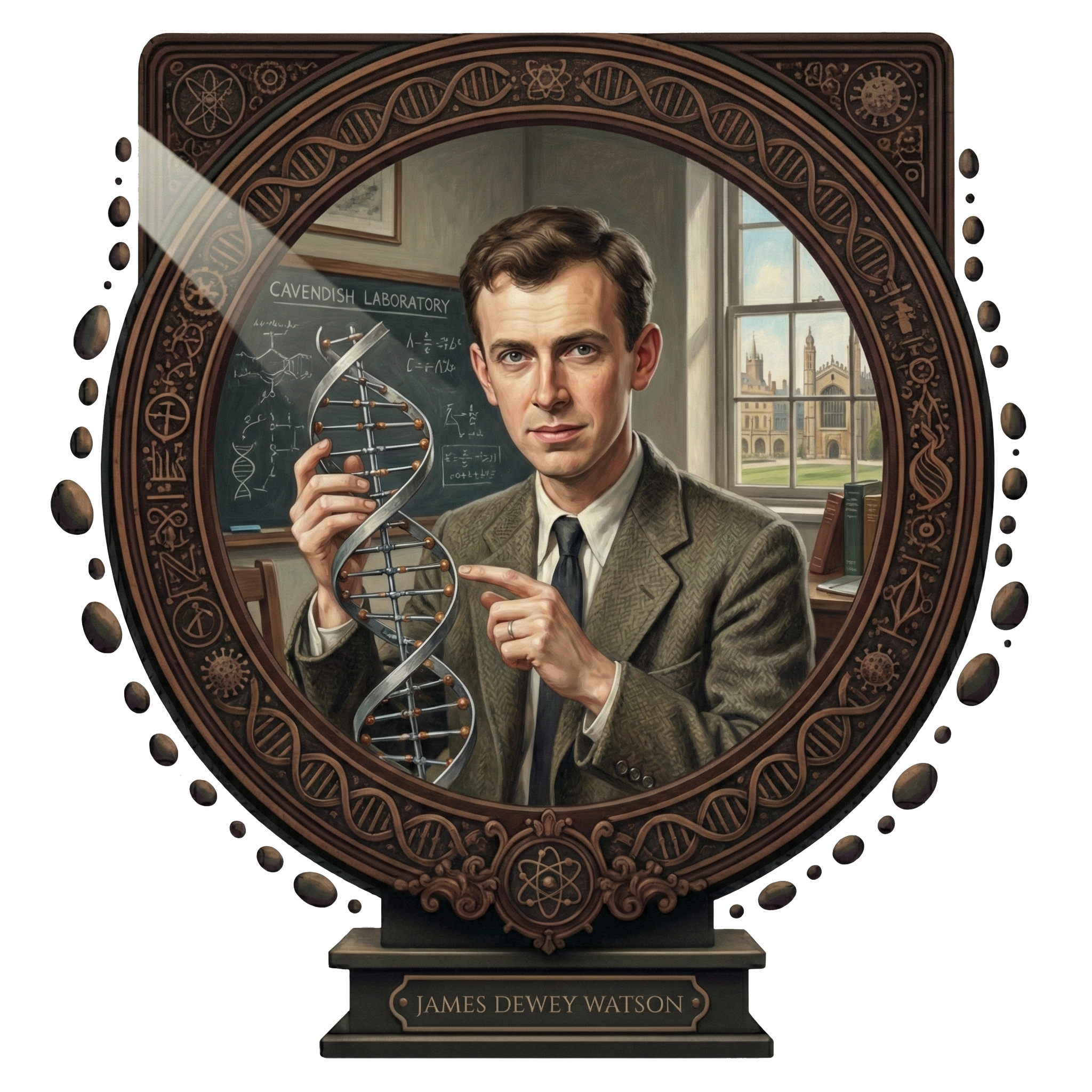
In 1951, Watson began working at the Cavendish Laboratory at the University of Cambridge, where he met English biophysicist Francis Crick. Sharing a mutual interest in solving the structure of DNA, the two collaborated closely. In 1953, drawing crucially upon the X-ray diffraction images taken by Rosalind Franklin and Maurice Wilkins, Watson and Crick successfully proposed the double helix structure of DNA. This breakthrough provided the mechanism for genetic inheritance and fundamentally revolutionized the biological sciences.
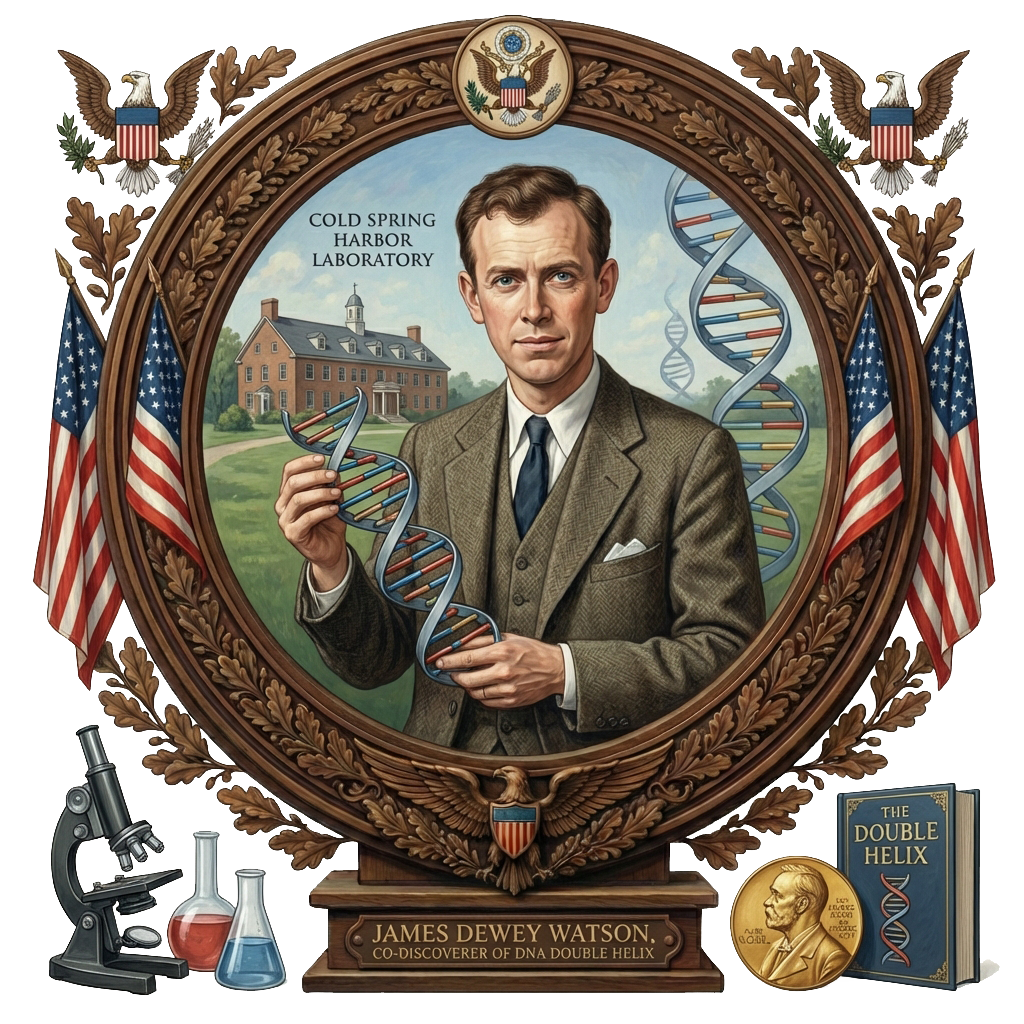
For their monumental discovery, Watson, Crick, and Wilkins were jointly awarded the 1962 Nobel Prize in Physiology or Medicine. Watson subsequently joined the faculty at Harvard University, where he taught and conducted research for two decades. He also took over the leadership of the Cold Spring Harbor Laboratory in New York, transforming it into one of the world's premier research institutions for molecular biology and genetics.
In the late 1980s, Watson became the first director of the National Center for Human Genome Research, playing a pivotal role in launching the Human Genome Project. Despite his immense scientific legacy, Watson's later years have been heavily overshadowed by controversy. He has made numerous scientifically unfounded and offensive remarks regarding race, gender, and intelligence, which led to his resignation from Cold Spring Harbor Laboratory and the revocation of his honorary titles, largely isolating him from the broader scientific community.
Portrayal characteristics
Saved editorial descriptions used for the reconstruction; these are not authenticated statements by the depicted person.
- Ambitious
- Brilliant
- Controversial
- Outspoken
- Driven
Images & artwork 4
Connections
Rosalind Franklin
Scientific Collaborators & Rivals
Watson and Francis Crick used Franklin's X-ray diffraction data to determine the double-helix structure of DNA.
Franklin's 'Photo 51' was shown to Watson without her knowledge by Maurice Wilkins, providing the crucial evidence needed to build the correct molecular model. This remains one of the most controversial episodes in modern scientific history regarding credit and ethics.
Charles Darwin
Scientific Legacy
Watson's discovery of the DNA structure provided the molecular mechanism for Darwin's theory of evolution.
While Darwin proposed natural selection and inheritance, he lacked knowledge of the physical medium of heredity. Watson and Crick's work revealed how genetic information is stored and replicated, confirming the biological basis for Darwinian evolution.
Rosalind Franklin
Scientific Rivals
Watson used Franklin's X-ray diffraction data to build the first correct model of DNA.
Without Franklin's knowledge or permission, Watson was shown 'Photo 51' by Maurice Wilkins. This image was critical for Watson and Francis Crick to determine the double-helix structure of DNA, a contribution for which Franklin was not initially given proper credit.
Known for
- Co-discovering the double helix structure of DNA
- 1962 Nobel Prize in Physiology or Medicine
- Authoring 'The Double Helix'
- Leading the Human Genome Project
- Directing Cold Spring Harbor Laboratory
Episodes featuring or mentioning this figure
No eligible published episode featuring this figure is currently in the library.