



Rosalind Franklin
English chemist and X-ray crystallographer whose work was central to understanding the molecular structure of DNA.

At a glance
- Born
- 1920 CE
- Died
- 1958 CE
- Era classification
- 37
- Homeland
- United Kingdom
- Period
- 1920–1958
- Field
- Science, Medicine & Engineering
- Language
- English
- Religion
- Jewish
- Gender
- female
Biography
Rosalind Elsie Franklin was born in London to a prominent British Jewish family. Displaying exceptional intelligence from an early age, she studied natural sciences at Newnham College, Cambridge, graduating in 1941. During the Second World War, she worked for the British Coal Utilisation Research Association, investigating the physical chemistry of carbon and coal. This vital research earned her a Ph.D. from Cambridge in 1945.
After the war, Franklin moved to Paris, where she worked at the Laboratoire Central des Services Chimiques de l'État. Here, she became an accomplished X-ray crystallographer, applying her expertise to the structure of coals and other carbonaceous materials. Her meticulous techniques laid the foundation for her later, more famous work in structural biology.
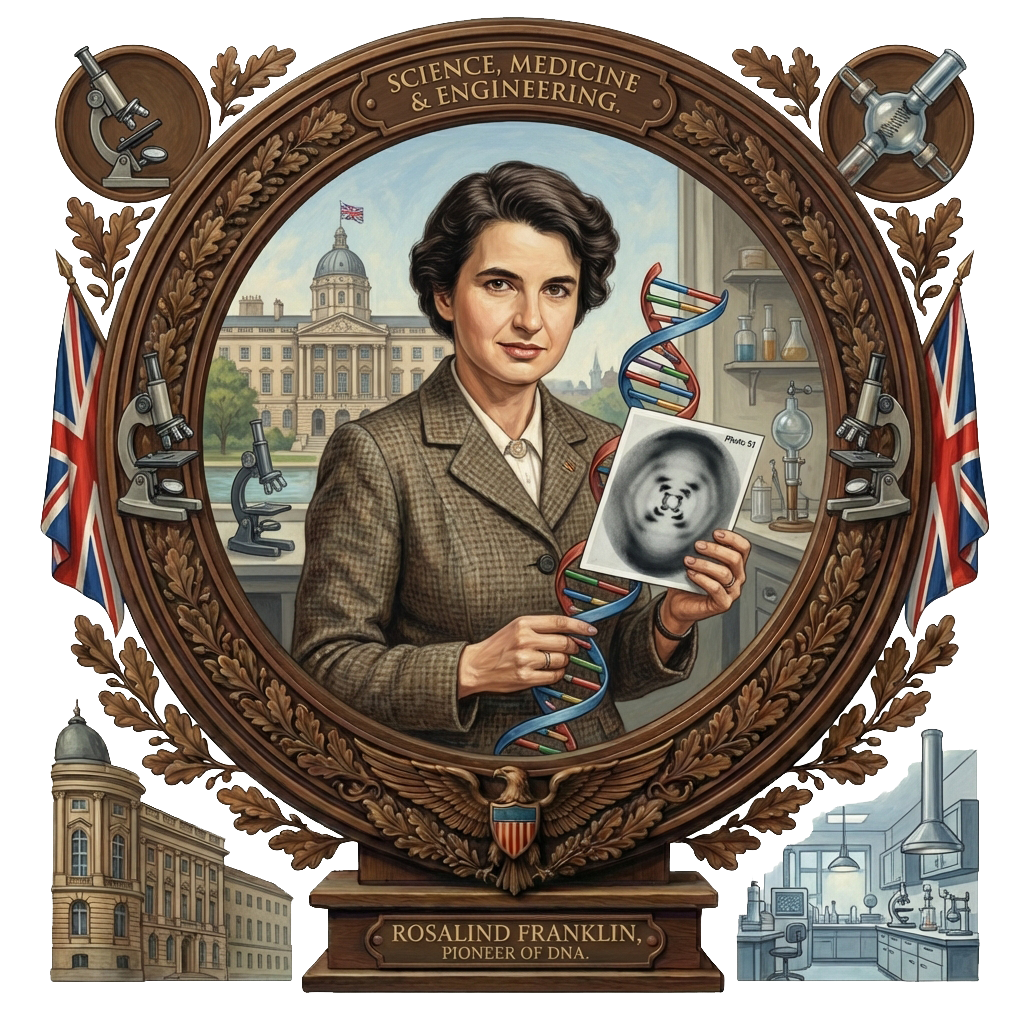
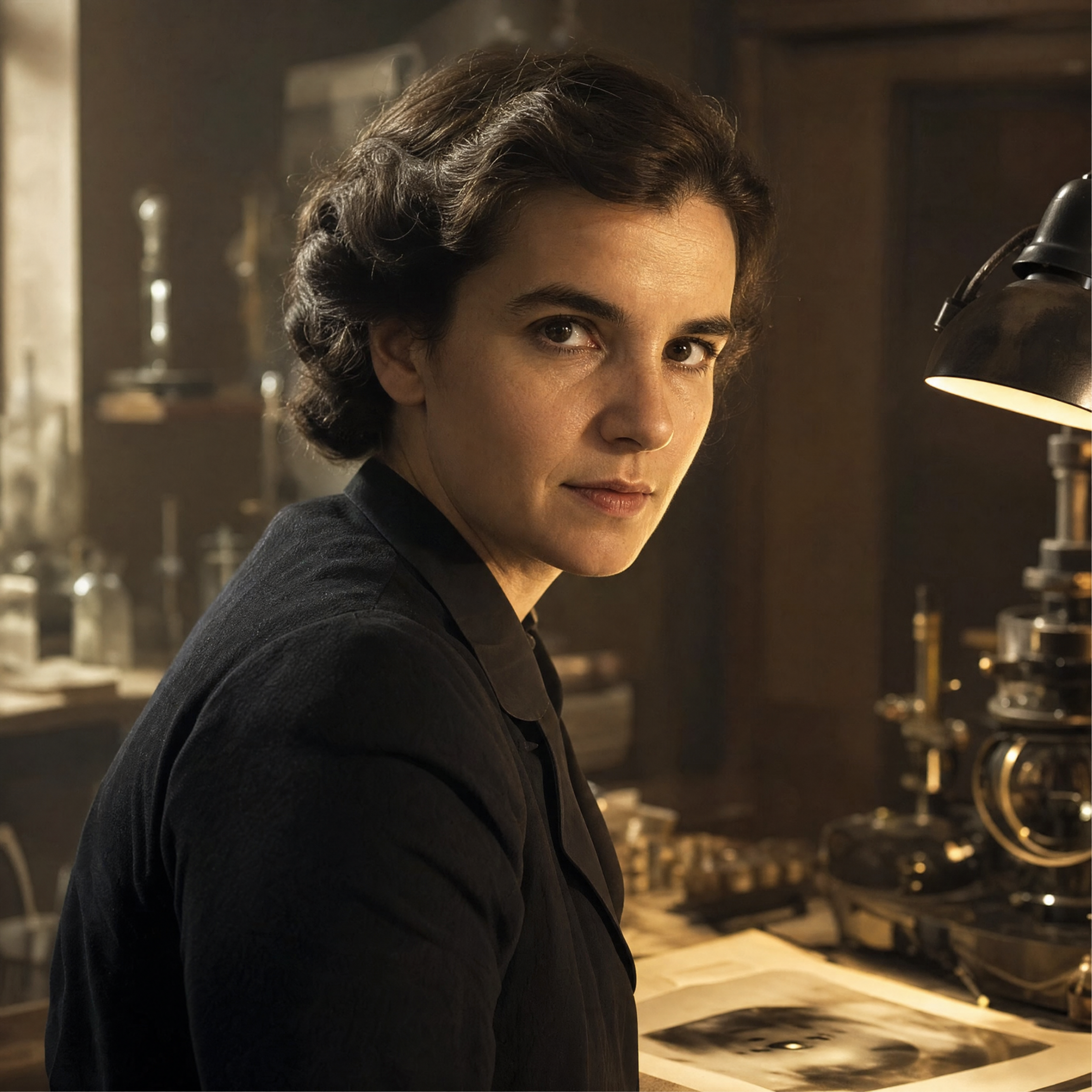
In 1951, she joined King's College London as a research associate. Using her refined X-ray diffraction techniques, she and her student Raymond Gosling captured 'Photo 51,' a remarkably clear image of DNA. This crucial piece of evidence, shown to James Watson and Francis Crick without her direct permission, was instrumental in their formulation of the double-helix model of DNA, for which they later won the Nobel Prize.
Leaving King's College due to a strained environment, Franklin moved to Birkbeck College in 1953. There, she led pioneering research on the molecular structures of viruses, particularly the tobacco mosaic virus and the polio virus. Tragically, her brilliant career was cut short when she died of ovarian cancer at the age of 37, leaving behind a legacy as one of the most important scientists of the 20th century.
Portrayal characteristics
Saved editorial descriptions used for the reconstruction; these are not authenticated statements by the depicted person.
- Meticulous
- Brilliant
- Independent
- Resolute
- Detail-oriented
Images & artwork 5


Connections
James Dewey Watson
Scientific Collaborators & Rivals
Watson and Francis Crick used Franklin's X-ray diffraction data to determine the double-helix structure of DNA.
Franklin's 'Photo 51' was shown to Watson without her knowledge by Maurice Wilkins, providing the crucial evidence needed to build the correct molecular model. This remains one of the most controversial episodes in modern scientific history regarding credit and ethics.
James Dewey Watson
Scientific Rivals
Watson used Franklin's X-ray diffraction data to build the first correct model of DNA.
Without Franklin's knowledge or permission, Watson was shown 'Photo 51' by Maurice Wilkins. This image was critical for Watson and Francis Crick to determine the double-helix structure of DNA, a contribution for which Franklin was not initially given proper credit.
Known for
- Photo 51 (X-ray diffraction image of DNA)
- Discovery of DNA's double-helix density
- Research on the molecular structure of viruses
- Physical chemistry of coal and carbon
Episodes featuring or mentioning this figure
No eligible published episode featuring this figure is currently in the library.