



Thales of Miletus
The first Greek philosopher and mathematician, known for predicting a solar eclipse and foundational geometry.

At a glance
- Born
- c. 624 BCE
- Died
- c. 545 BCE
- Era classification
- c. 79
- Homeland
- Ancient Greece (Ionia)
- Period
- Pre-Socratic
- Field
- Science, Medicine & Engineering
- Language
- Ancient Greek
- Religion
- Hellenistic
- Gender
- male
Biography
Thales of Miletus was a pre-Socratic Greek philosopher, mathematician, and astronomer from Miletus in Ionia, Asia Minor. Recognized as the first individual in Western civilization known to have entertained and engaged in scientific philosophy, he is universally considered the founder of the Milesian school and the first of the Seven Sages of Greece.
Breaking from the mythological explanations of the cosmos that dominated his era, Thales sought naturalistic and rational answers to explain the world. He famously posited that water is the fundamental underlying substance (arche) of all matter, a revolutionary idea that marked the transition from mythos to logos. His inquiries laid the groundwork for the scientific method and subsequent philosophical thought.
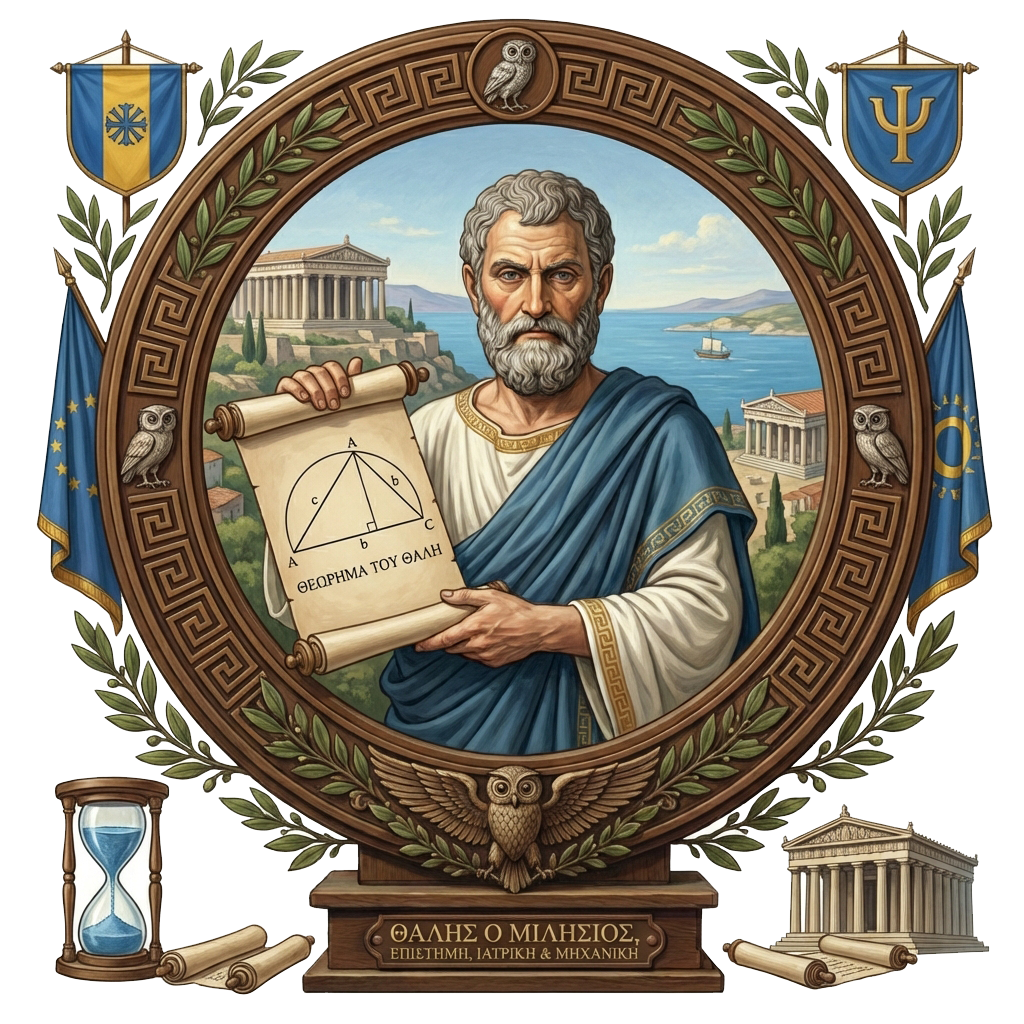
Beyond philosophy, Thales made significant contributions to mathematics and astronomy. He is credited with introducing geometry to Greece from Egypt and formulating Thales's theorem, which states that if a triangle is drawn within a circle with the longest side as a diameter, the opposite angle is always a right angle. Historically, he is also celebrated for allegedly predicting the solar eclipse of 585 BCE, an event that halted the Battle of the Halys.
Portrayal characteristics
Saved editorial descriptions used for the reconstruction; these are not authenticated statements by the depicted person.
- Rational
- Analytical
- Visionary
- Inquisitive
- Observant
Images & artwork 4


Connections
Aristotle
Historical Predecessor
Aristotle identified Thales as the first philosopher in the Greek tradition.
In his 'Metaphysics', Aristotle credits Thales of Miletus as the founder of natural philosophy. Aristotle's documentation of Thales' theories on water as the primary substance is the main reason Thales is recognized as the first scientist in Western history.
Pythagoras
Philosophical Influence
Thales of Miletus is often regarded as a mentor who encouraged a young Pythagoras to pursue mathematics and travel to Egypt.
While historical accounts are semi-legendary, Thales is credited with introducing Pythagoras to the geometric and astronomical studies that would define the Pythagorean school's curriculum.
Aristotle
Primary Historian & Successor
Aristotle identified Thales as the first philosopher in the Greek tradition and the founder of the Milesian school.
Most of what is known about Thales's theories, such as his belief that water is the primary substance of all matter, survives through Aristotle's critical analysis in his work 'Metaphysics'.
Pythagoras
Philosophical Predecessor
Thales is often cited as an early influence on Pythagoras, potentially advising him to travel to Egypt to study mathematics.
As the first of the 'Seven Sages,' Thales established the tradition of rational inquiry and mathematical proof that Pythagoras would later expand into a mystical and mathematical system.
Euclid of Alexandria
Mathematical Foundation
Thales is credited with introducing geometry to Greece, providing the early proofs that Euclid would later systematize.
Theorems such as 'Thales's Theorem' regarding angles in a semicircle were foundational to the geometric principles compiled in Euclid's 'Elements' centuries later.
Known for
- Thales's theorem in geometry
- Predicting the solar eclipse of 585 BCE
- Identifying water as the first principle (arche)
- Founding the Milesian school of philosophy
- Being one of the Seven Sages of Greece
Episodes featuring or mentioning this figure
No eligible published episode featuring this figure is currently in the library.