



Pythagoras
Ancient Ionian Greek philosopher and mathematician, best known for the Pythagorean theorem.
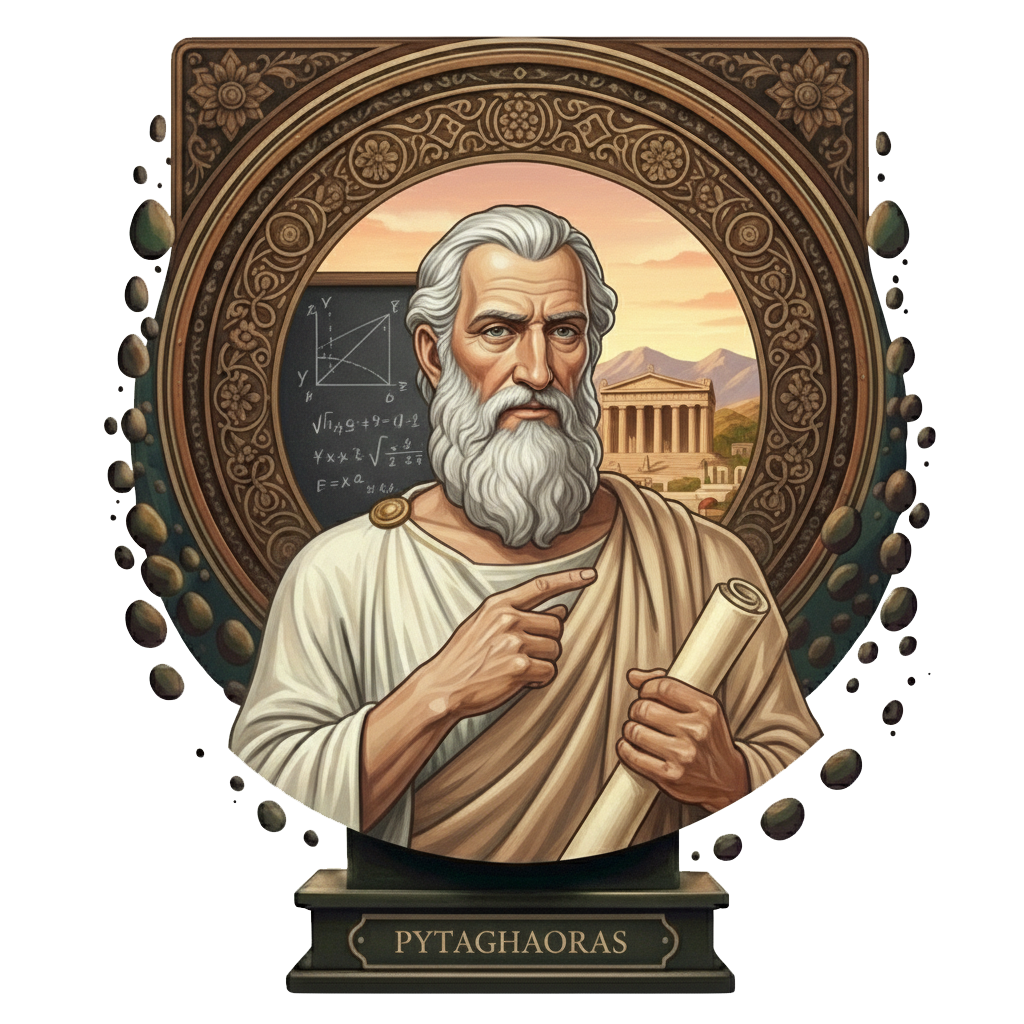
At a glance
- Born
- c. 570 BCE
- Died
- c. 495 BCE
- Era classification
- c. 75
- Homeland
- Ancient Greece (Samos)
- Period
- 6th century BCE
- Field
- Mathematics & Logic
- Language
- Ancient Greek
- Religion
- Pythagoreanism
- Gender
- male
Biography
Born on the island of Samos around 570 BCE, Pythagoras traveled widely in his youth, reportedly visiting Egypt and the Near East to study mathematics, religion, and philosophy. Fleeing the tyrannical rule of Polycrates, he eventually settled in Croton, a Greek colony in southern Italy, around 530 BCE.
In Croton, he founded a secretive, ascetic philosophical and religious school. His followers, known as Pythagoreans, lived communally, adhered to strict dietary rules, and believed in metempsychosis, or the transmigration of souls. The school functioned as both a religious brotherhood and an academy of scientific inquiry.
Pythagoras and his followers believed that the universe was fundamentally mathematical. They are credited with discovering the mathematical proportions of musical intervals and laying the foundations for classical geometry. Though the famous Pythagorean theorem was known to earlier Babylonians, his school is widely credited with formalizing its mathematical proof.
Pythagoras left no written works, making it difficult to distinguish his original thoughts from those of his later disciples. Nevertheless, his synthesis of mathematics, mysticism, and philosophy profoundly influenced Plato, Aristotle, and the subsequent development of Western rational and scientific thought.
Portrayal characteristics
Saved editorial descriptions used for the reconstruction; these are not authenticated statements by the depicted person.
- Mystical
- Analytical
- Ascetic
- Charismatic
- Visionary
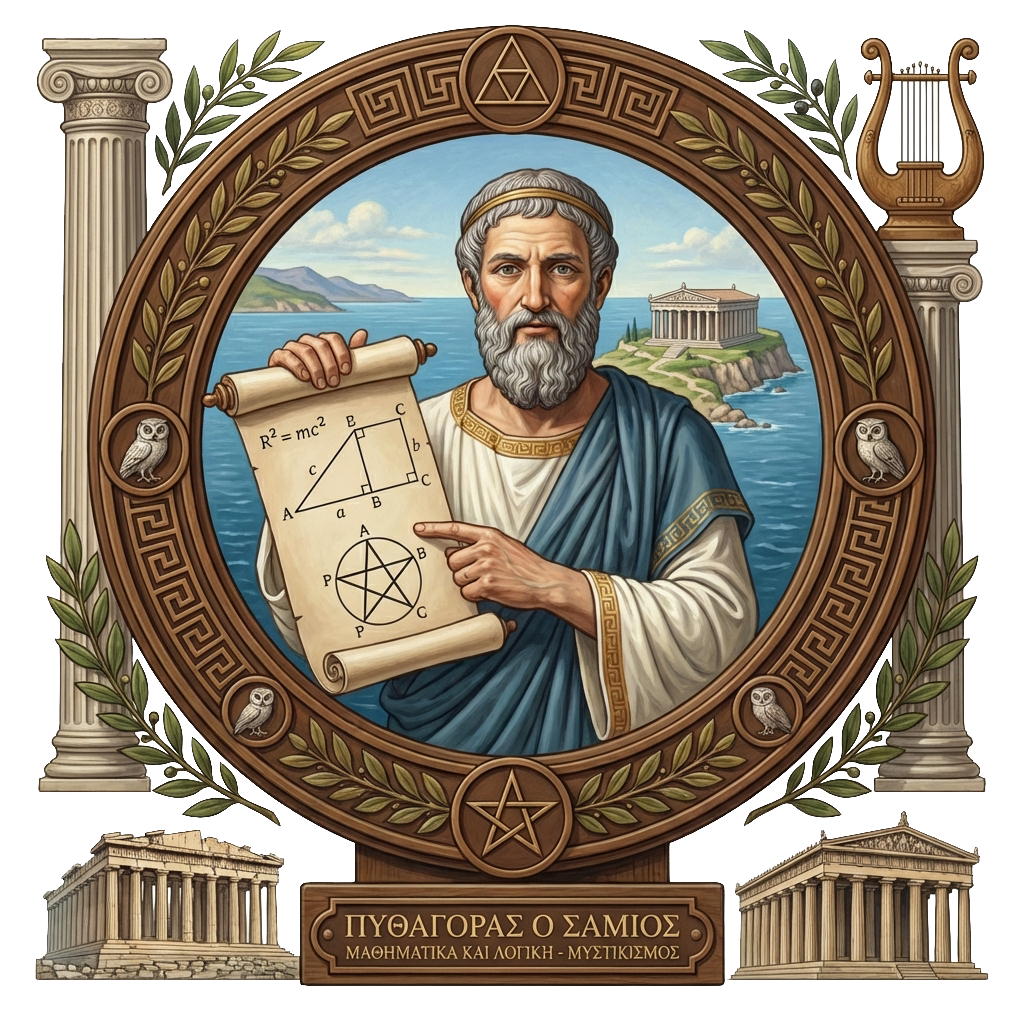
Images & artwork 5



Connections
Euclid of Alexandria
Influenced By
Euclid formalized and expanded upon the geometric principles established by the Pythagorean school.
In his 'Elements,' Euclid compiled and provided rigorous proofs for many theorems that had been discovered by earlier Greek mathematicians, most notably the Pythagorean theorem. He turned disparate geometric observations into a logical, deductive system.
Hipparchus
Influenced By
Hipparchus applied Pythagorean mathematical principles to the study of the stars.
Hipparchus relied on the mathematical ratios and the theorem attributed to Pythagoras to calculate the distances and sizes of the Sun and Moon. This application of Greek mathematics to physical observation was a cornerstone of his scientific method.
Thales of Miletus
Philosophical Influence
Thales of Miletus is often regarded as a mentor who encouraged a young Pythagoras to pursue mathematics and travel to Egypt.
While historical accounts are semi-legendary, Thales is credited with introducing Pythagoras to the geometric and astronomical studies that would define the Pythagorean school's curriculum.
Euclid of Alexandria
Mathematical Successor
Euclid formalized the mathematical proofs for the geometric principles first explored by Pythagoras and his followers.
The 'Pythagorean Theorem' is most famously proved in Book I of Euclid's 'Elements', ensuring the preservation of Pythagorean thought in the foundation of Western mathematics.
Aristotle
Historical Chronicler
Aristotle provided much of the surviving information regarding the beliefs and mathematical theories of the Pythagorean school.
In his works like 'Metaphysics', Aristotle analyzed the Pythagorean belief that 'all is number', though he often critiqued their mystical approach to mathematics and cosmology.
Socrates
Philosophical Influence
The mathematical and mystical teachings of Pythagoras significantly influenced the Socratic and Platonic schools of thought.
Socrates and his student Plato integrated Pythagorean concepts regarding the immortality of the soul and the mathematical order of the universe into their own philosophical frameworks.
Thales of Miletus
Philosophical Predecessor
Thales is often cited as an early influence on Pythagoras, potentially advising him to travel to Egypt to study mathematics.
As the first of the 'Seven Sages,' Thales established the tradition of rational inquiry and mathematical proof that Pythagoras would later expand into a mystical and mathematical system.
Known for
- Pythagorean theorem
- Harmony of the spheres
- Transmigration of souls (Metempsychosis)
- Founding Pythagoreanism
- Mathematical ratios in music
Episodes featuring or mentioning this figure
No eligible published episode featuring this figure is currently in the library.