



Al-Khwarizmi
Persian mathematician and astronomer whose work introduced algebra and Hindu-Arabic numerals to the world.

At a glance
- Born
- c. 780 CE
- Died
- c. 850 CE
- Era classification
- 70
- Homeland
- Khwarezm (Modern Uzbekistan)
- Period
- Islamic Golden Age
- Field
- Mathematics & Logic
- Language
- Arabic
- Religion
- Islam
- Gender
- male
Biography
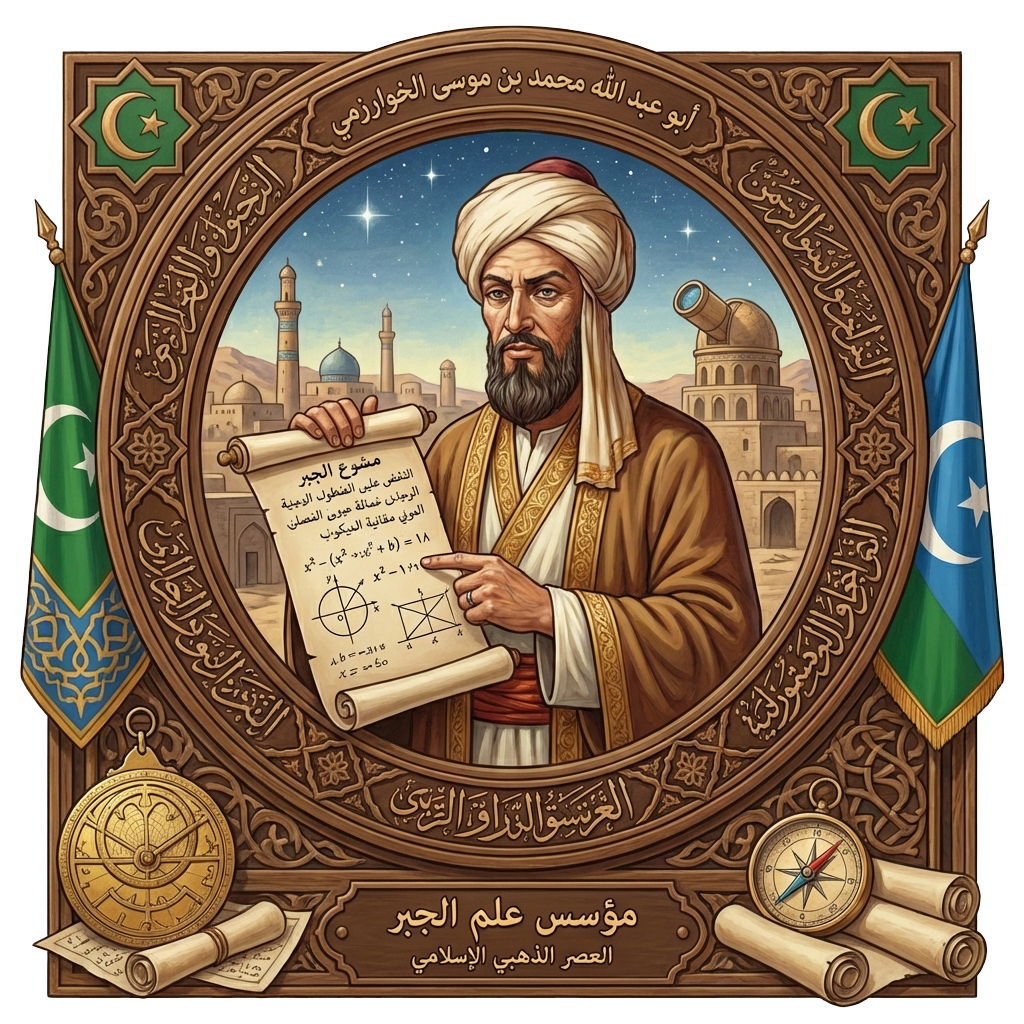
Born around 780 CE in Khwarezm (modern-day Khiva, Uzbekistan), Muhammad ibn Musa al-Khwarizmi was a brilliant Persian polymath who became a central figure in the Islamic Golden Age. He spent most of his productive life in Baghdad, working as a prominent scholar at the House of Wisdom (Bayt al-Hikmah) under the patronage of the Abbasid Caliph al-Ma'mun.
Al-Khwarizmi's most monumental contribution was his book 'Al-Kitab al-Mukhtasar fi Hisab al-Jabr wal-Muqabala' (The Compendious Book on Calculation by Completion and Balancing). This foundational text provided the first systematic solution of linear and quadratic equations, earning him the title of the 'father of algebra.' The very word 'algebra' is derived from 'al-jabr,' one of the two operations he used to solve quadratic equations.
Beyond algebra, he was instrumental in introducing the Hindu-Arabic numeral system to the Islamic world and, subsequently, to Europe. The Latin translation of his work on arithmetic led to the term 'algorithm,' which is derived from the Latinized version of his name, Algoritmi. He also made significant contributions to astronomy, geography, and cartography, assisting in a project to determine the circumference of the Earth and creating a detailed map of the known world.
Al-Khwarizmi died around 850 CE, leaving behind a legacy that fundamentally shaped the trajectory of mathematics and science. His works bridged the gap between ancient Babylonian, Greek, and Indian mathematics, synthesizing them into a cohesive mathematical language that would eventually ignite the European Renaissance and form the bedrock of modern computing.
Portrayal characteristics
Saved editorial descriptions used for the reconstruction; these are not authenticated statements by the depicted person.
- Analytical
- Innovative
- Methodical
- Visionary
- Synthesizer
Images & artwork 4
Connections
Euclid of Alexandria
Influenced By
Al-Khwarizmi utilized Euclidean geometric principles to provide rigorous proofs for his algebraic solutions.
While Al-Khwarizmi is the father of algebra, he justified his methods of 'completion' and 'balancing' using geometric demonstrations that drew upon the logic found in Euclid's 'Elements'. This synthesis of Greek geometry and Eastern arithmetic defined the character of Islamic mathematics.
Omar Khayyam
Intellectual Successor
Khayyam expanded upon the algebraic foundations laid by Al-Khwarizmi, particularly in the classification of equations.
While Al-Khwarizmi focused on linear and quadratic equations, Omar Khayyam took the next major step by providing a systematic method for solving cubic equations using the intersection of conic sections, building directly on the algebraic language Al-Khwarizmi created.
Alan Turing
Conceptual Ancestor
Al-Khwarizmi's mathematical procedures gave rise to the concept of the 'algorithm', which Alan Turing later formalized.
In the 12th century, translations of Al-Khwarizmi's work introduced the decimal positional number system to the Western world, and his Latinized name, 'Algoritmi', evolved into the term 'algorithm'. Centuries later, Alan Turing formalized the mathematical concept of the algorithm with his Turing machine. Turing's foundational work in computer science is the direct modern descendant of Al-Khwarizmi's step-by-step mathematical procedures.
Abu Ali Sina (Avicenna)
Intellectual Successor
Avicenna utilized the mathematical and scientific foundations laid by Al-Khwarizmi during the Islamic Golden Age.
Al-Khwarizmi was a pioneering figure of the early Islamic Golden Age whose works in mathematics and astronomy became standard texts across the Middle East. Avicenna, living roughly a century and a half later, studied these foundational texts during his early education. The mathematical framework and Hindu-Arabic numeral system popularized by Al-Khwarizmi were essential tools for Avicenna's later extensive works in science, philosophy, and medicine.
Aryabhata
Influenced By
Al-Khwarizmi's introduction of the decimal system was heavily influenced by the work of Indian mathematicians like Aryabhata.
Al-Khwarizmi's 'On the Calculation with Hindu Numerals' was instrumental in transmitting the Indian positional number system to the Islamic world and later to Europe. This transmission relied on the mathematical foundations laid by Aryabhata and his successors in the Gupta Empire.
Aryabhata
Mathematical Influence
Aryabhata's work on the decimal system and trigonometry was a primary source for the Islamic Golden Age mathematicians.
Aryabhata's 'Aryabhatiya' introduced the concept of the sine function and the place-value system. These Indian mathematical advancements were translated into Arabic and became the foundation for Al-Khwarizmi's development of algebra and the global adoption of Hindu-Arabic numerals.
Ibn Khaldun
Intellectual Successor
Ibn Khaldun studied and praised the mathematical advancements of Al-Khwarizmi as essential to scientific progress.
As a scholar of the Islamic Golden Age, Ibn Khaldun recognized Al-Khwarizmi's foundational role in algebra and arithmetic. He viewed these mathematical disciplines as vital tools for the administrative and scientific functions of the civilizations he analyzed.
Nasir al-Din al-Tusi
Mathematical Influence
Tusi's work in trigonometry and algebra was a direct evolution of the methods pioneered by Al-Khwarizmi.
Tusi is credited with treating trigonometry as an independent mathematical discipline rather than just a tool for astronomy, a significant advancement from the foundational algebraic principles established by Al-Khwarizmi.
Known for
- Founding the discipline of Algebra
- Introducing Hindu-Arabic numerals to the West
- The concept and etymology of the 'Algorithm'
- Writing 'Al-Jabr'
- Compiling the Zij al-Sindhind astronomical tables
Episodes featuring or mentioning this figure
No eligible published episode featuring this figure is currently in the library.