



Ibn Khaldun
Arab sociologist, philosopher, and historian widely considered a founding father of modern sociology and historiography.
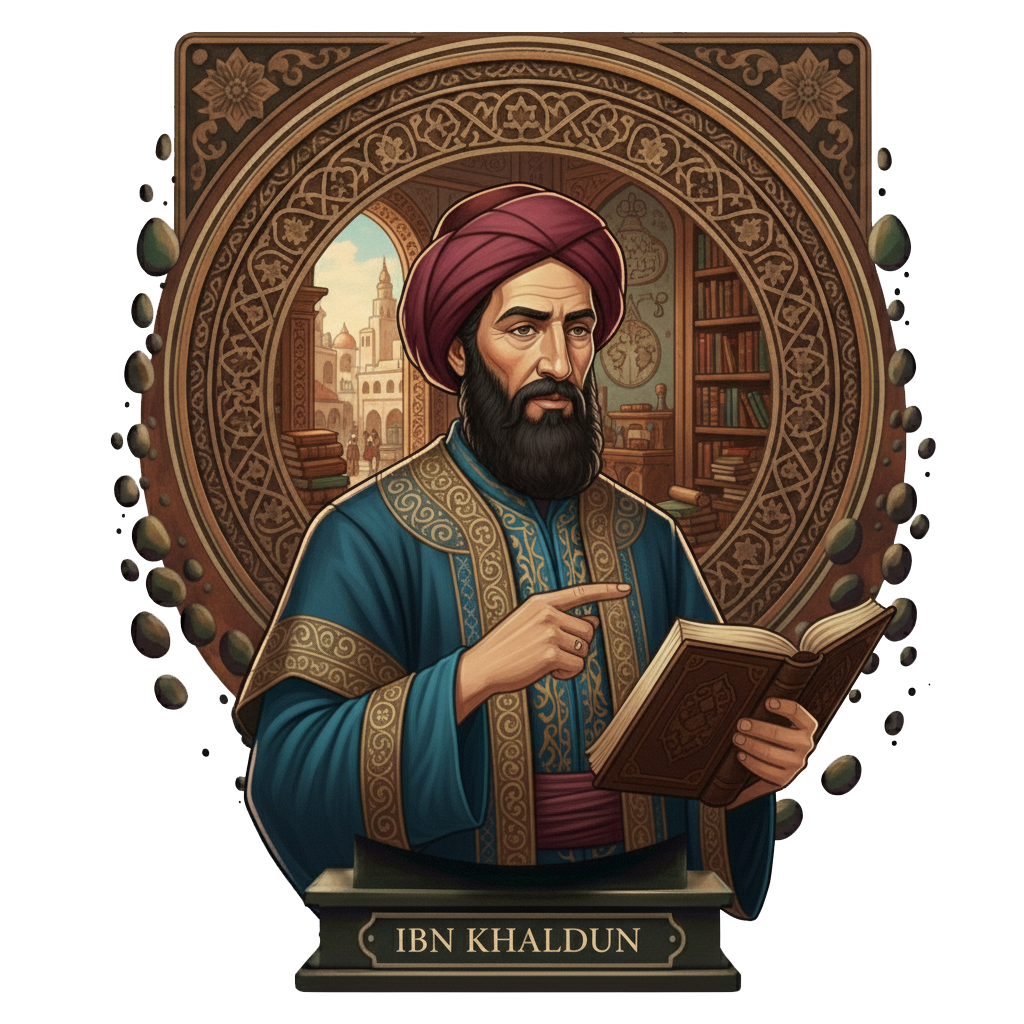
At a glance
- Born
- 1332 CE
- Died
- 1406 CE
- Era classification
- 73
- Homeland
- Tunisia / Egypt
- Period
- 1332–1406 CE
- Field
- Philosophy & Ideology
- Language
- Arabic
- Religion
- Islam
- Gender
- male
Biography
Abū Zayd ‘Abd ar-Raḥmān ibn Muḥammad ibn Khaldūn al-Ḥaḍramī was born in Tunis in 1332 CE to an upper-class Andalusian family of Arab descent. Benefiting from his family's high status, he received a comprehensive education in Islamic sciences, philosophy, mathematics, and literature. His early life was marked by the devastating impact of the Black Death, which swept through Tunis and claimed the lives of his parents and many of his teachers, profoundly shaping his worldview.
Ibn Khaldun embarked on a turbulent political career that spanned several decades and took him across North Africa and Al-Andalus. He served various sultans and emirs as a diplomat, minister, and judge. However, his deep involvement in court intrigues frequently led to sudden falls from grace, including a period of imprisonment in Fez. Recognizing the precarious nature of political life, he eventually sought refuge from the chaotic courts of the Maghreb.
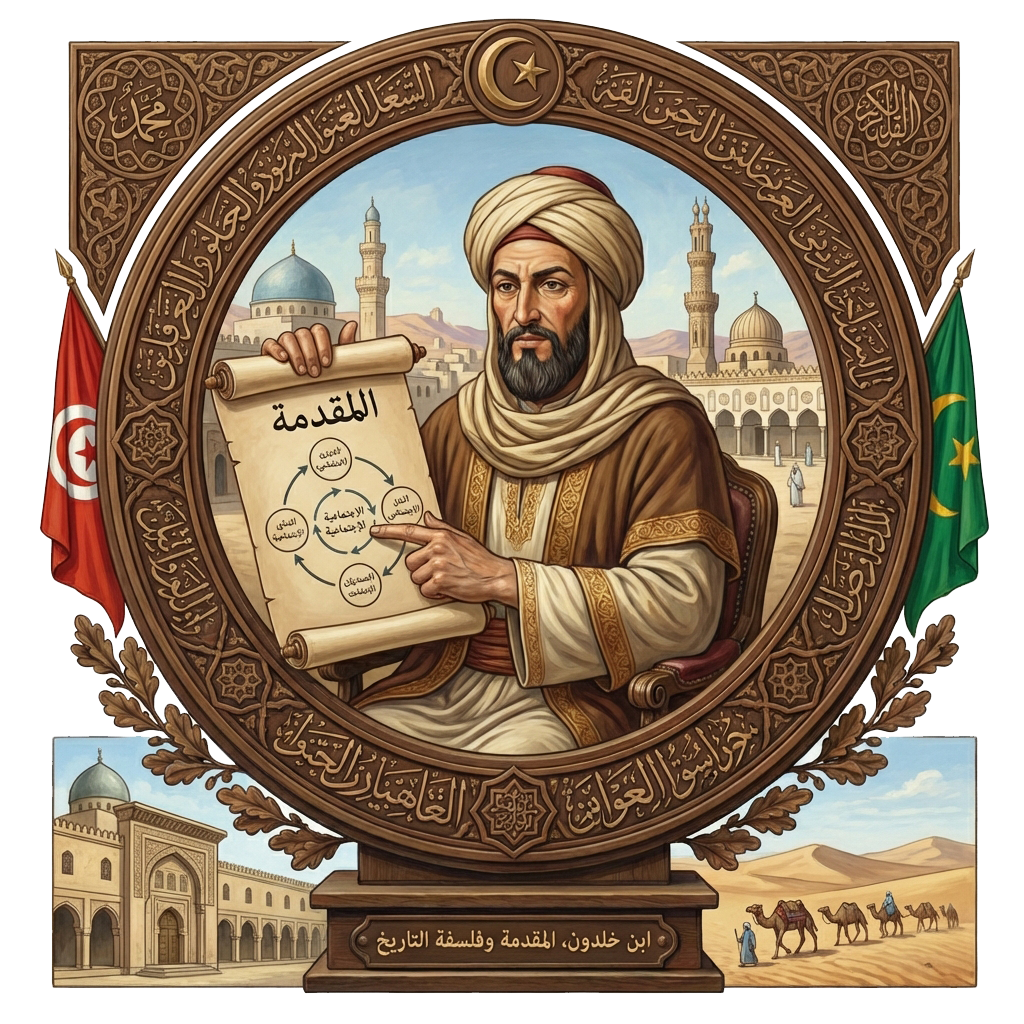
Retreating to the fortress of Qalat Ibn Salama in Algeria, Ibn Khaldun spent four years writing his magnum opus, the 'Kitab al-Ibar', and its famous introduction, the 'Muqaddimah' (Prolegomena). In the 'Muqaddimah', he revolutionized the study of history by rejecting mere chronicling in favor of analyzing the underlying social, economic, and environmental forces that drive human events. He introduced the groundbreaking concept of 'Asabiyyah' (social cohesion or tribalism) to explain the cyclical rise and fall of empires, laying the foundational principles for modern sociology, demography, and economics.
In his later years, Ibn Khaldun moved to Mamluk Egypt, where he was appointed as the Maliki chief judge of Cairo and taught at prestigious institutions like Al-Azhar. His final major historical act occurred in 1400 CE when he was sent to Damascus to negotiate with the Turco-Mongol conqueror Timur (Tamerlane). The two men engaged in extensive philosophical and historical discussions. Ibn Khaldun eventually returned to Cairo, where he spent his remaining years writing and teaching until his death in 1406 CE.
Portrayal characteristics
Saved editorial descriptions used for the reconstruction; these are not authenticated statements by the depicted person.
- Analytical
- Observant
- Pragmatic
- Intellectually independent
- Resilient
Images & artwork 5



Connections
Aristotle
Influenced By
Ibn Khaldun engaged deeply with Aristotelian logic and political philosophy while developing his own theories of history.
In his 'Muqaddimah', Ibn Khaldun utilized Aristotelian categories of thought to analyze society, though he famously critiqued the Greek philosopher's views on the ideal state, preferring to focus on the empirical 'asabiyyah' (social cohesion).
Al-Khwarizmi
Intellectual Successor
Ibn Khaldun studied and praised the mathematical advancements of Al-Khwarizmi as essential to scientific progress.
As a scholar of the Islamic Golden Age, Ibn Khaldun recognized Al-Khwarizmi's foundational role in algebra and arithmetic. He viewed these mathematical disciplines as vital tools for the administrative and scientific functions of the civilizations he analyzed.
Known for
- The Muqaddimah (Prolegomena)
- Concept of Asabiyyah (social cohesion)
- Founding father of sociology
- Founding father of historiography
- Early theories of economics and demography
Episodes featuring or mentioning this figure

Can Accurate History Miss the Point? Halil İnalcık vs İlber Ortaylı
AI jury: 3 members
What gives a historian lasting value: disciplined research or interpretive judgment?