



Aristotle
Ancient Greek philosopher and polymath who profoundly shaped Western philosophy and science.
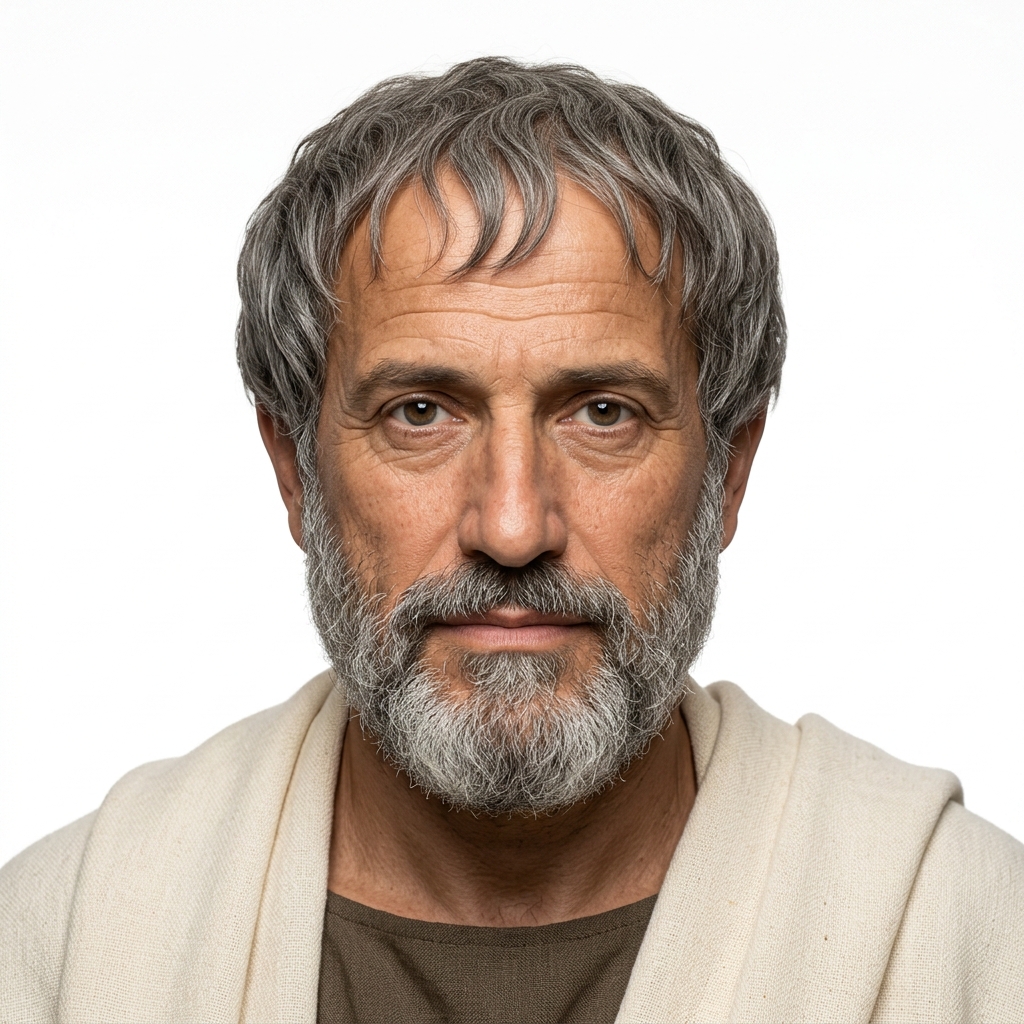
At a glance
- Born
- 384 BCE
- Died
- 322 BCE
- Era classification
- 62
- Homeland
- Greece
- Period
- 384–322 BCE
- Field
- Philosophy & Ideology
- Language
- Ancient Greek
- Religion
- Ancient Greek religion
- Gender
- male
Biography
Aristotle was born in 384 BCE in Stagira, a small town on the northern coast of Greece. His father, Nicomachus, served as the personal physician to King Amyntas of Macedon, establishing an early connection between Aristotle and the Macedonian court. At the age of seventeen, Aristotle traveled to Athens to enroll in Plato's Academy. He remained there for two decades, first as a star pupil and later as a researcher and teacher, deeply absorbing but eventually diverging from his master's idealistic philosophy.
Following Plato's death in 347 BCE, Aristotle left Athens and traveled extensively, conducting pioneering biological and zoological research in Asia Minor and Lesbos. In 343 BCE, King Philip II of Macedon invited him to tutor his young son, who would later become known as Alexander the Great. This prestigious post lasted for several years, after which Aristotle returned to Athens in 335 BCE to establish his own school, the Lyceum. For the next twelve years, he led a collaborative research institute, gathering a massive collection of manuscripts and establishing one of the world's first comprehensive libraries.
Aristotle's intellectual output was staggering in its breadth and depth. His surviving writings, largely thought to be lecture notes, systematically examine almost every area of human knowledge, including physics, biology, metaphysics, logic, ethics, aesthetics, politics, and rhetoric. He invented the formal study of logic, famously developing the syllogism, and his empirical, teleological approach to the natural world laid the groundwork for the scientific method. His ethical framework, particularly the concept of the 'Golden Mean' outlined in the Nicomachean Ethics, remains highly influential.
After the death of Alexander the Great in 323 BCE, anti-Macedonian sentiment surged in Athens. Fearing the same fate as Socrates, Aristotle reportedly declared that he would not allow the city to 'sin twice against philosophy' and fled to his mother's family estate in Chalcis on the island of Euboea. He died there of natural causes the following year at the age of 62. His monumental legacy earned him the title of 'The First Teacher' in the Islamic world and simply 'The Philosopher' among medieval Christian scholastics.
Portrayal characteristics
Saved editorial descriptions used for the reconstruction; these are not authenticated statements by the depicted person.
- Analytical
- Empirical
- Systematic
- Polymathic
- Observant
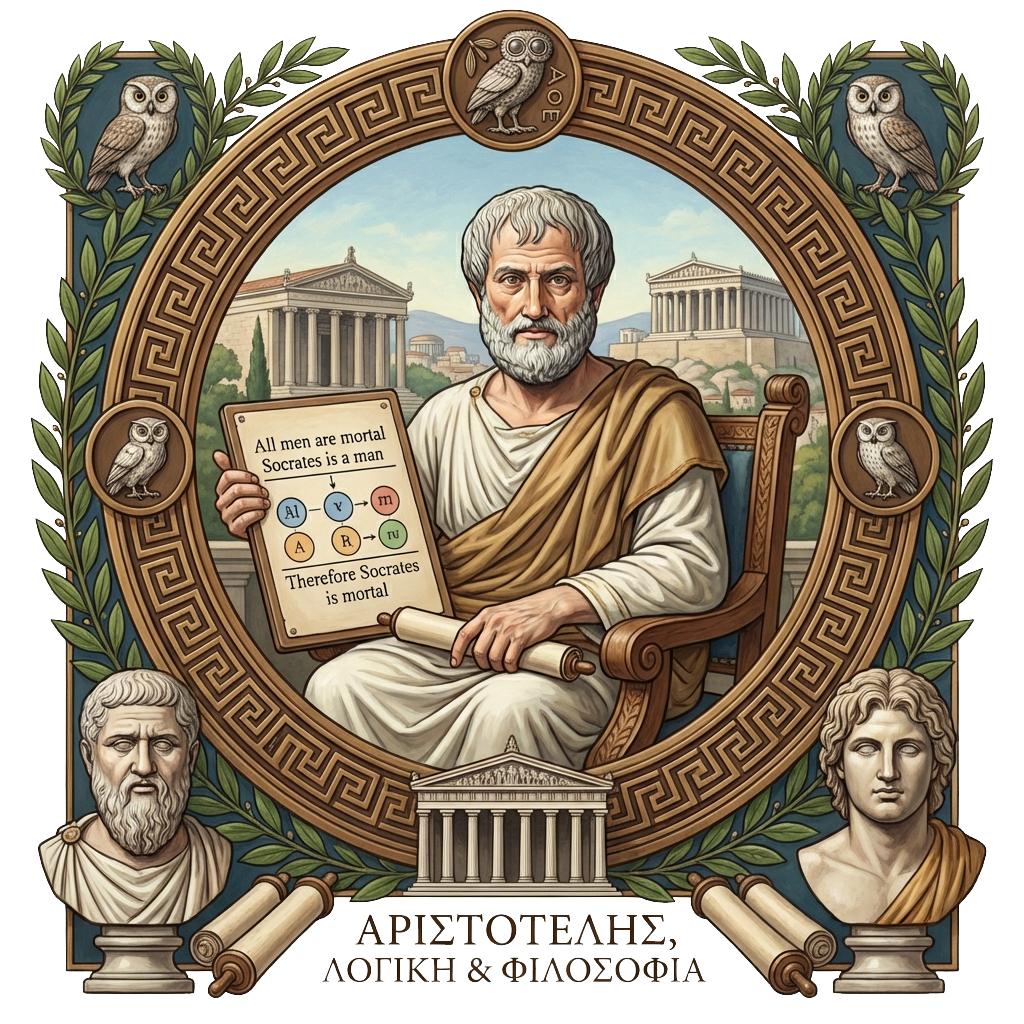
Images & artwork 6


Connections
Abu Ali Sina (Avicenna)
Influenced By
Avicenna's philosophical system was a profound synthesis and expansion of Aristotelian logic and metaphysics.
Avicenna wrote 'The Book of Healing' (Kitab al-Shifa), which served as a comprehensive commentary on Aristotle's works, attempting to reconcile Peripatetic philosophy with Islamic theology. His interpretation of Aristotle became the standard for both the Islamic world and medieval European scholasticism.
Alexander the Great
Teacher & Student
Aristotle served as the personal tutor to the young Alexander the Great for several years.
In 343 BCE, Philip II of Macedon invited Aristotle to tutor his son, Alexander. Aristotle's teachings on politics, ethics, and science are believed to have significantly influenced Alexander's later governance and his interest in scientific exploration during his conquests.
Abu Ali Sina (Avicenna)
Major Influence
Avicenna's philosophical and medical systems were built upon the foundational works of Aristotle.
Avicenna (Abu Ali Sina) was the leading figure in the reconciliation of Aristotelian logic and metaphysics with Islamic theology. His 'The Book of Healing' is an encyclopedic effort to preserve and expand upon the Peripatetic tradition established by Aristotle.
Socrates
Philosophical Lineage
Aristotle was the most famous student of Plato, who was himself the student of Socrates.
While Aristotle was born after Socrates' death, he spent twenty years at Plato's Academy. His work often engages with, critiques, and systematizes the dialectical methods and ethical inquiries first introduced by Socrates.
Thales of Miletus
Historical Predecessor
Aristotle identified Thales as the first philosopher in the Greek tradition.
In his 'Metaphysics', Aristotle credits Thales of Miletus as the founder of natural philosophy. Aristotle's documentation of Thales' theories on water as the primary substance is the main reason Thales is recognized as the first scientist in Western history.
Alexander the Great
Teacher & Student
Aristotle served as the personal tutor to the young Alexander for three years, teaching him philosophy, medicine, and scientific inquiry.
Aristotle's influence is seen in Alexander's habit of bringing scientists on his campaigns and his lifelong interest in Greek literature, particularly the works of Homer.
Euclid of Alexandria
Philosophical Influence
Euclid's axiomatic method was heavily influenced by Aristotelian logic and definitions.
Euclid applied Aristotle's theories on the nature of definitions, axioms, and logical deduction to the field of mathematics. The structure of 'The Elements' serves as the ultimate practical application of the logical framework Aristotle described in his 'Posterior Analytics'.
Hipparchus
Scientific Critic
Hipparchus refined and sometimes challenged the cosmological models proposed by Aristotle.
While Hipparchus operated within a broadly Aristotelian geocentric framework, his discovery of the precession of the equinoxes and his use of epicycles provided a more mathematically rigorous model than Aristotle's simpler concentric spheres.
Hippocrates
Intellectual Successor
Aristotle's biological and empirical methods were deeply influenced by the Hippocratic school.
Aristotle's focus on observation and classification in biology mirrored the Hippocratic emphasis on clinical observation and case histories. Both figures moved Greek thought away from purely supernatural explanations toward naturalistic causes for physical phenomena.
Ibn Khaldun
Influenced By
Ibn Khaldun engaged deeply with Aristotelian logic and political philosophy while developing his own theories of history.
In his 'Muqaddimah', Ibn Khaldun utilized Aristotelian categories of thought to analyze society, though he famously critiqued the Greek philosopher's views on the ideal state, preferring to focus on the empirical 'asabiyyah' (social cohesion).
Galen
Philosophical Influence
Galen adopted Aristotle's teleological approach, believing that every part of the body was designed by nature for a specific purpose.
Galen heavily utilized Aristotelian logic and biology to explain the functions of organs. He combined Aristotle's concept of 'final causes' with his own medical practice, arguing that the complexity of the human body was proof of a divine or natural design.
Galileo Galilei
Intellectual Opponent
Galileo's scientific career was defined by his systematic rejection of Aristotelian physics and geocentric cosmology.
Galileo used both mathematical proofs and telescopic observations to refute Aristotle's claims that heavier objects fall faster and that the heavens are unchanging. His work 'Dialogue Concerning the Two Chief World Systems' was a direct critique of the Aristotelian-Ptolemaic worldview.
Pythagoras
Historical Chronicler
Aristotle provided much of the surviving information regarding the beliefs and mathematical theories of the Pythagorean school.
In his works like 'Metaphysics', Aristotle analyzed the Pythagorean belief that 'all is number', though he often critiqued their mystical approach to mathematics and cosmology.
Socrates
Philosophical Successor
Aristotle was the student of Plato, who was the primary student and biographer of Socrates.
Socrates' dialectic method and focus on ethics provided the foundation for the Platonic school, which in turn educated Aristotle. Together, these three figures established the core tenets of Western philosophy.
Thales of Miletus
Primary Historian & Successor
Aristotle identified Thales as the first philosopher in the Greek tradition and the founder of the Milesian school.
Most of what is known about Thales's theories, such as his belief that water is the primary substance of all matter, survives through Aristotle's critical analysis in his work 'Metaphysics'.
Alexis de Tocqueville
Philosophical Lineage
Tocqueville is widely regarded by political scientists as the 'modern Aristotle' due to his empirical, comparative approach to studying political regimes and civil society.
While separated by millennia, Tocqueville and Aristotle share a profound methodological and philosophical lineage. Both thinkers rejected purely utopian or abstract political theorizing, opting instead for empirical observation and comparative analysis. Just as Aristotle collected the constitutions of Greek city-states to analyze the practical mechanics of different regimes, Tocqueville traveled to America to empirically study the 'anatomy' of democracy. Both concluded that the health of a political regime depends entirely on the 'mores' (habits of the heart) of its citizens and the presence of a robust middle class. Tocqueville's focus on intermediary institutions and civic associations as the lifeblood of liberty is a direct modern continuation of Aristotle's vision of the political community.
Known for
- Formalizing syllogistic logic
- Founding the Lyceum in Athens
- Tutoring Alexander the Great
- Nicomachean Ethics and the Golden Mean
- Pioneering biological taxonomy
Episodes featuring or mentioning this figure
No eligible published episode featuring this figure is currently in the library.