



Bertrand Russell
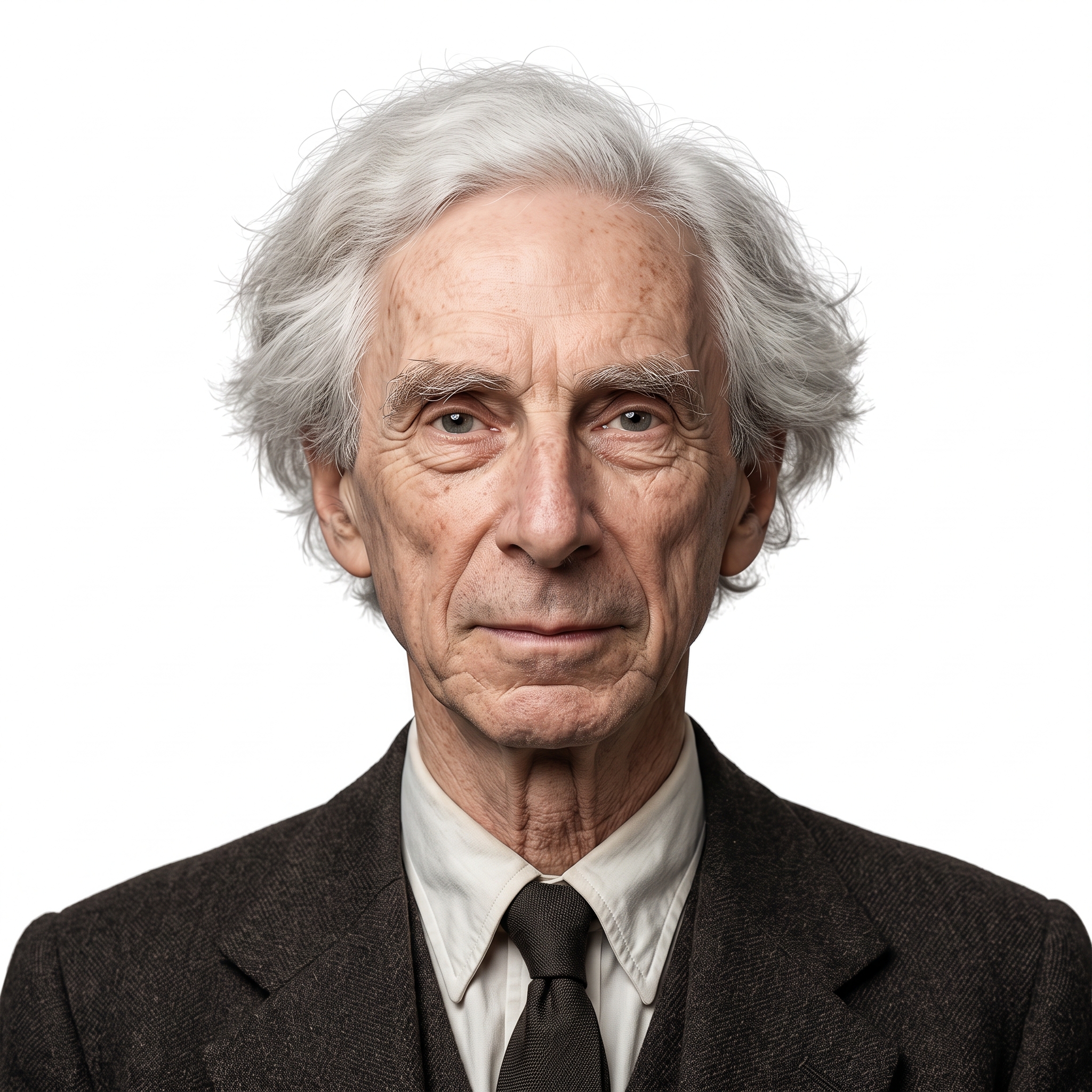
British polymath and philosopher who co-founded analytic philosophy and championed global nuclear disarmament.
At a glance
- Born
- 1872 CE
- Died
- 1970 CE
- Era classification
- Modern
- Occupation
- Philosopher
- Homeland
- United Kingdom
- Period
- Late 19th to Mid-20th Century
- Field
- Philosophy & Ideology
- Language
- English
- Religion
- Agnosticism
- Gender
- male
Biography
Bertrand Arthur William Russell was born into an influential aristocratic British family in Monmouthshire, Wales. Orphaned at a young age, he was raised by his paternal grandparents in a strict, puritanical environment. Finding solace in mathematics and philosophy, Russell entered Trinity College, Cambridge, in 1890. There, he demonstrated extraordinary intellectual brilliance, quickly becoming one of the pivotal figures in the revolution of modern logic alongside his former tutor and collaborator, Alfred North Whitehead.
In the early 20th century, Russell spearheaded the development of analytic philosophy alongside G. E. Moore and his pupil Ludwig Wittgenstein. His monumental work with Whitehead, 'Principia Mathematica' (1910–1913), sought to ground all mathematics in formal logic. He also transformed metaphysics and epistemology through his theory of descriptions, logical atomism, and rigorous critique of Hegelian idealism, establishing clarity, precise language, and formal analysis as central tenets of 20th-century Western philosophy.
Beyond academic philosophy, Russell was a fiercely independent public intellectual and an ardent social critic. A committed pacifist, he was imprisoned during World War I for his vocal opposition to the conflict. Throughout his long life, he produced extensive writings on ethics, education, secularism, and political theory. In the post-World War II era, he became a leading advocate for nuclear disarmament, co-authoring the Russell-Einstein Manifesto in 1955 and founding the Campaign for Nuclear Disarmament.
Russell was awarded the Nobel Prize in Literature in 1950 in recognition of his diverse and significant writings championing humanitarian ideals and freedom of thought. Remaining politically and intellectually active well into his nineties, Russell died in 1970 at the age of 97, leaving behind a profound legacy that shaped modern mathematical logic, epistemology, and global peace activism.
Portrayal characteristics
Saved editorial descriptions used for the reconstruction; these are not authenticated statements by the depicted person.
- Analytical
- Outspoken
- Pacifist
- Skeptical
- Witty
- Humanitarian
Images & artwork 2
Known for
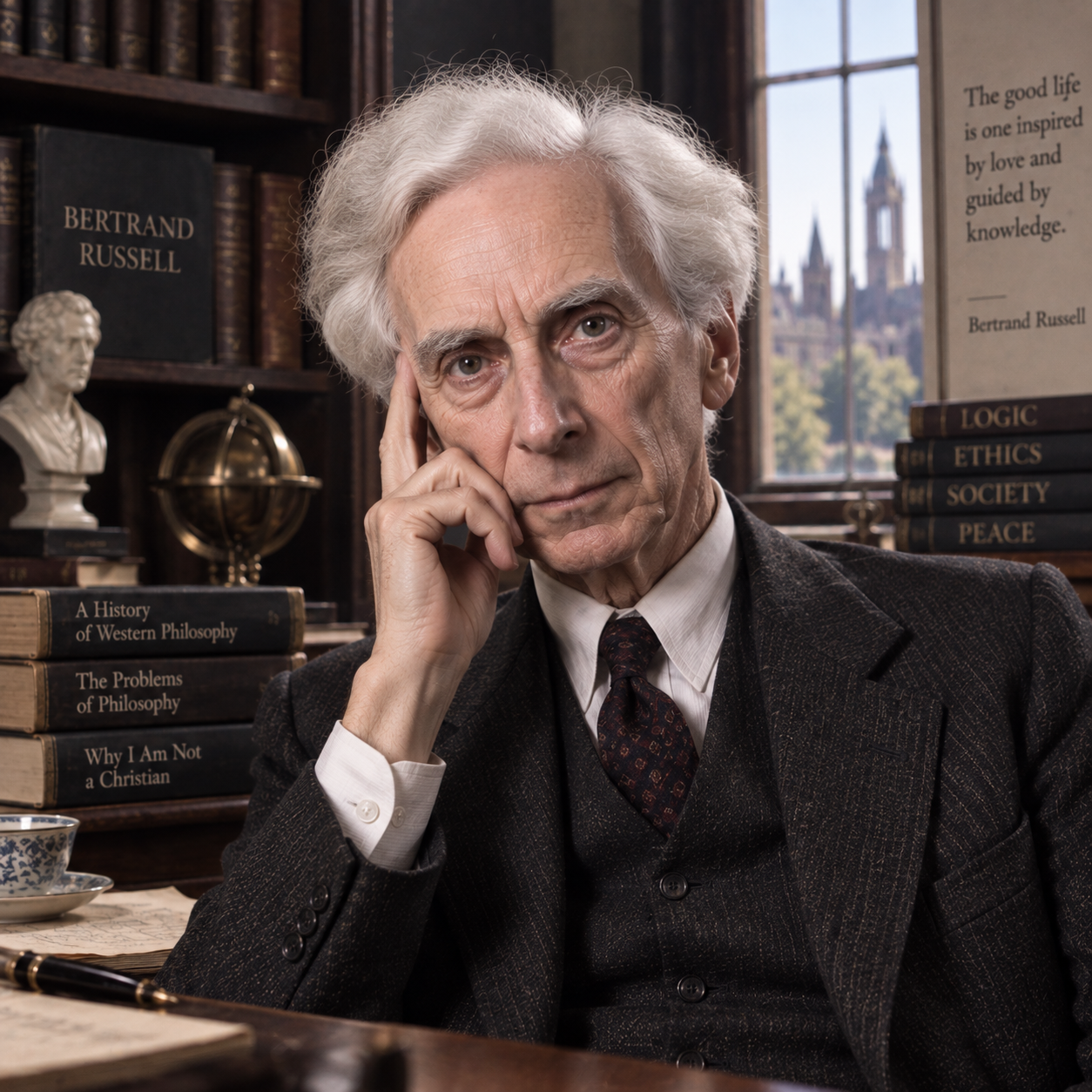
- Co-authoring Principia Mathematica
- Founding analytic philosophy
- Russell's Paradox
- Co-authoring the Russell-Einstein Manifesto
- 1950 Nobel Prize in Literature
Episodes featuring or mentioning this figure
No eligible published episode featuring this figure is currently in the library.