



Euclid of Alexandria
Ancient Greek mathematician known as the 'father of geometry' whose Elements shaped mathematics for millennia.
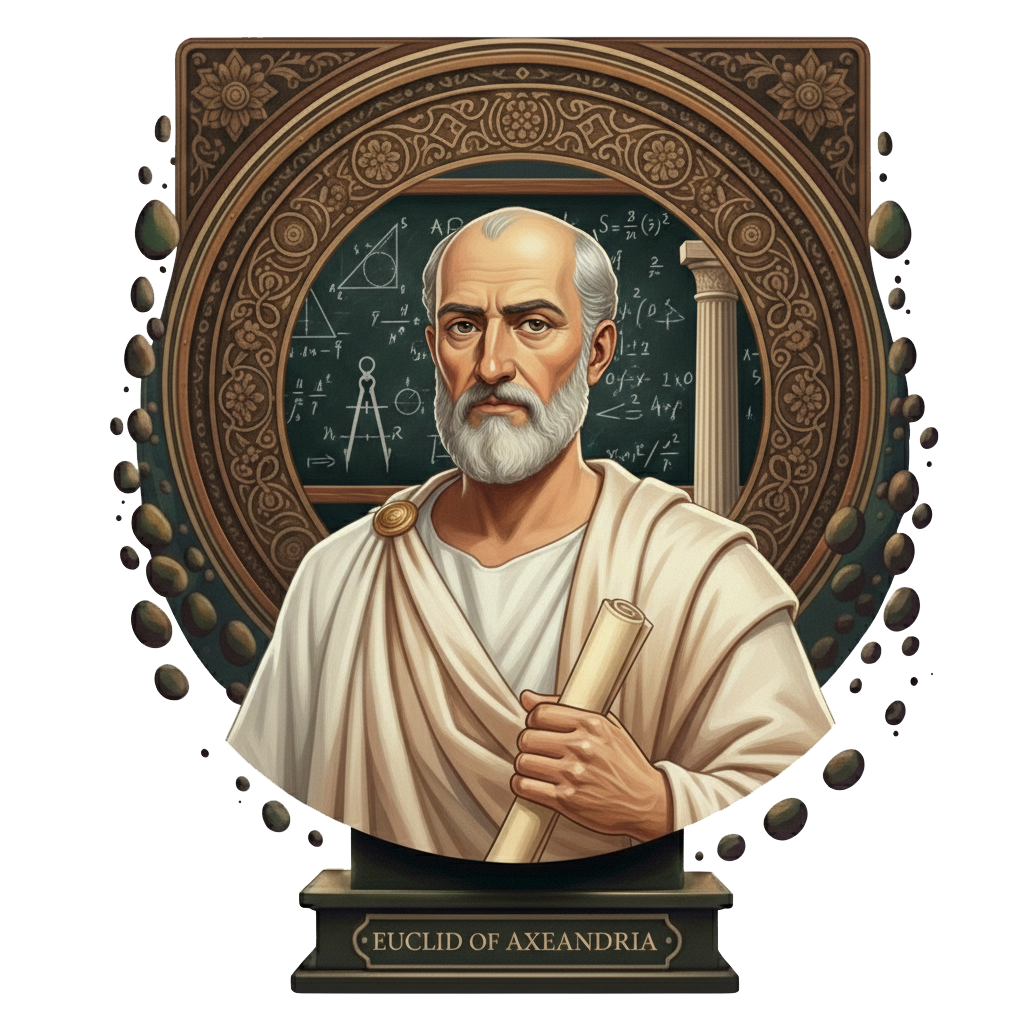
At a glance
- Born
- c. 325 BCE
- Died
- c. 270 BCE
- Era classification
- Unknown
- Homeland
- Ptolemaic Egypt
- Period
- c. 300 BCE
- Field
- Mathematics & Logic
- Language
- Ancient Greek
- Religion
- Hellenistic Polytheism
- Gender
- male
Biography
Euclid of Alexandria was an ancient Greek mathematician, universally recognized as the 'father of geometry.' While very little is known about his personal life, historical records indicate he was active in Alexandria, Egypt, during the reign of Ptolemy I Soter (323–283 BCE). It is highly probable that he studied at Plato's Academy in Athens before moving to Alexandria, where he established a prominent school of mathematics and taught at the legendary Library of Alexandria.
His magnum opus, 'Elements,' is widely considered the most successful and influential textbook in the history of mathematics. In this monumental thirteen-volume work, Euclid compiled, organized, and expanded upon the mathematical knowledge of his predecessors, such as Pythagoras and Eudoxus. He deduced the principles of what is now known as Euclidean geometry from a small set of self-evident axioms, creating a logical framework that remained the undisputed foundation of geometry until the 19th century.
Beyond 'Elements,' Euclid authored several other important treatises on topics ranging from perspective and spherical geometry to number theory and mathematical rigor. His enduring legacy lies not just in the specific theorems he recorded, such as the infinitude of prime numbers and the Euclidean algorithm, but in his revolutionary axiomatic method. By demanding rigorous logical deduction from basic postulates, Euclid established the standard of proof that continues to define mathematics and the exact sciences today.
Portrayal characteristics
Saved editorial descriptions used for the reconstruction; these are not authenticated statements by the depicted person.
- Logical
- Systematic
- Rigorous
- Analytical
- Foundational
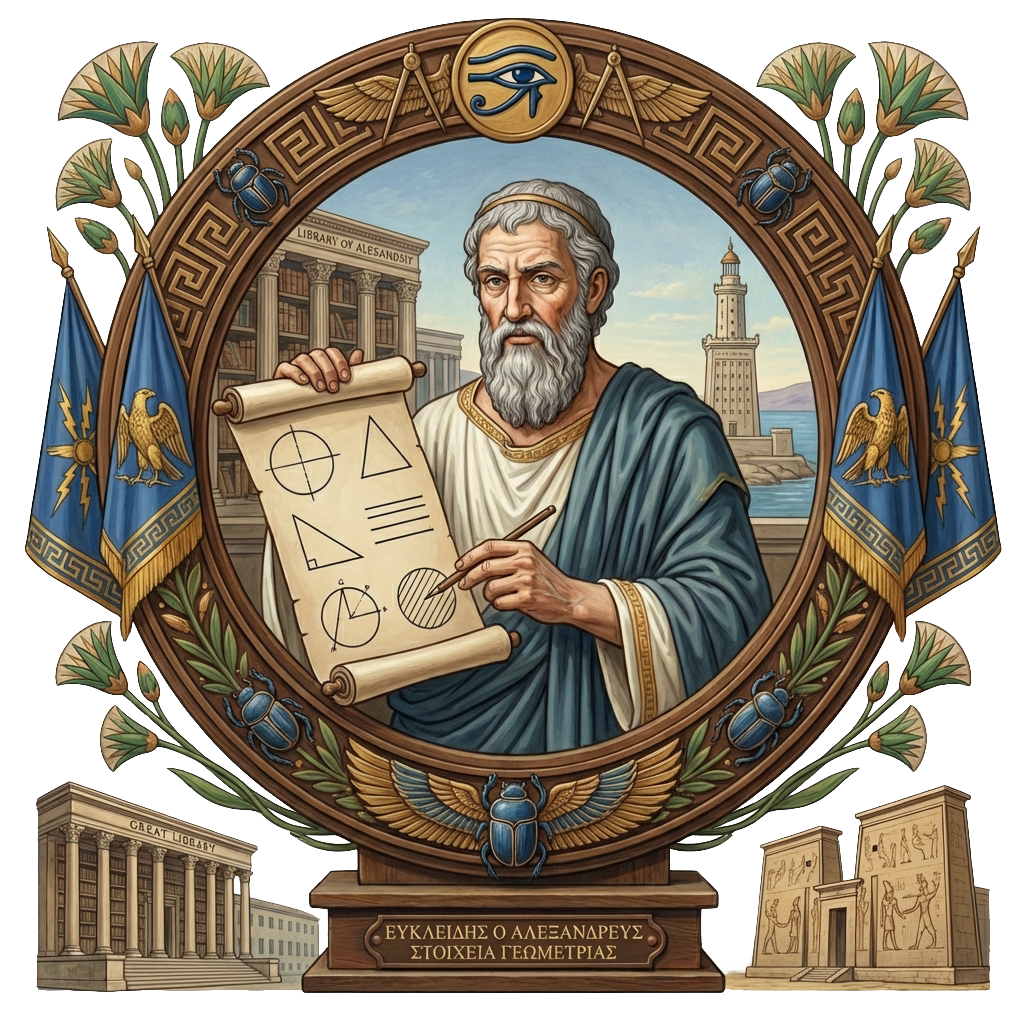
Images & artwork 4


Connections
Abu Ali Sina (Avicenna)
Studied & Commented On
Avicenna studied Euclid's foundational works in mathematics and geometry, incorporating them into his own scientific treatises.
In his encyclopedic work 'The Book of Healing', Avicenna included a comprehensive summary and commentary on Euclid's 'Elements'. He used Euclidean geometry as a foundational basis for his own explorations into mathematics, astronomy, and logic, helping to transmit and refine Greek mathematical traditions in the Islamic Golden Age.
Al-Khwarizmi
Influenced By
Al-Khwarizmi utilized Euclidean geometric principles to provide rigorous proofs for his algebraic solutions.
While Al-Khwarizmi is the father of algebra, he justified his methods of 'completion' and 'balancing' using geometric demonstrations that drew upon the logic found in Euclid's 'Elements'. This synthesis of Greek geometry and Eastern arithmetic defined the character of Islamic mathematics.
Abraham Lincoln
Influenced By
Lincoln intensely studied Euclid's mathematical proofs to hone his logical reasoning and legal argumentation.
As a self-taught lawyer and politician, Lincoln realized he needed a better grasp of formal logic to effectively argue his cases. He carried a copy of Euclid's 'Elements' with him while traveling the judicial circuit, eventually mastering the first six books. He frequently applied Euclidean logic to his political arguments against slavery, demonstrating that if all men are created equal, certain unalienable rights must logically follow.
Pythagoras
Influenced By
Euclid formalized and expanded upon the geometric principles established by the Pythagorean school.
In his 'Elements,' Euclid compiled and provided rigorous proofs for many theorems that had been discovered by earlier Greek mathematicians, most notably the Pythagorean theorem. He turned disparate geometric observations into a logical, deductive system.
Aristotle
Philosophical Influence
Euclid's axiomatic method was heavily influenced by Aristotelian logic and definitions.
Euclid applied Aristotle's theories on the nature of definitions, axioms, and logical deduction to the field of mathematics. The structure of 'The Elements' serves as the ultimate practical application of the logical framework Aristotle described in his 'Posterior Analytics'.
Abraham Lincoln
Influenced (Logic)
Lincoln famously studied Euclid's 'Elements' to master the art of logical demonstration.
As a self-taught lawyer, Lincoln carried Euclid's 'Elements' with him on the legal circuit. He claimed that he could not understand the meaning of 'demonstrate' until he had mastered Euclid's proofs, a skill he later used to construct his rigorous political arguments against slavery.
Isaac Newton
Influenced (Methodology)
Newton modeled the structure of his 'Principia Mathematica' on Euclid's geometric proofs.
Newton held Euclid in the highest regard, choosing to present his revolutionary laws of motion and universal gravitation in the style of Euclidean geometry. By using axioms and propositions, Newton aimed to give his physics the same absolute certainty found in Euclid's mathematics.
Hipparchus
Scientific Successor
Hipparchus built upon the geometric foundations established by Euclid to develop trigonometry.
Hipparchus utilized Euclidean geometry to create the first known trigonometric tables, which allowed him to solve problems related to the movement of celestial bodies. His work effectively translated Euclid's abstract geometry into a practical tool for astronomy.
Pythagoras
Mathematical Successor
Euclid formalized the mathematical proofs for the geometric principles first explored by Pythagoras and his followers.
The 'Pythagorean Theorem' is most famously proved in Book I of Euclid's 'Elements', ensuring the preservation of Pythagorean thought in the foundation of Western mathematics.
Thales of Miletus
Mathematical Foundation
Thales is credited with introducing geometry to Greece, providing the early proofs that Euclid would later systematize.
Theorems such as 'Thales's Theorem' regarding angles in a semicircle were foundational to the geometric principles compiled in Euclid's 'Elements' centuries later.
Known for
- Euclid's Elements
- Euclidean geometry
- Axiomatic method
- Euclidean algorithm
- Proof of the infinitude of primes
Episodes featuring or mentioning this figure
No eligible published episode featuring this figure is currently in the library.