



Kurt Gödel
Revolutionary logician whose Incompleteness Theorems transformed modern mathematics, logic, and philosophy.
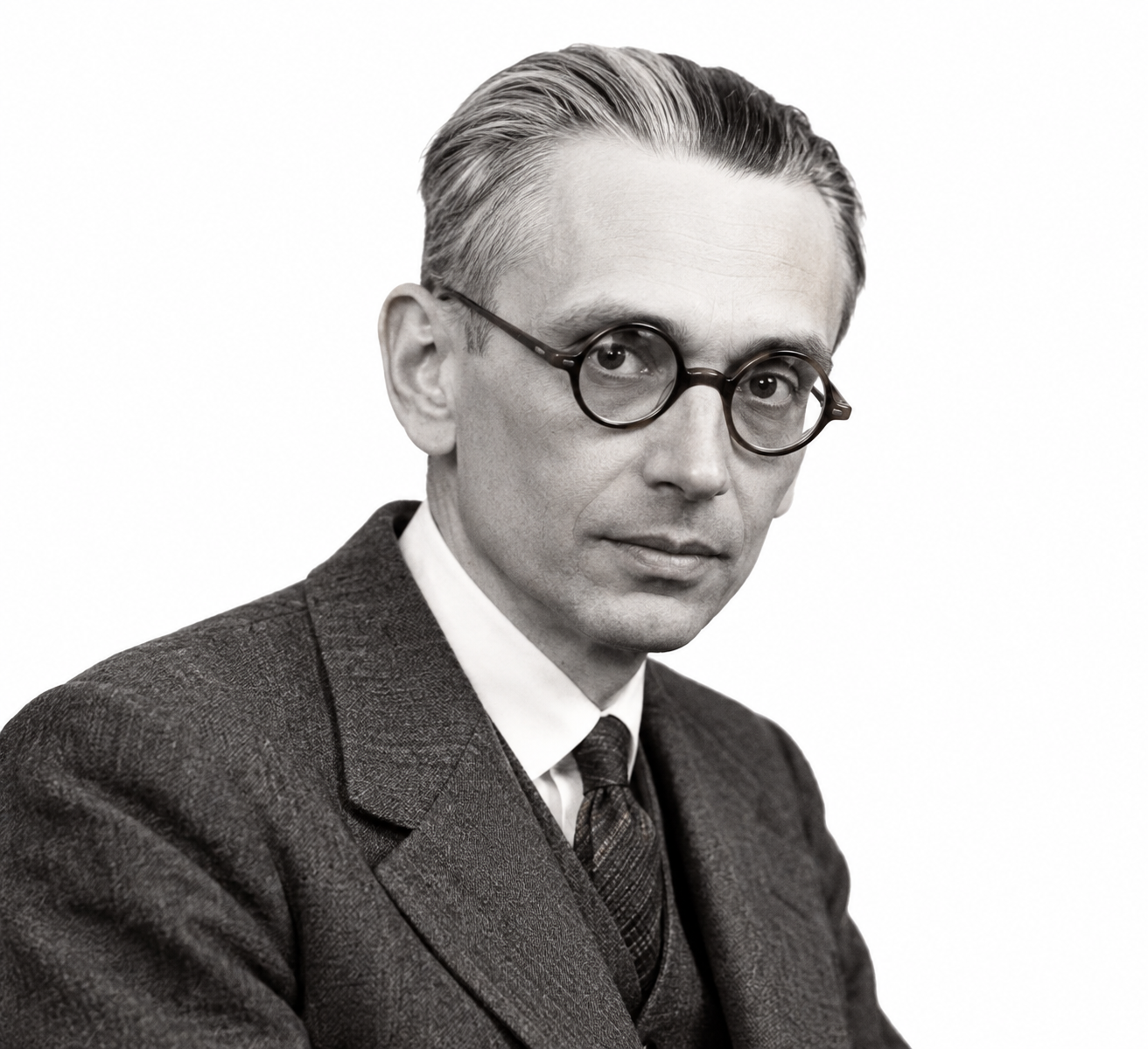
At a glance
- Born
- 1906 CE
- Died
- 1978 CE
- Era classification
- Modern
- Occupation
- Logician / Mathematician
- Homeland
- Austria-Hungary
- Period
- 20th Century
- Field
- Mathematics & Logic
- Language
- German
- Religion
- Theistic Platonism
- Gender
- male
Biography
Kurt Gödel was born in Brünn, Austria-Hungary (now Brno, Czech Republic), in 1906. He studied theoretical physics and mathematics at the University of Vienna, where he attended meetings of the logical positivist Vienna Circle, though he maintained an independent, realist philosophical outlook. In 1931, at the age of just twenty-five, Gödel published his landmark Incompleteness Theorems, which demonstrated that in any consistent formal mathematical system capable of doing basic arithmetic, there exist true statements that cannot be proven within the system itself. This profoundly shattered David Hilbert's formalist dream of establishing a complete and consistent foundation for all of mathematics.
Following the Nazi annexation of Austria (the Anschluss) in 1938 and the increasing hostility in Europe, Gödel emigrated to the United States in 1940 with his wife Adele. He took up a permanent position at the Institute for Advanced Study in Princeton, New Jersey, where he became one of the central figures of the academic community. During his years at Princeton, Gödel formed an extraordinary and intimate intellectual friendship with Albert Einstein, with whom he took daily walks and discussed foundational questions in physics, philosophy, and cosmology.
Beyond his work on incompleteness, Gödel made monumental contributions to mathematical logic and theoretical physics. He proved the relative consistency of both the Axiom of Choice and the Generalized Continuum Hypothesis with the axioms of Zermelo–Fraenkel set theory by constructing the constructible universe (L). In 1949, he discovered exact rotating solutions to Einstein's field equations of general relativity, known as the Gödel metric, which demonstrated the theoretical possibility of closed timelike curves and time travel into the past.
Throughout his adult life, Gödel suffered from severe bouts of mental instability, hypochondria, and deep paranoia. In his final years, consumed by an obsessive fear of being poisoned, he refused to eat any food unless it was prepared and tasted by his wife Adele. When she was hospitalized in late 1977 and unable to assist him, Gödel essentially starved to death, dying of malnutrition in Princeton Hospital in January 1978. He remains widely regarded as one of the greatest logicians since Aristotle.
Portrayal characteristics
Saved editorial descriptions used for the reconstruction; these are not authenticated statements by the depicted person.
- Meticulous
- Profoundly analytical
- Reclusive
- Philosophically idealistic
- Hypochondriac
Images & artwork 1
Known for
- Gödel's Incompleteness Theorems
- Completeness Theorem for first-order logic
- Constructible universe and consistency of the Continuum Hypothesis
- Gödel metric in General Relativity
- Formalization of the Ontological Proof for God's existence
Episodes featuring or mentioning this figure
No eligible published episode featuring this figure is currently in the library.