



Omar Khayyam
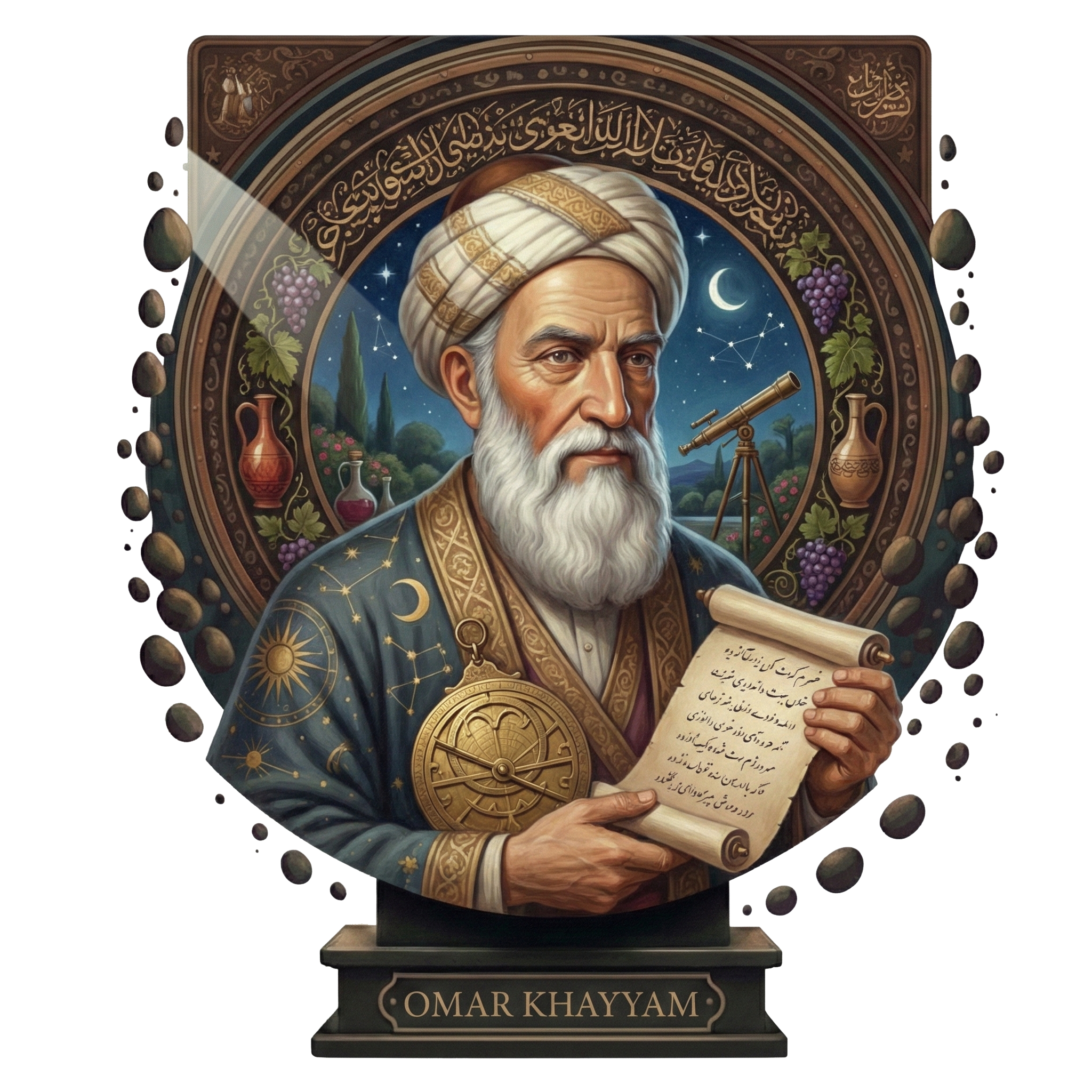
A Persian polymath, mathematician, astronomer, and poet famous for the Rubaiyat and the Jalali calendar.
At a glance
- Born
- 1048 CE
- Died
- 1131 CE
- Era classification
- 83
- Homeland
- Persia
- Period
- 1048–1131 CE
- Field
- Mathematics & Logic
- Language
- Persian
- Religion
- Islam
- Gender
- male
Biography
Born in Nishapur, Persia (modern-day Iran) in 1048 CE, Omar Khayyam grew up during the height of the Seljuk Empire. He received a comprehensive education in science, philosophy, and mathematics, eventually becoming one of the most prominent polymaths of the Islamic Golden Age. His early years were spent moving between major centers of learning, where he established his reputation as an exceptional scholar.
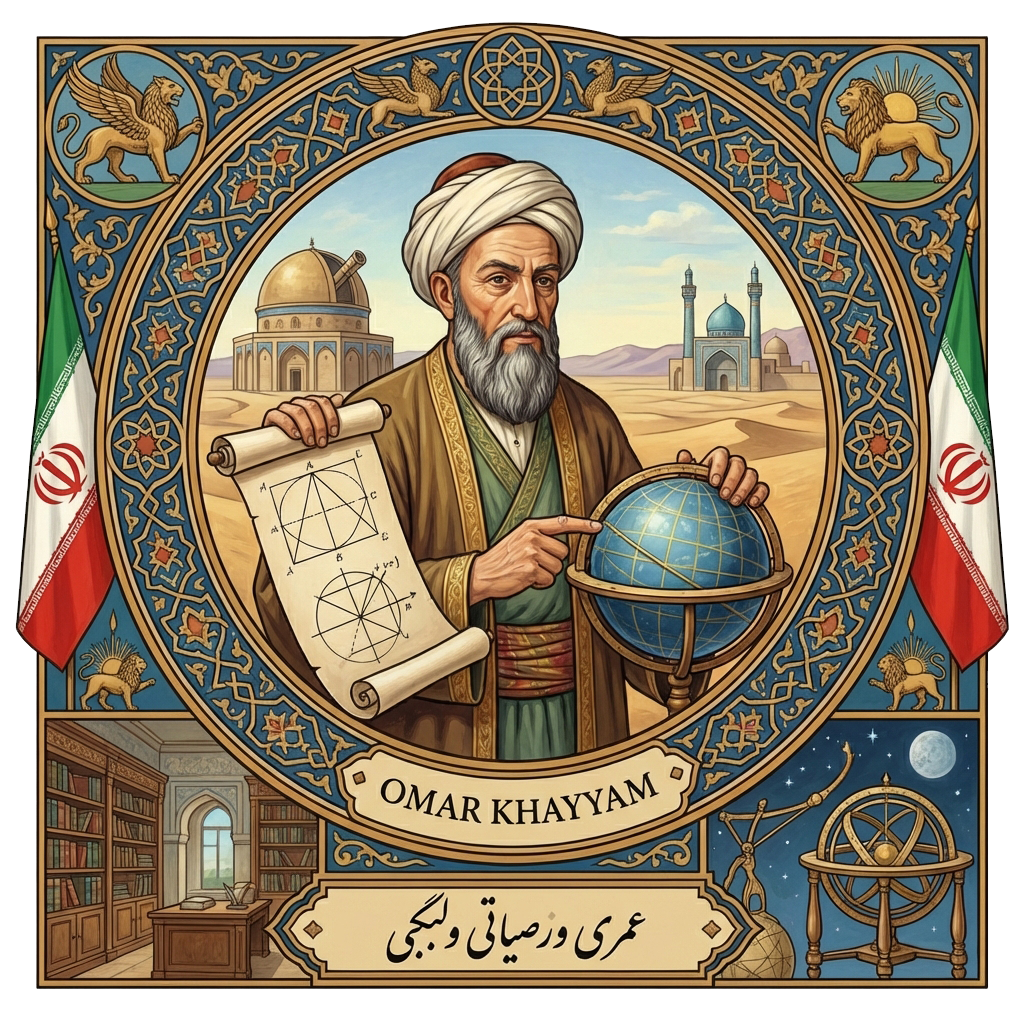
As a mathematician, Khayyam made groundbreaking advancements in algebra. He is celebrated for his 'Treatise on Demonstration of Problems of Algebra', where he provided a systematic method for solving cubic equations by intersecting conic sections. Furthermore, his critiques of Euclid's parallel postulate laid early groundwork for the later development of non-Euclidean geometry. In astronomy, he was commissioned by the Seljuk Sultan Malik-Shah I to lead an observatory in Isfahan. There, he and his team designed the Jalali calendar, a solar calendar of remarkable precision that remains the foundation of the modern Iranian calendar.
Despite his immense scientific achievements, Khayyam is most widely known in the Western world for his poetry, specifically the 'Rubaiyat'. Translated and popularized by Edward FitzGerald in the 19th century, these quatrains explore themes of existentialism, the fleeting nature of life, and the pursuit of earthly joys. His philosophical verses often reflect a deep skepticism, a rationalist approach to the mysteries of the universe, and a poignant awareness of human mortality.
Khayyam's dual legacy as a rigorous scientist and a profound poet makes him a unique figure in global intellectual history. He died in his hometown of Nishapur in 1131 CE, leaving behind a body of work that seamlessly bridged empirical science and the literary arts. His tomb in Nishapur remains a monument to a mind that sought to measure the stars while contemplating the profound fragility of human existence.
Portrayal characteristics
Saved editorial descriptions used for the reconstruction; these are not authenticated statements by the depicted person.
- Analytical
- Philosophical
- Skeptical
- Creative
- Rationalist
- Observant
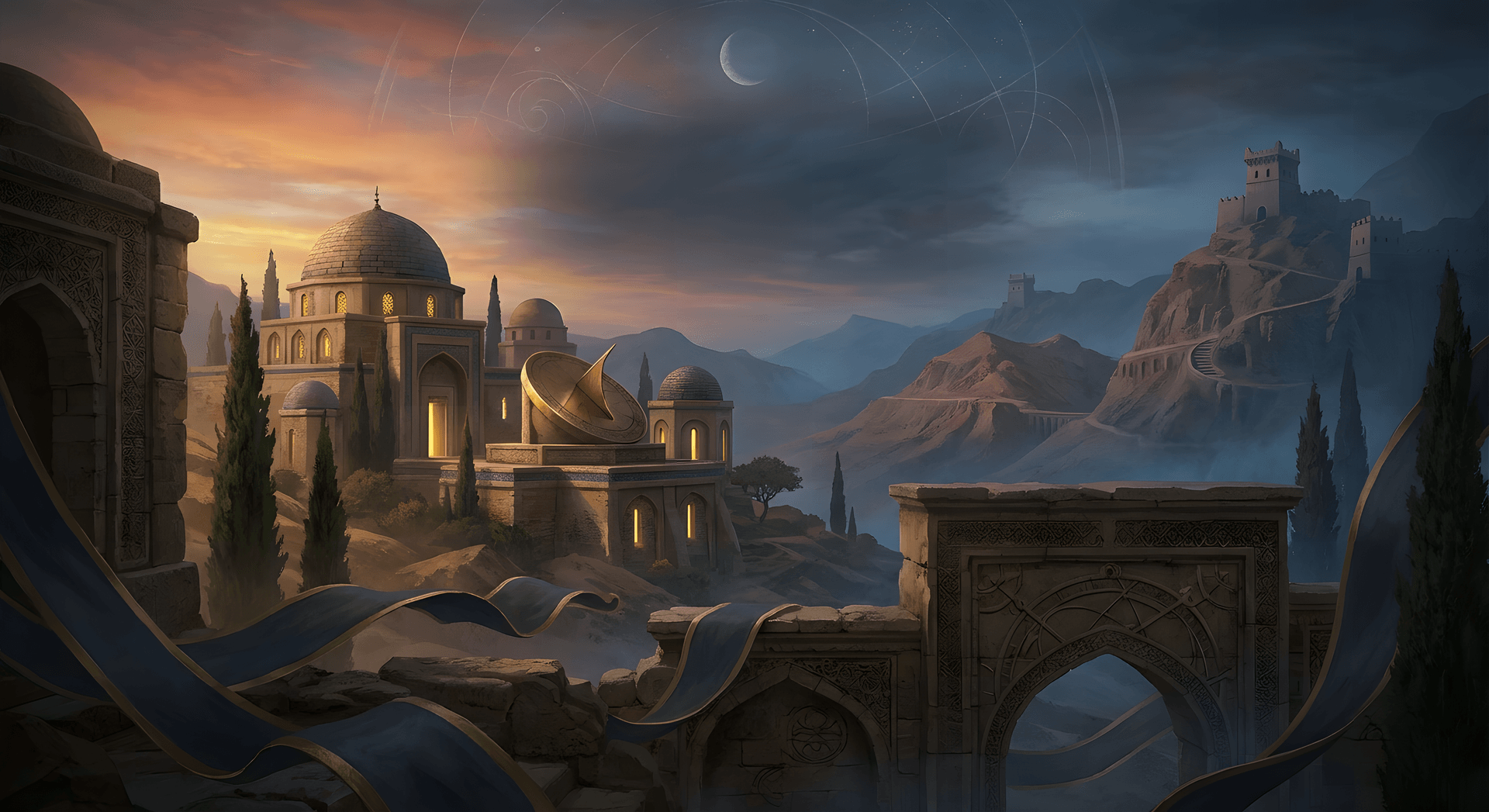
Images & artwork 5
Connections
Abu Ali Sina (Avicenna)
Philosophical Master
Omar Khayyam deeply revered Avicenna as his philosophical master and intellectual predecessor.
Khayyam studied Avicenna's works extensively and frequently defended his philosophical views against orthodox critics. According to historical accounts, Khayyam was reading Avicenna's 'Book of Healing' on his deathbed. This demonstrates his lifelong devotion to Avicenna's rationalist philosophy and scientific methodology.
Al-Khwarizmi
Intellectual Successor
Khayyam expanded upon the algebraic foundations laid by Al-Khwarizmi, particularly in the classification of equations.
While Al-Khwarizmi focused on linear and quadratic equations, Omar Khayyam took the next major step by providing a systematic method for solving cubic equations using the intersection of conic sections, building directly on the algebraic language Al-Khwarizmi created.
Nizam al-Mulk
Patron & Scholar
Nizam al-Mulk was the powerful Seljuk vizier who served as Khayyam's primary political patron.
Nizam al-Mulk invited Khayyam to Isfahan to lead the reform of the Persian calendar and provided him with the funding and protection necessary to build a major astronomical observatory.
Nasir al-Din al-Tusi
Influenced
Tusi was a later polymath who built upon Khayyam's pioneering work in mathematics and astronomy.
Tusi's work on the parallel postulate and his developments in trigonometry were deeply influenced by Khayyam's earlier critiques of Euclid's 'Elements' and his methods for solving cubic equations.
Abu Ali Sina (Avicenna)
Philosophical Successor
Khayyam considered himself a spiritual and intellectual student of Avicenna's Peripatetic philosophy.
In his philosophical writings, Khayyam explicitly referred to Avicenna as his 'teacher,' and he spent much of his career defending and refining Avicenna's metaphysical theories against theological critics.
Nasir al-Din al-Tusi
Scientific Successor
Tusi built upon the mathematical and astronomical foundations established by Omar Khayyam.
Tusi utilized Khayyam's work on the extraction of roots and the Jalali calendar. At the Maragheh Observatory, Tusi refined the planetary models and mathematical proofs that Khayyam had explored a century earlier.
Nizam al-Mulk
Patron & Scientist
Nizam al-Mulk was the primary political patron of Omar Khayyam, facilitating his scientific and mathematical work.
As the Grand Vizier of the Seljuk Empire, Nizam al-Mulk provided Khayyam with a substantial stipend and the resources to lead the astronomical observatory in Isfahan. This partnership allowed Khayyam to develop the Jalali calendar and conduct groundbreaking research in algebra and geometry.
Mohammad Reza Pahlavi
Cultural Heritage & State Patronage
The Pahlavi regime celebrated the legacy of the poet and mathematician Omar Khayyam, commissioning a modernist mausoleum for him to promote a secular, culturally rich Iranian national identity.
Mohammad Reza Pahlavi's cultural policies were heavily focused on reviving and monumentalizing Iran's pre-Islamic and classical Persian heritage to foster a secular national identity. The 11th-century polymath and poet Omar Khayyam, famous globally for his Rubaiyat, was a central figure in this cultural campaign. Khayyam's reputation as a rationalist, astronomer, and poet who often expressed skepticism toward orthodox religious dogma made him an ideal historical symbol for the Shah's secularizing, modernizing state. In the early 1960s, the Pahlavi government commissioned the prominent Iranian architect Houshang Seyhoun to design a striking, modernist mausoleum for Khayyam in his hometown of Nishapur. The construction of this monument was part of a broader initiative by the Shah and Empress Farah to elevate Iranian arts and sciences, using the genius of historical figures like Khayyam to legitimize the regime's progressive, Western-facing vision for Iran's future.
Known for
- The Rubaiyat of Omar Khayyam
- Creation of the Jalali calendar
- Geometric solutions to cubic equations
- Treatise on Demonstration of Problems of Algebra
- Early contributions to non-Euclidean geometry
Episodes featuring or mentioning this figure
No eligible published episode featuring this figure is currently in the library.