



Nizam al-Mulk
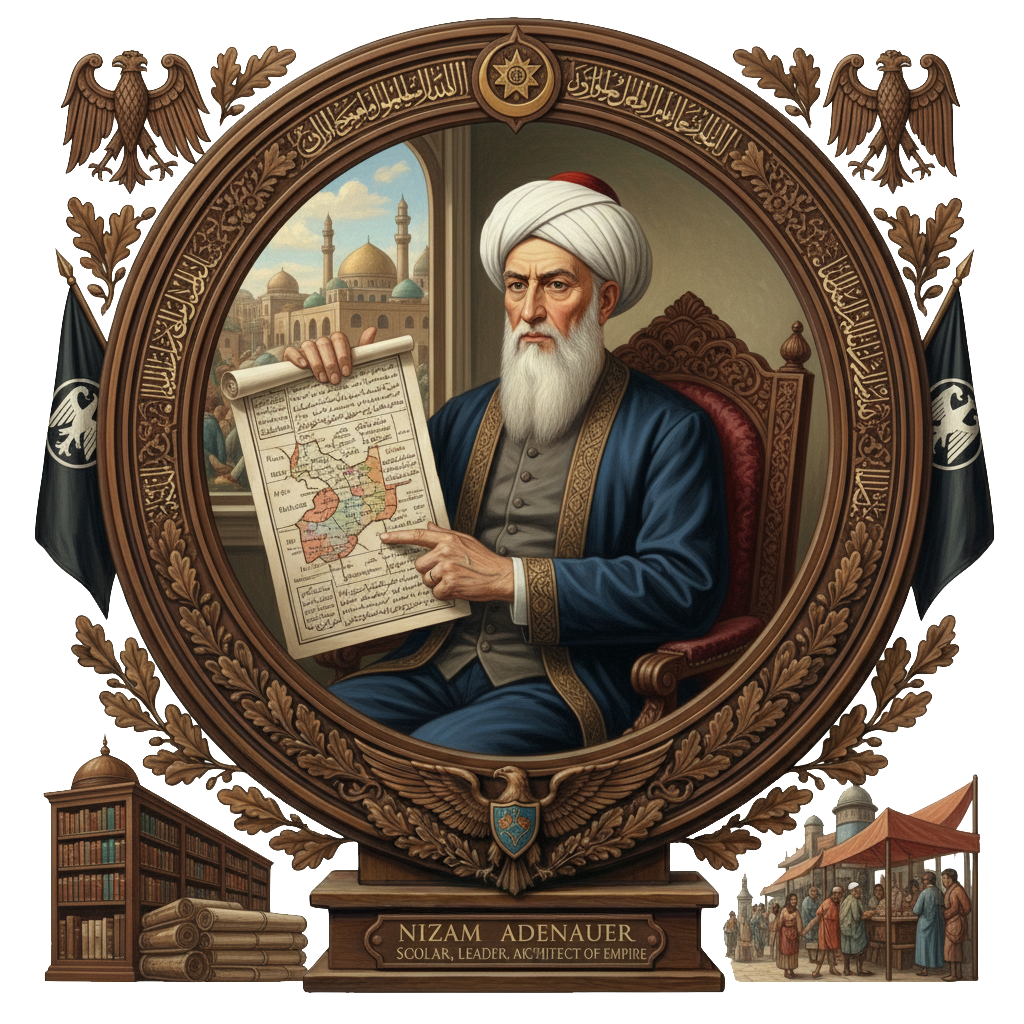
A brilliant Persian scholar and vizier of the Seljuk Empire, famous for establishing the Nizamiyya madrasas.
At a glance
- Born
- 1018 CE
- Died
- 1092 CE
- Era classification
- Medieval
- Homeland
- Seljuk Empire
- Period
- Seljuk Era
- Field
- Politics & Leadership
- Language
- Farsi
- Religion
- Islam (Sunni)
- Gender
- male
Biography
Abu Ali Hasan ibn Ali Tusi, universally known by his honorific Nizam al-Mulk (Order of the Realm), was one of the most capable and influential statesmen in Islamic history. Born in Tus in the Khorasan region, he rose through the administrative ranks to become the grand vizier of the Seljuk Empire, serving under the sultans Alp Arslan and Malik-Shah I. For nearly thirty years, Nizam al-Mulk was the de facto ruler of the empire, guiding it to its greatest territorial and cultural zenith.
As an administrator, he was unparalleled. He established a network of higher education institutions across the Islamic world known as the Nizamiyya madrasas, the most famous being in Baghdad. These institutions standardized Sunni Islamic theology and law, and attracted the greatest scholars of the age, including Al-Ghazali. Nizam al-Mulk also authored the 'Siyasatnama' (The Book of Government), a seminal Persian treatise on statecraft, justice, and the duties of a ruler, which remains a classic of political philosophy.
Despite his immense power and contributions to the stability of the empire, Nizam al-Mulk made formidable enemies. He was a staunch opponent of the Ismaili order, known as the Assassins, led by Hassan-i Sabbah. In 1092, while traveling with the court, Nizam al-Mulk was assassinated by a dervish who was secretly a member of the Assassins. His death marked the beginning of the decline of the Great Seljuk Empire.
Portrayal characteristics
Saved editorial descriptions used for the reconstruction; these are not authenticated statements by the depicted person.
- Strategic
- Scholarly
- Authoritative
- Institutionalist
- Astute
Images & artwork 3
Connections
Amir Kabir
Historical Comparison
Both are regarded as the most significant and reform-minded grand viziers in the history of the Iranian state.
Historians frequently compare Amir Kabir's 19th-century administrative reforms and the founding of the Dar al-Funun to the institutional stability and educational patronage provided by Nizam al-Mulk in the 11th century.
Omar Khayyam
Patron & Scholar
Nizam al-Mulk was the powerful Seljuk vizier who served as Khayyam's primary political patron.
Nizam al-Mulk invited Khayyam to Isfahan to lead the reform of the Persian calendar and provided him with the funding and protection necessary to build a major astronomical observatory.
Omar Khayyam
Patron & Scientist
Nizam al-Mulk was the primary political patron of Omar Khayyam, facilitating his scientific and mathematical work.
As the Grand Vizier of the Seljuk Empire, Nizam al-Mulk provided Khayyam with a substantial stipend and the resources to lead the astronomical observatory in Isfahan. This partnership allowed Khayyam to develop the Jalali calendar and conduct groundbreaking research in algebra and geometry.
Known for
- Writing the Siyasatnama
- Founding the Nizamiyya schools
- De facto ruler of the Seljuk Empire
- Patronage of Al-Ghazali
Episodes featuring or mentioning this figure
No eligible published episode featuring this figure is currently in the library.