



Aryabhata
A pioneering ancient Indian mathematician and astronomer who made significant contributions to trigonometry and algebra.

At a glance
- Born
- 476 CE
- Died
- 550 CE
- Era classification
- Ancient
- Homeland
- Gupta Empire (India)
- Period
- 5th-6th Century CE
- Field
- Mathematics & Logic
- Language
- Sanskrit
- Religion
- Hinduism
- Gender
- male
Biography
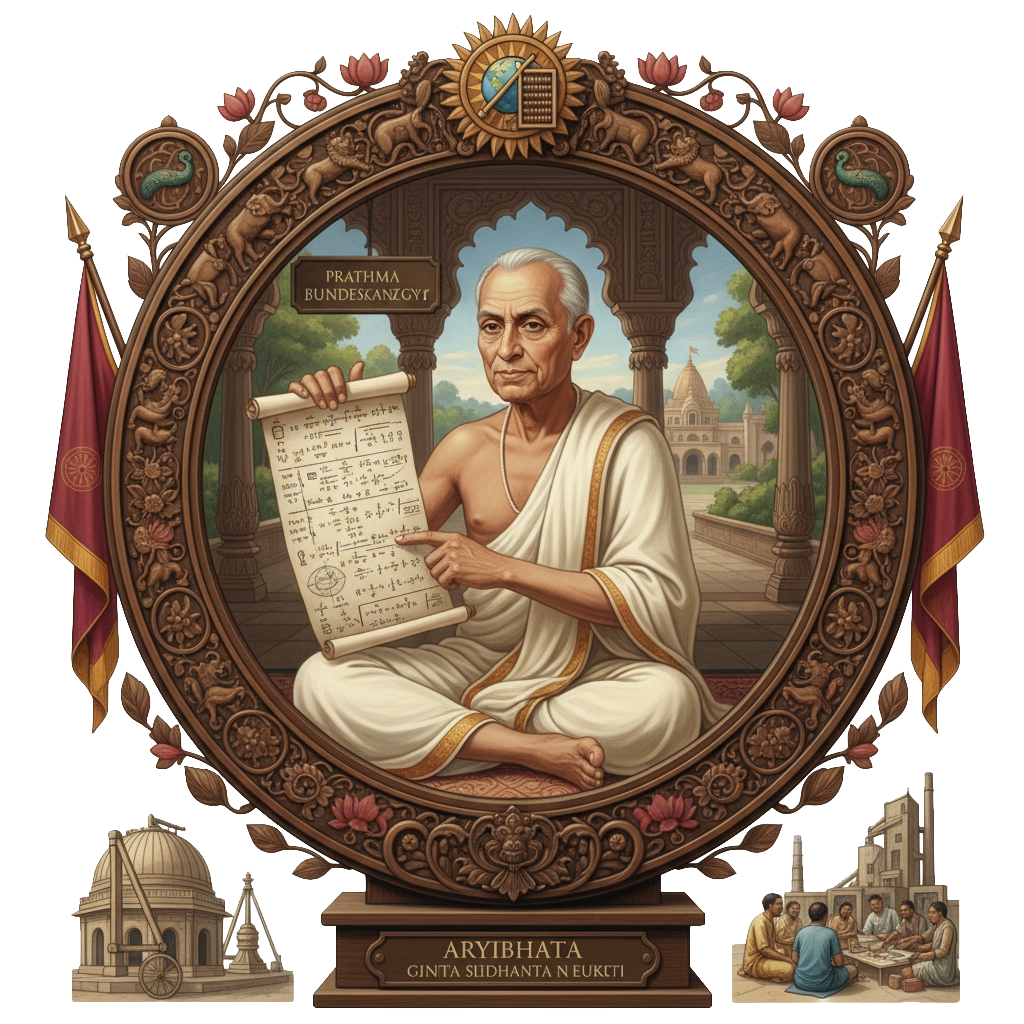
Aryabhata was the first of the major mathematician-astronomers from the classical age of Indian mathematics and Indian astronomy. Born in Kusumapura (modern Patna), he flourished during the Gupta Empire, a period often referred to as the Golden Age of India. His most famous work, the Aryabhatiya, is a compendium of mathematics and astronomy that profoundly influenced subsequent scholars in India and the Islamic world.
In mathematics, Aryabhata made groundbreaking discoveries. He provided an approximation of pi (π) that was remarkably accurate for his time and formulated the rules for calculating the areas of triangles and circles. He is also credited with early concepts of sine and cosine in trigonometry, and he utilized a place-value system that laid the groundwork for the modern decimal system, even incorporating a placeholder concept akin to zero.
His astronomical contributions were equally revolutionary. Aryabhata correctly asserted that the Earth rotates on its axis daily, explaining the apparent movement of the stars. He also provided scientific explanations for solar and lunar eclipses, rejecting the prevailing mythological beliefs, and accurately calculated the length of the sidereal year.
Portrayal characteristics
Saved editorial descriptions used for the reconstruction; these are not authenticated statements by the depicted person.
- Analytical
- Innovative
- Logical
- Observant
- Pioneering
Images & artwork 4


Connections
Al-Khwarizmi
Influenced By
Al-Khwarizmi's introduction of the decimal system was heavily influenced by the work of Indian mathematicians like Aryabhata.
Al-Khwarizmi's 'On the Calculation with Hindu Numerals' was instrumental in transmitting the Indian positional number system to the Islamic world and later to Europe. This transmission relied on the mathematical foundations laid by Aryabhata and his successors in the Gupta Empire.
Al-Khwarizmi
Mathematical Influence
Aryabhata's work on the decimal system and trigonometry was a primary source for the Islamic Golden Age mathematicians.
Aryabhata's 'Aryabhatiya' introduced the concept of the sine function and the place-value system. These Indian mathematical advancements were translated into Arabic and became the foundation for Al-Khwarizmi's development of algebra and the global adoption of Hindu-Arabic numerals.
Srinivasa Ramanujan
Mathematical Predecessor
Both are iconic figures in the history of Indian mathematics, representing the pinnacle of the field in their respective eras.
Ramanujan's work in number theory and infinite series is often seen as a modern continuation of the mathematical tradition in India that began with pioneers like Aryabhata.
Known for
- Aryabhatiya
- Approximation of Pi
- Heliocentric concepts
- Trigonometric functions
Episodes featuring or mentioning this figure
No eligible published episode featuring this figure is currently in the library.