



Carl Friedrich Gauss
A brilliant German mathematician and physicist widely celebrated as the "Prince of Mathematicians."
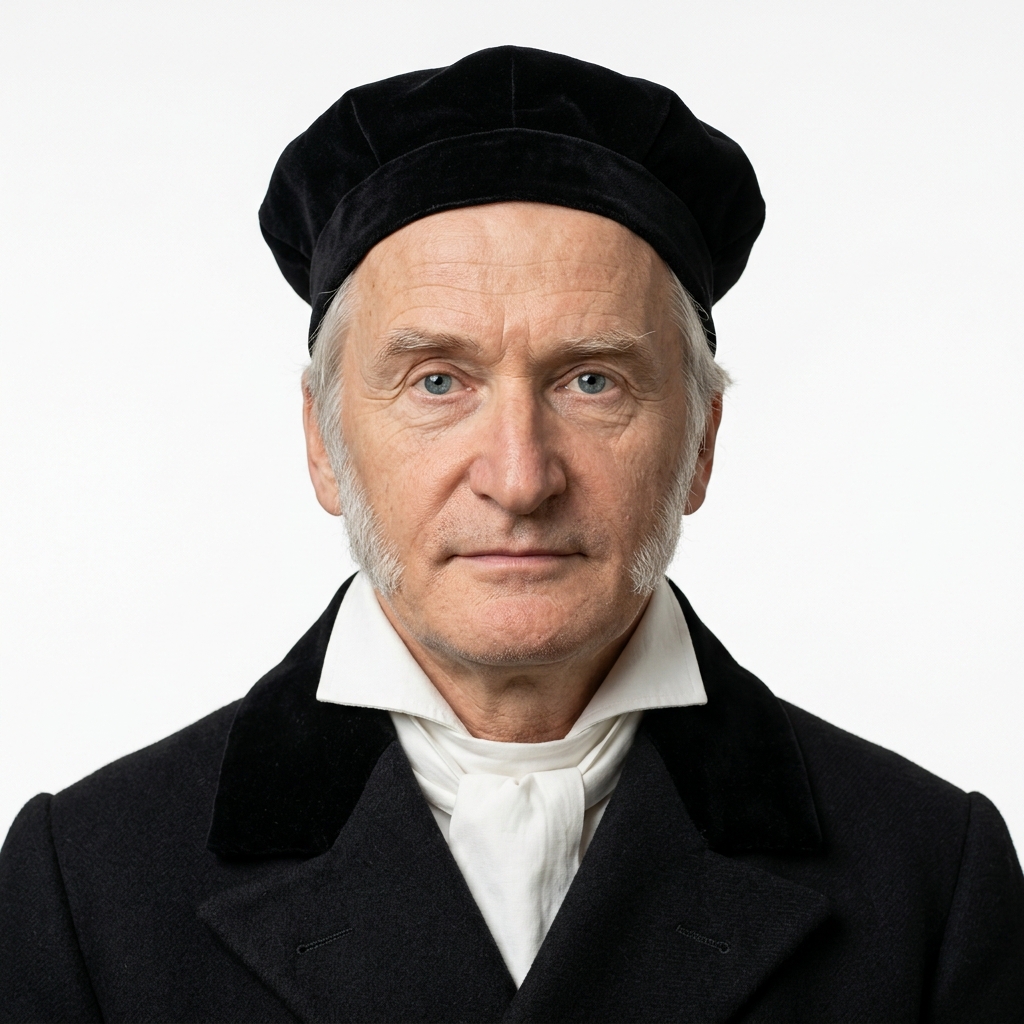
At a glance
- Born
- 1777 CE
- Died
- 1855 CE
- Era classification
- 77
- Homeland
- Germany
- Period
- 1777–1855
- Field
- Mathematics & Logic
- Language
- German
- Religion
- Lutheran
- Gender
- male
Biography
Carl Friedrich Gauss, born in 1777 in Brunswick, Germany, was a child prodigy whose astonishing intellect became apparent at an early age. Supported by the Duke of Brunswick, Gauss attended the Collegium Carolinum and later the University of Göttingen. In 1796, at just 19 years old, he made his first major breakthrough by proving that a regular 17-sided polygon (heptadecagon) could be constructed using only a compass and straightedge, a problem that had baffled mathematicians since antiquity.
In 1801, Gauss published his magnum opus, 'Disquisitiones Arithmeticae', a foundational text that systematized number theory and introduced the symbol for congruence. That same year, he gained international fame by accurately predicting the orbit of the dwarf planet Ceres. He achieved this by developing the method of least squares, a statistical technique still widely used today to minimize errors in data measurement.
Beyond pure mathematics, Gauss made profound contributions to physics, astronomy, and geodesy. Appointed director of the Göttingen Observatory in 1807, he spent decades studying celestial mechanics and the Earth's shape. Collaborating with physicist Wilhelm Weber in the 1830s, Gauss conducted pioneering research in magnetism and electricity, leading to the invention of the first electromechanical telegraph and the establishment of a worldwide network of magnetic observatories.
Known for his personal motto 'pauca sed matura' (few, but ripe), Gauss was a strict perfectionist who refused to publish any work he deemed incomplete. Consequently, many of his groundbreaking discoveries, such as his early realization of non-Euclidean geometry, were only found in his private diaries after his death in 1855. His unparalleled legacy endures across nearly every branch of mathematics and theoretical physics.
Portrayal characteristics
Saved editorial descriptions used for the reconstruction; these are not authenticated statements by the depicted person.
- Perfectionist
- Analytical
- Prodigious
- Rigorous
- Reserved
Images & artwork 5



Connections
Isaac Newton
Influenced By
Gauss considered Newton the greatest mathematician and built extensively upon his work.
Gauss frequently referred to Newton as 'Summus' (the greatest) and modeled his rigorous mathematical style after Newton's 'Principia.' His work in celestial mechanics, particularly the calculation of the orbit of Ceres, was a direct evolution of Newtonian physics.
Johann Wolfgang von Goethe
Contemporary Acquaintances
The two giants of German intellectual life met and corresponded on scientific matters.
Goethe, who had a deep interest in the theory of colors and natural science, sought Gauss's opinion on scientific topics. While Gauss was often reclusive, he respected Goethe's cultural stature, representing the pinnacle of the German Romantic and Scientific eras respectively.
Napoleon Bonaparte
Political Opponents
Napoleon's military campaigns significantly disrupted Gauss's life and work in Göttingen.
The French occupation of Germany led to the death of Gauss's patron, the Duke of Brunswick, and forced Gauss to pay a massive war tax. Despite the conflict, French mathematicians under Napoleon's rule, such as Laplace, intervened to ensure Gauss's safety and financial stability due to his scientific genius.
Known for
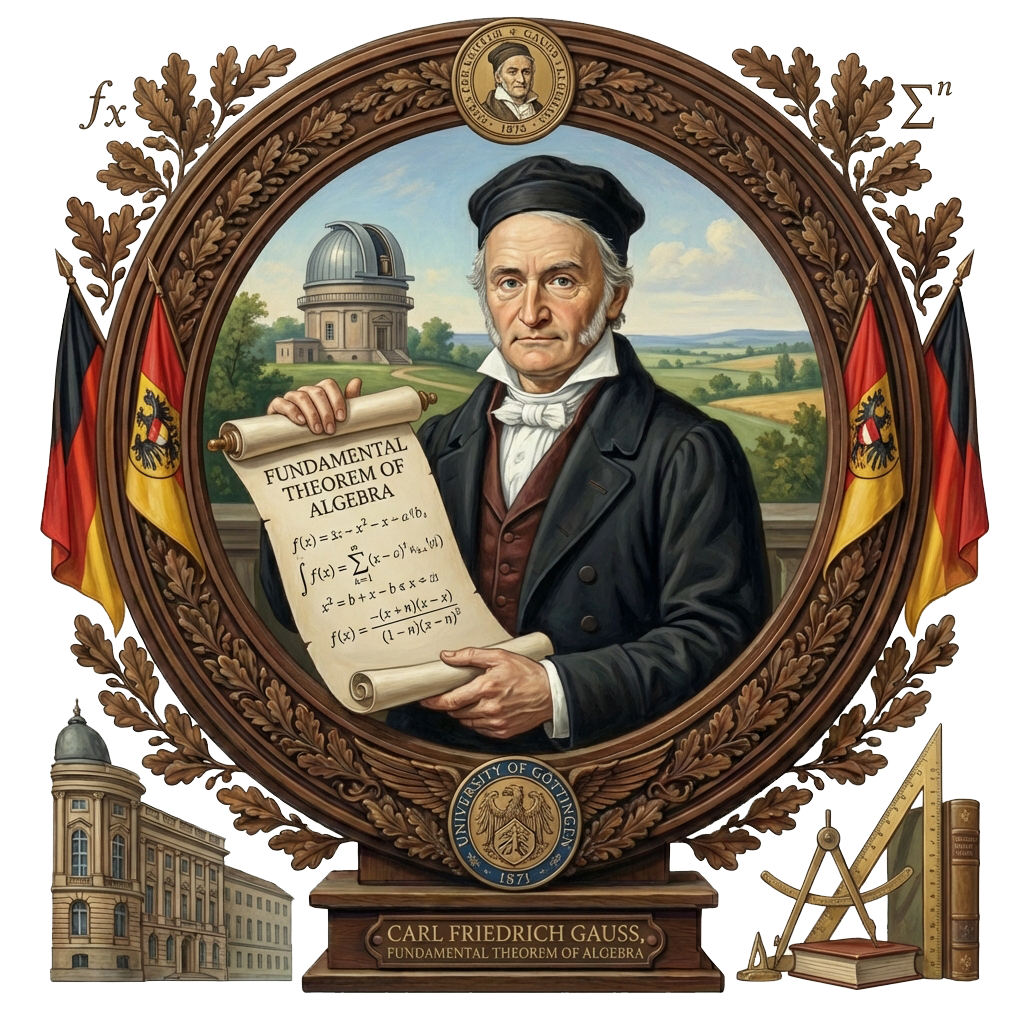
- Fundamental Theorem of Algebra
- Disquisitiones Arithmeticae
- Method of least squares
- Gaussian distribution (Bell curve)
- Contributions to non-Euclidean geometry
- Invention of the heliotrope
Episodes featuring or mentioning this figure
No eligible published episode featuring this figure is currently in the library.