



Johann Wolfgang von Goethe
A German poet, playwright, and polymath who is widely regarded as the greatest writer in the German language.
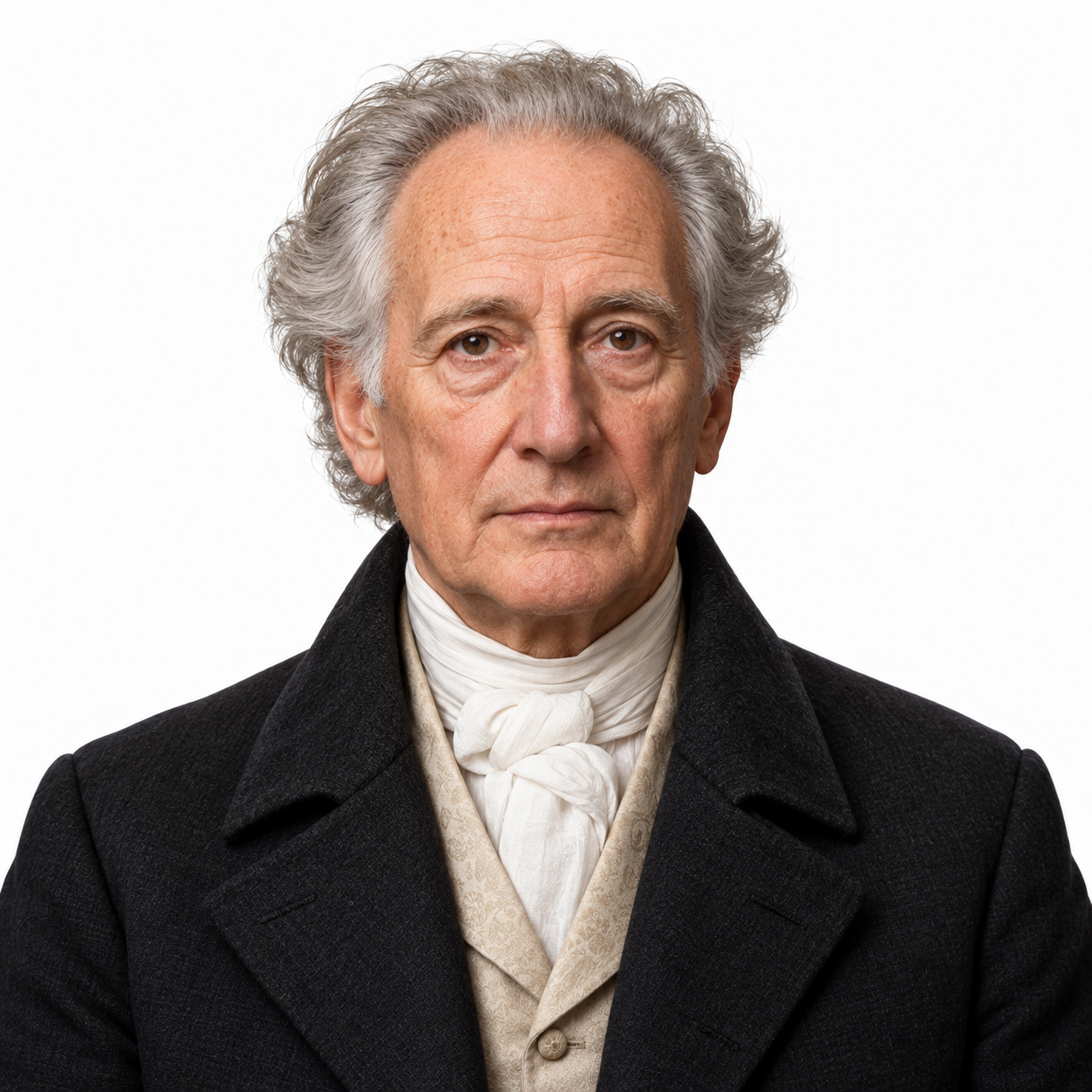
At a glance
- Born
- 1749 CE
- Died
- 1832 CE
- Era classification
- Modern
- Homeland
- Germany
- Period
- Late 18th - Early 19th Century
- Field
- Poetry, Art & Ethics
- Language
- German
- Religion
- Pantheist
- Gender
- male
Biography
Johann Wolfgang von Goethe was a German poet, playwright, novelist, scientist, and statesman. Born in Frankfurt to a wealthy bourgeois family, he studied law in Leipzig and Strasbourg. However, his true passion lay in literature and the arts. He became the leading figure of the Sturm und Drang (Storm and Stress) literary movement, which emphasized individual subjectivity and extreme emotion.
Goethe achieved early fame with his 1774 novel "The Sorrows of Young Werther," which captured the zeitgeist of European youth and made him an international literary celebrity. He later settled in Weimar, where he served in various administrative roles for the Duke of Saxe-Weimar. During this time, he broadened his interests to include natural sciences, publishing works on botany and color theory.
His magnum opus is the two-part tragic play "Faust," considered one of the greatest works of world literature. "Faust" explores themes of human ambition, knowledge, and redemption, reflecting Goethe's own vast intellectual curiosity. His profound influence on German culture is immeasurable, and his works have inspired countless composers, philosophers, and writers across the globe.
Portrayal characteristics
Saved editorial descriptions used for the reconstruction; these are not authenticated statements by the depicted person.
- Polymathic
- Creative
- Philosophical
- Romantic
- Observant
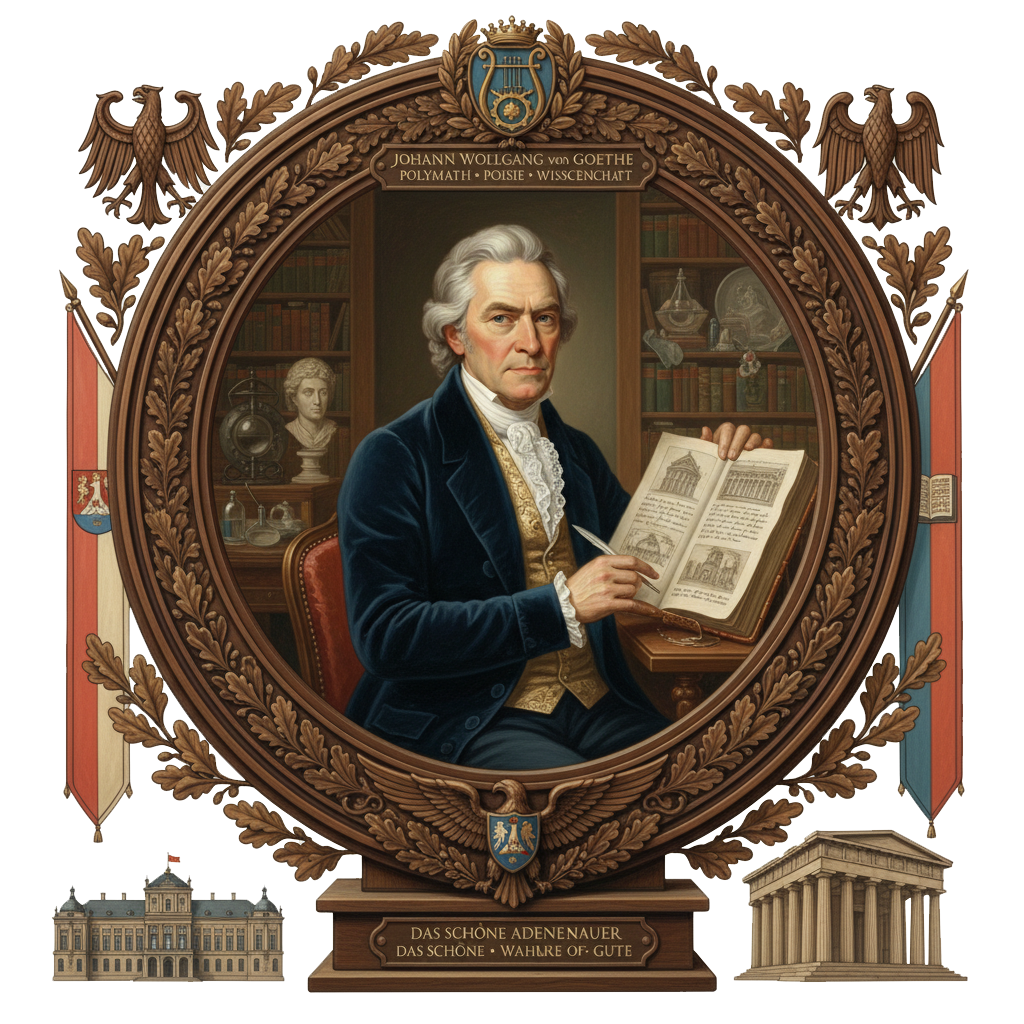
Images & artwork 4


Connections
Carl Friedrich Gauss
Contemporary Acquaintances
The two giants of German intellectual life met and corresponded on scientific matters.
Goethe, who had a deep interest in the theory of colors and natural science, sought Gauss's opinion on scientific topics. While Gauss was often reclusive, he respected Goethe's cultural stature, representing the pinnacle of the German Romantic and Scientific eras respectively.
Friedrich Nietzsche
Intellectual Idol
Nietzsche deeply admired Goethe as a model of the 'total human being' and a precursor to the Übermensch.
Nietzsche regarded Goethe as a man who overcame his own internal contradictions to achieve a state of 'Dionysian' affirmation. He frequently cited Goethe as one of the few Germans who possessed the greatness of spirit he advocated for.
Hafez
Literary Influence
Goethe was deeply inspired by Hafez's poetry, leading him to write the 'West-Eastern Diwan' as a tribute.
In the early 19th century, Goethe encountered a translation of Hafez's Divan. This encounter profoundly shifted Goethe's poetic style, as he sought to bridge Western and Eastern literary traditions through his own lyrical responses to Hafez's mystical and romantic themes.
Johann Sebastian Bach
Legacy & Appreciation
Goethe was a significant admirer of Bach's music, describing it as 'eternal harmony conversing with itself.'
Although they were not contemporaries, Goethe's late-life discovery of Bach's keyboard works through his friend Carl Friedrich Zelter led to a profound spiritual and intellectual appreciation of Bach's mathematical and musical genius.
Ludwig van Beethoven
Contemporary Admirers
Goethe and Beethoven met in 1812, though they had a complex relationship due to their differing temperaments.
Beethoven deeply admired Goethe's poetry and set several of his works to music, most notably the 'Egmont' overture. While they respected each other's genius, Goethe found Beethoven's personality 'untamed,' while Beethoven found Goethe too courtly.
Napoleon Bonaparte
Historical Meeting
Napoleon Bonaparte met Goethe in 1808 during the Congress of Erfurt and expressed his great admiration for Goethe's work.
Napoleon, an avid reader of 'The Sorrows of Young Werther,' famously remarked 'Vous êtes un homme' (You are a man) upon meeting the poet, and the two discussed literature and politics.
Immanuel Kant
Philosophical Influence
Goethe was significantly influenced by Kant's 'Critique of Judgment,' which helped him reconcile his scientific and poetic views of nature.
Goethe studied Kant's work extensively, finding in Kant's teleological view of nature a philosophical framework that supported his own morphological studies and his belief in the organic unity of the world.
Baruch Spinoza
Philosophical Influence
Goethe was a lifelong devotee of Spinoza's philosophy, particularly his pantheistic view of God and nature.
Goethe claimed that Spinoza's 'Ethics' provided him with a sense of peace and a way to view the divine as immanent within the natural world, a concept that permeated his poetry and scientific writings.
Voltaire
Literary Influence
Goethe was deeply engaged with the works of Voltaire, translating some of his plays and critiquing his Enlightenment rationalism.
While Goethe admired Voltaire's wit and influence on European culture, he also sought to move beyond Voltaire's strict rationalism toward the more emotional and organic perspectives of the Sturm und Drang and Weimar Classicism movements.
Ludwig van Beethoven
Contemporary Admirers
Beethoven and Goethe met in 1812 and held a complex mutual respect for each other's genius, despite personality clashes.
Beethoven set several of Goethe's poems to music, including the 'Egmont' overture, and deeply admired Goethe's intellect. However, during their meeting in Teplitz, Goethe found Beethoven's personality 'untamed,' while Beethoven found Goethe too deferential to the aristocracy.
Napoleon Bonaparte
Mutual Admirers
Napoleon and Goethe met in 1808, expressing mutual respect for each other's genius.
During the Congress of Erfurt, Napoleon famously told Goethe, 'Vous êtes un homme' (You are a man). Napoleon had read Goethe's 'The Sorrows of Young Werther' seven times and discussed literature extensively with the German poet.
Known for
- Faust
- The Sorrows of Young Werther
- Theory of Colours
- Weimar Classicism
Episodes featuring or mentioning this figure
No eligible published episode featuring this figure is currently in the library.