



Friedrich Nietzsche
A profound German philosopher whose radical critiques of morality and religion shaped modern existentialism.
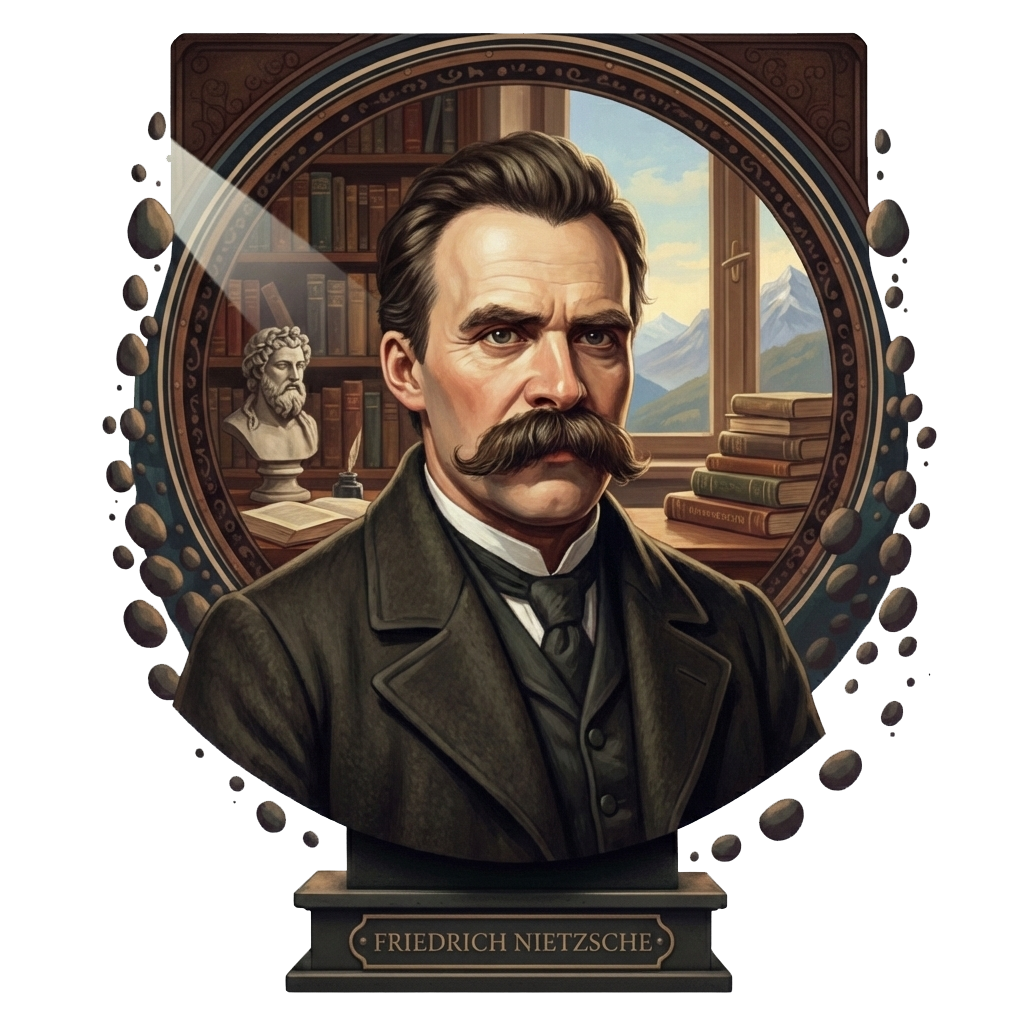
At a glance
- Born
- 1844 CE
- Died
- 1900 CE
- Era classification
- 55
- Homeland
- Germany
- Period
- 1844–1900
- Field
- Philosophy & Ideology
- Language
- German
- Religion
- Atheist
- Gender
- male
Biography
Friedrich Wilhelm Nietzsche was born in 1844 in Röcken, Prussia, into a family of Lutheran ministers. A brilliant student with a deep passion for literature and music, he achieved extraordinary early academic success. At just 24 years old, he became the youngest individual to hold the Chair of Classical Philology at the University of Basel. During this period, he was heavily influenced by the pessimistic philosophy of Arthur Schopenhauer and formed a close, though ultimately fractured, friendship with the composer Richard Wagner.
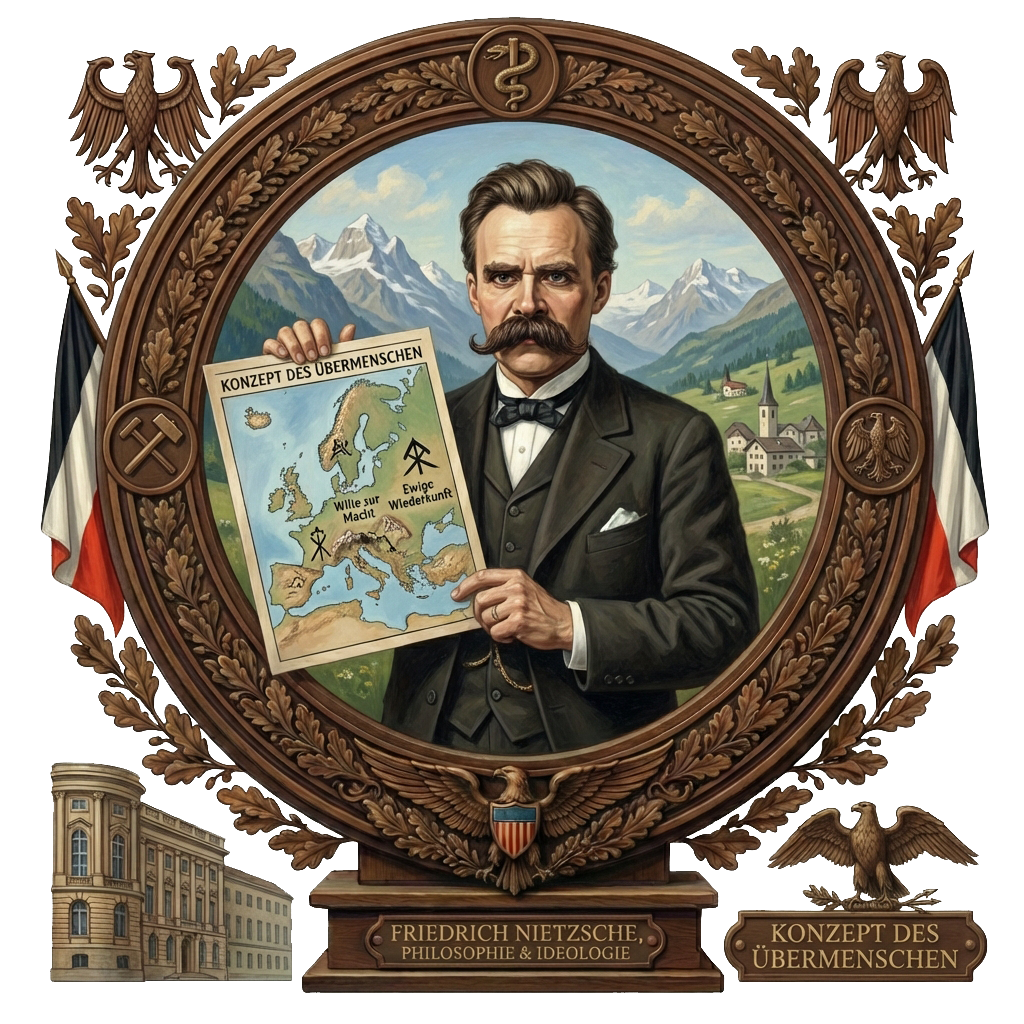
Plagued by severe migraines and deteriorating health, Nietzsche resigned from his academic post in 1879. Over the next decade, he lived a nomadic and solitary existence across Switzerland, France, and Italy, producing his most influential philosophical works. Books such as 'Thus Spoke Zarathustra', 'Beyond Good and Evil', and 'On the Genealogy of Morality' introduced revolutionary concepts like the 'Übermensch' (Overman), the 'will to power', and the 'eternal recurrence'. He famously declared that 'God is dead', critiquing the collapse of traditional religious frameworks and warning of the impending crisis of nihilism.
In 1889, at the age of 44, Nietzsche suffered a sudden and complete mental collapse in Turin, Italy, from which he never recovered. He spent the final eleven years of his life under the care of his mother and his sister, Elisabeth Förster-Nietzsche. Elisabeth controversially edited and manipulated his unpublished manuscripts to align with German nationalist and anti-Semitic ideologies—views Nietzsche himself had fiercely opposed. Following his death in 1900, his genuine ideas were reclaimed by later scholars, profoundly shaping existentialism, postmodernism, and 20th-century literature and psychology.
Portrayal characteristics
Saved editorial descriptions used for the reconstruction; these are not authenticated statements by the depicted person.
- Iconoclastic
- Provocative
- Solitary
- Visionary
- Passionate
- Analytical
Images & artwork 4
Connections
Fyodor Dostoevsky
Intellectual Influence
Nietzsche discovered Dostoevsky's work late in life and considered him a kindred psychological spirit.
Nietzsche famously called Dostoevsky 'the only psychologist from whom I had something to learn.' He found in Dostoevsky's 'Notes from Underground' and 'The Idiot' a profound exploration of nihilism and human suffering that mirrored his own philosophical inquiries.
Immanuel Kant
Philosophical Antagonists
Nietzsche's philosophy served as a radical critique of Kant's moral and metaphysical systems.
Nietzsche rejected Kant's 'categorical imperative' and the concept of the 'thing-in-itself,' viewing them as veiled attempts to preserve Christian morality through reason. He sought to dismantle the 'back-worlds' of Kantian metaphysics in favor of life-affirmation.
Socrates
Philosophical Rival
Nietzsche viewed Socrates as the figure responsible for the decline of Greek tragic culture.
In 'The Birth of Tragedy,' Nietzsche argued that Socratic rationalism destroyed the vital Dionysian element of art. He saw Socrates as the 'corrupter' who replaced instinct and myth with a sterile, logic-driven morality.
Johann Wolfgang von Goethe
Intellectual Idol
Nietzsche deeply admired Goethe as a model of the 'total human being' and a precursor to the Übermensch.
Nietzsche regarded Goethe as a man who overcame his own internal contradictions to achieve a state of 'Dionysian' affirmation. He frequently cited Goethe as one of the few Germans who possessed the greatness of spirit he advocated for.
Fyodor Dostoevsky
Posthumous Influence
Dostoevsky's psychological insights and exploration of nihilism deeply influenced Nietzsche's philosophy.
Although they never corresponded, Nietzsche's discovery of Dostoevsky's writing provided him with a 'psychological' validation of his own theories on the death of God. Dostoevsky's characters, such as Raskolnikov and Kirillov, served as case studies for Nietzsche's concepts of the will to power and nihilism.
Known for
- Concept of the Übermensch
- The 'God is dead' declaration
- The Will to Power
- Eternal recurrence
- Master-slave morality critique
- Thus Spoke Zarathustra
Episodes featuring or mentioning this figure
No eligible published episode featuring this figure is currently in the library.