



Fyodor Dostoevsky
Russian novelist whose psychological penetration into the human soul profoundly influenced 20th-century literature.

At a glance
- Born
- 1821 CE
- Died
- 1881 CE
- Era classification
- Modern
- Homeland
- Russia
- Period
- 19th Century
- Field
- Ethics & Culture
- Language
- Russian
- Religion
- Russian Orthodox
- Gender
- male
Biography
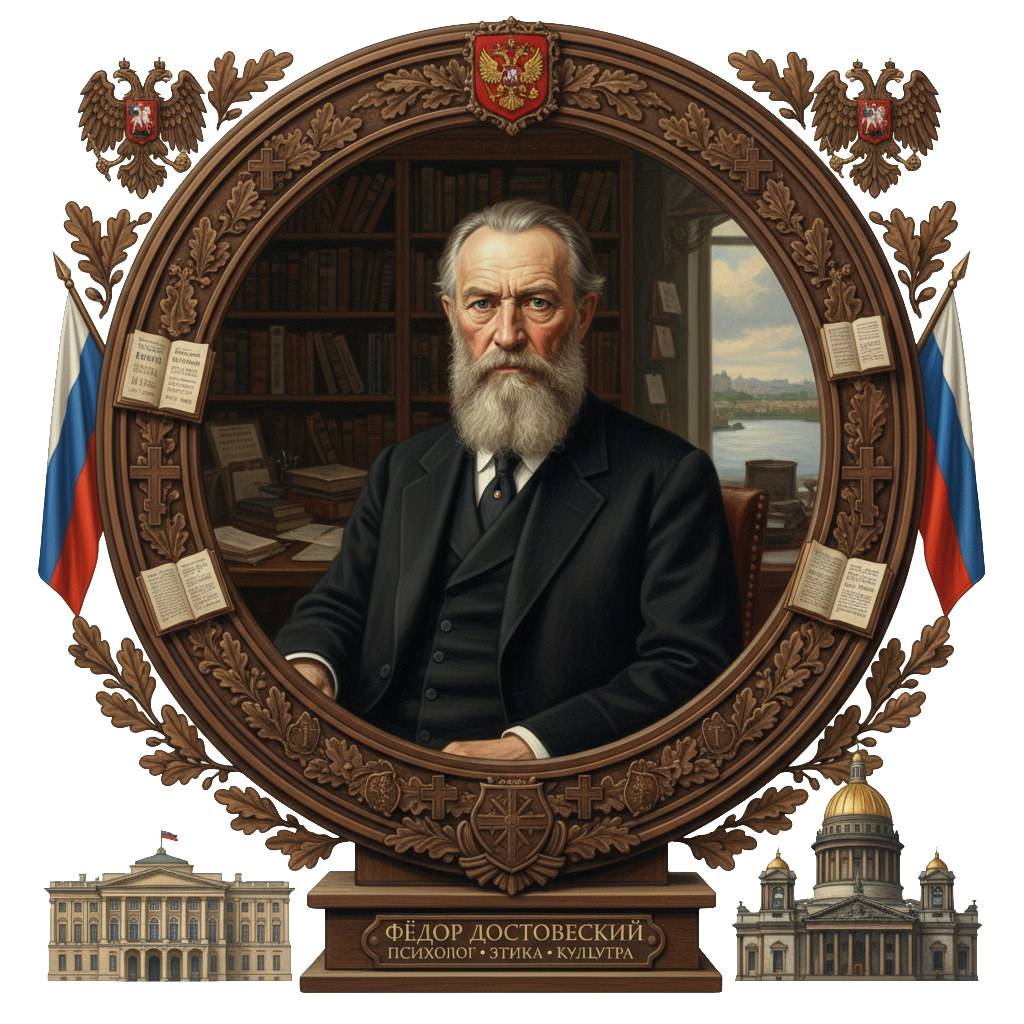
Fyodor Mikhailovich Dostoevsky was a Russian novelist, short story writer, essayist, and journalist. His literary works explore human psychology in the troubled political, social, and spiritual atmospheres of 19th-century Russia, and engage with a variety of philosophical and religious themes. He is best known for his masterpieces 'Crime and Punishment', 'The Idiot', 'Demons', and 'The Brothers Karamazov'.
Dostoevsky's early life was marked by involvement in radical intellectual circles, which led to his arrest in 1849. He was sentenced to death, but the sentence was commuted at the last moment to hard labor in a Siberian prison camp. This harrowing experience profoundly changed him, leading to a rejection of his earlier utopian socialist views and a deep embrace of Russian Orthodox Christianity. His subsequent writings reflect a profound understanding of suffering, redemption, and the complexities of the human condition.
Often considered one of the greatest psychologists in world literature, Dostoevsky's influence extends far beyond fiction. His ideas anticipated existentialism and psychoanalysis, and his exploration of free will, morality, and the existence of God continues to resonate with readers and thinkers worldwide.
Portrayal characteristics
Saved editorial descriptions used for the reconstruction; these are not authenticated statements by the depicted person.
- Psychological
- Introspective
- Profound
- Passionate
- Complex
Images & artwork 4
Connections
Alexander Pushkin
Literary Influence
Dostoevsky viewed Pushkin as the ultimate Russian poet and was deeply influenced by his psychological realism and national spirit.
In his famous 1880 'Pushkin Speech,' Dostoevsky argued that Pushkin embodied the 'universal responsiveness' of the Russian soul, cementing Pushkin's status as the father of Russian literature.
Friedrich Nietzsche
Intellectual Influence
Nietzsche discovered Dostoevsky's work late in life and considered him a kindred psychological spirit.
Nietzsche famously called Dostoevsky 'the only psychologist from whom I had something to learn.' He found in Dostoevsky's 'Notes from Underground' and 'The Idiot' a profound exploration of nihilism and human suffering that mirrored his own philosophical inquiries.
Alexander Pushkin
Literary Inspiration
Dostoevsky viewed Pushkin as the ultimate embodiment of the Russian soul and literary genius.
Dostoevsky's 1880 'Pushkin Speech' is a landmark in Russian history, where he argued that Pushkin's ability to empathize with all cultures made him a 'universal man.' This speech solidified Dostoevsky's own status as a national prophet shortly before his death.
Leo Tolstoy
Literary Contemporaries
The two giants of the 19th-century Russian novel were contemporaries who never met but deeply respected each other.
Despite their different social backgrounds and philosophical approaches—Dostoevsky focusing on urban psychological depths and Tolstoy on epic realism—they followed each other's work closely. Tolstoy was famously found reading 'The Brothers Karamazov' shortly before his own death.
Friedrich Nietzsche
Posthumous Influence
Dostoevsky's psychological insights and exploration of nihilism deeply influenced Nietzsche's philosophy.
Although they never corresponded, Nietzsche's discovery of Dostoevsky's writing provided him with a 'psychological' validation of his own theories on the death of God. Dostoevsky's characters, such as Raskolnikov and Kirillov, served as case studies for Nietzsche's concepts of the will to power and nihilism.
Leo Tolstoy
Literary Contemporaries
The two are considered the greatest Russian novelists of the 19th century, though they never met in person.
Despite their lack of personal contact, they shared a mutual respect and were both deeply preoccupied with themes of morality, faith, and the Russian soul. Upon Dostoevsky's death, Tolstoy expressed deep regret that they had never spoken, acknowledging Dostoevsky as a kindred spirit.
Known for
- Crime and Punishment
- The Brothers Karamazov
- Notes from Underground
- Psychological realism
Episodes featuring or mentioning this figure
No eligible published episode featuring this figure is currently in the library.