



Leo Tolstoy
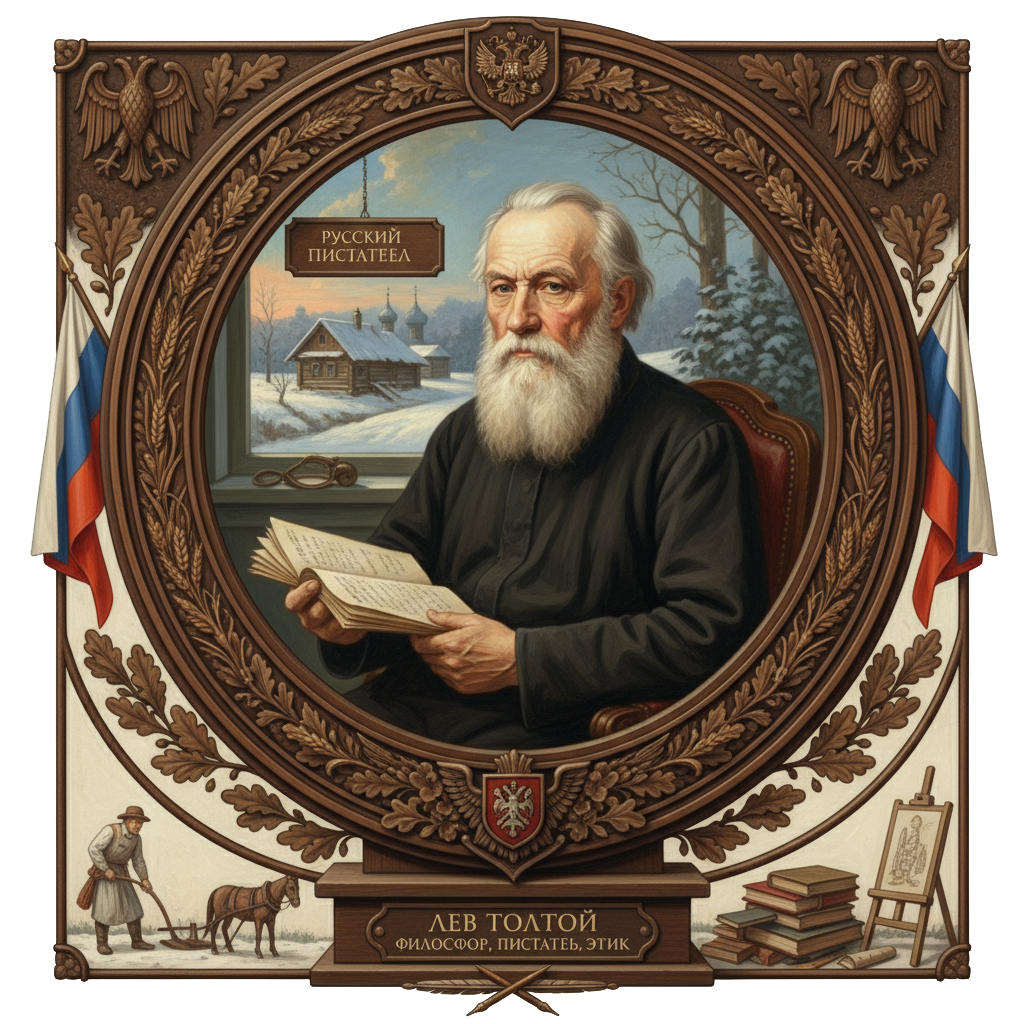
Russian writer and philosopher widely regarded as one of the greatest authors of all time.
At a glance
- Born
- 1828 CE
- Died
- 1910 CE
- Era classification
- Modern
- Homeland
- Russia
- Period
- 19th Century
- Field
- Poetry, Art & Ethics
- Language
- Russian
- Religion
- Christianity (Tolstoyan movement)
- Gender
- male
Biography
Count Lev Nikolayevich Tolstoy, usually referred to in English as Leo Tolstoy, was a Russian writer who is regarded as one of the greatest authors of all time. He received nominations for the Nobel Prize in Literature every year from 1902 to 1906 and for the Nobel Peace Prize in 1901, 1902, and 1909. His masterpieces, 'War and Peace' and 'Anna Karenina', stand at the pinnacle of realist fiction.
Beyond his literary achievements, Tolstoy became known for his complicated and paradoxical persona and for his extreme moralistic and ascetic views, which he adopted after a moral crisis and spiritual awakening in the 1870s. He became a fervent Christian anarchist and pacifist. His ideas on nonviolent resistance, expressed in works such as 'The Kingdom of God Is Within You', were to have a profound impact on such pivotal 20th-century figures as Mahatma Gandhi and Martin Luther King Jr.
Tolstoy's later life was marked by a deep commitment to his philosophical beliefs, leading him to renounce his wealth and aristocratic privileges. His profound psychological insights and detailed descriptions of Russian society have left an indelible mark on world literature and philosophy.
Portrayal characteristics
Saved editorial descriptions used for the reconstruction; these are not authenticated statements by the depicted person.
- Philosophical
- Idealistic
- Observant
- Pacifist
- Ascetic
Images & artwork 3
Connections
Alexander Pushkin
Literary Influence
Tolstoy admired Pushkin's prose for its clarity and economy, using it as a stylistic benchmark for his own writing.
Tolstoy reportedly re-read Pushkin's stories to find inspiration for the narrative structure of 'Anna Karenina' and praised Pushkin for creating the foundation of the modern Russian literary language.
Confucius
Intellectual Influence
Tolstoy was deeply influenced by Confucian ethics later in his life, incorporating its principles of moral self-improvement into his own philosophy.
Tolstoy studied the Analects and other Confucian texts extensively, seeing parallels between Chinese thought and his own interpretation of Christian ethics. He translated and published selections of Confucius's sayings for a Russian audience in his work 'The Path of Life'.
Fyodor Dostoevsky
Literary Contemporaries
The two giants of the 19th-century Russian novel were contemporaries who never met but deeply respected each other.
Despite their different social backgrounds and philosophical approaches—Dostoevsky focusing on urban psychological depths and Tolstoy on epic realism—they followed each other's work closely. Tolstoy was famously found reading 'The Brothers Karamazov' shortly before his own death.
Mahatma Gandhi
Philosophical Mentor
Gandhi was deeply influenced by Tolstoy's writings on non-violence and Christian anarchism.
The two exchanged letters during the final year of Tolstoy's life while Gandhi was in South Africa. Gandhi credited Tolstoy's book 'The Kingdom of God Is Within You' with curing his skepticism and providing a foundation for his philosophy of Satyagraha.
Mahatma Gandhi
Philosophical Mentors
Tolstoy and Gandhi engaged in a significant correspondence regarding non-violent resistance and spiritual ethics.
Tolstoy's book 'The Kingdom of God Is Within You' profoundly influenced Gandhi's development of Satyagraha. Their letters exchanged in the final years of Tolstoy's life highlight a shared commitment to pacifism and the rejection of state-sanctioned violence.
Fyodor Dostoevsky
Literary Contemporaries
The two are considered the greatest Russian novelists of the 19th century, though they never met in person.
Despite their lack of personal contact, they shared a mutual respect and were both deeply preoccupied with themes of morality, faith, and the Russian soul. Upon Dostoevsky's death, Tolstoy expressed deep regret that they had never spoken, acknowledging Dostoevsky as a kindred spirit.
Alexander Pushkin
Influenced By
Tolstoy deeply admired Pushkin and considered his work the foundation of modern Russian literature.
Tolstoy frequently reread Pushkin's prose, particularly 'The Captain's Daughter,' which influenced his own approach to historical realism and narrative style. He famously stated that Pushkin's prose was the best school for any Russian writer.
Vladimir Lenin
Subject of Analysis
Lenin wrote several influential essays analyzing Tolstoy's role in the Russian revolutionary movement.
Lenin described Tolstoy as the 'mirror of the Russian revolution,' arguing that his work reflected the contradictions and grievances of the Russian peasantry. While Lenin disagreed with Tolstoy's pacifism, he recognized the power of Tolstoy's critique of the Tsarist state.
Pyotr Ilyich Tchaikovsky
Contemporary Admirers
Tchaikovsky and Tolstoy met in 1876 and shared a mutual respect for each other's artistic contributions to Russian culture.
During their meeting, Tolstoy was moved to tears by a performance of Tchaikovsky's String Quartet No. 1. Tchaikovsky later recorded in his diary that the author's emotional response was one of the greatest honors of his career.
Vladimir Lenin
Cultural Subject
Lenin wrote several influential essays analyzing Tolstoy's work as a reflection of the Russian revolutionary spirit.
In his essay 'Leo Tolstoy as the Mirror of the Russian Revolution,' Lenin praised Tolstoy's realistic depiction of the peasantry while critiquing his philosophy of non-violent resistance as 'reactionary'.
Known for
- War and Peace
- Anna Karenina
- Christian anarchism
- Nonviolent resistance philosophy
Episodes featuring or mentioning this figure
No eligible published episode featuring this figure is currently in the library.