



Johann Sebastian Bach
A German composer and musician of the Baroque period, revered for his complex and beautiful polyphonic works.
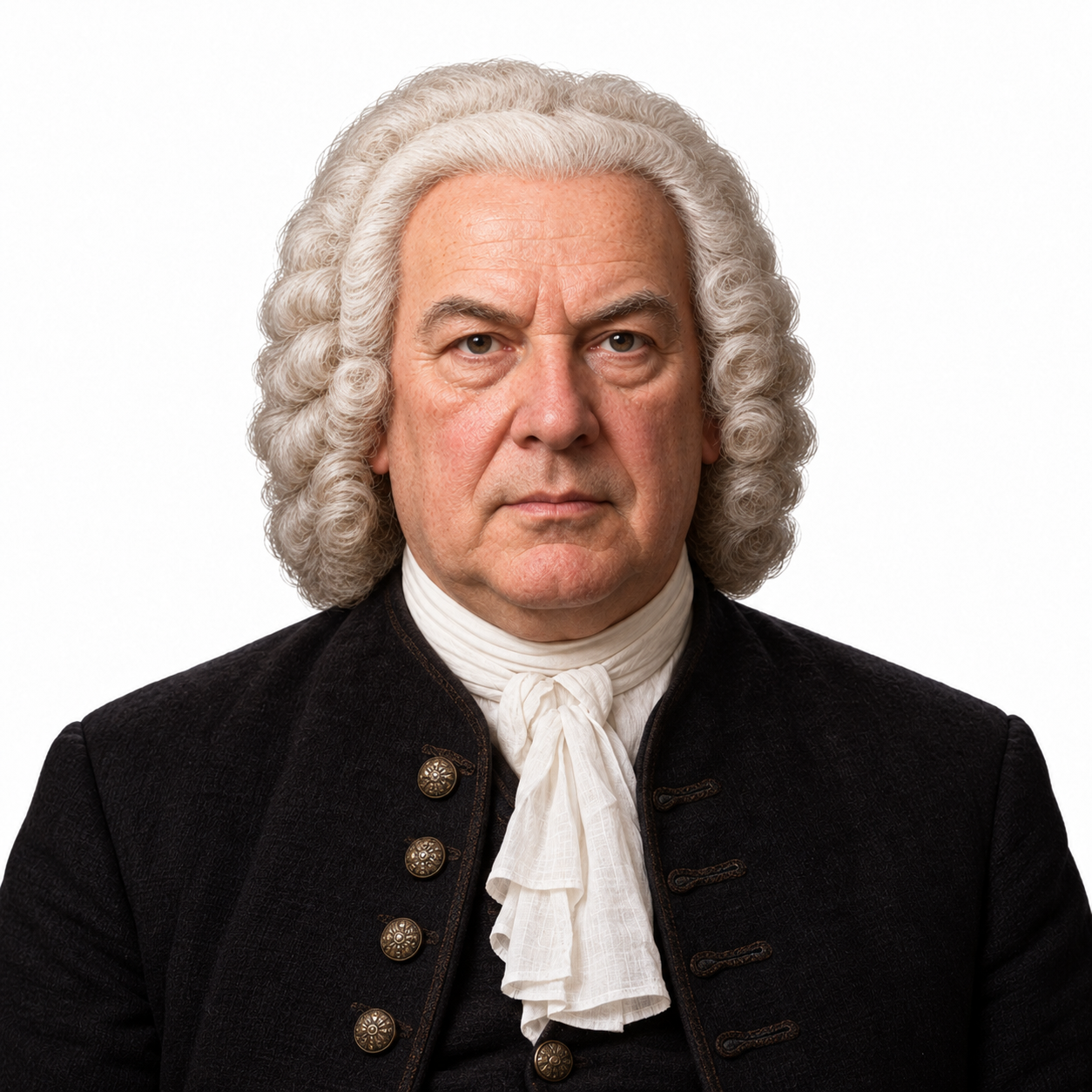
At a glance
- Born
- 1685 CE
- Died
- 1750 CE
- Era classification
- Modern
- Homeland
- Germany
- Period
- 18th Century
- Field
- Arts & Architecture
- Language
- German
- Religion
- Lutheran
- Gender
- male
Biography
Johann Sebastian Bach was a German composer and musician of the Baroque period, widely regarded as one of the greatest composers in Western musical history. Born into a highly musical family in Eisenach, he received early training from his father and older brother. Bach spent his entire life in central Germany, serving in various musical posts, including as a court musician, organist, and eventually as the Thomaskantor in Leipzig.
Bach's music is celebrated for its technical command, artistic beauty, and intellectual depth. He was a master of counterpoint, harmony, and motivic organization, seamlessly blending rhythms and textures from abroad, particularly from Italy and France, with the rich German musical tradition. His vast output includes sacred vocal works like the "St Matthew Passion" and the "Mass in B minor," as well as instrumental masterpieces such as the "Brandenburg Concertos" and "The Well-Tempered Clavier."
Although Bach was respected as a highly skilled organist during his lifetime, his compositions were often considered old-fashioned by his contemporaries. It was not until the 19th-century Bach revival, championed by Felix Mendelssohn, that his genius was fully recognized. Today, his works are seen as the pinnacle of the Baroque era, profoundly influencing almost every composer who followed him.
Portrayal characteristics
Saved editorial descriptions used for the reconstruction; these are not authenticated statements by the depicted person.
- Devout
- Industrious
- Virtuosic
- Meticulous
- Profound
Images & artwork 4


Connections
Ludwig van Beethoven
Musical Influence
Beethoven was a profound admirer of Bach, famously stating, 'Not Brook (Bach) but Ocean should be his name.'
Beethoven studied Bach's 'The Well-Tempered Clavier' from a young age, and the contrapuntal complexity of Bach's work deeply informed Beethoven's late-period compositions, such as his fugues.
Martin Luther
Theological Influence
Bach was a devout Lutheran whose sacred music was deeply rooted in the theology and hymns established by Martin Luther.
Bach utilized Luther's German translations of the Bible and his chorales as the foundational text and melodic basis for many of his cantatas and passions, viewing his music as a form of worship.
Johann Wolfgang von Goethe
Legacy & Appreciation
Goethe was a significant admirer of Bach's music, describing it as 'eternal harmony conversing with itself.'
Although they were not contemporaries, Goethe's late-life discovery of Bach's keyboard works through his friend Carl Friedrich Zelter led to a profound spiritual and intellectual appreciation of Bach's mathematical and musical genius.
Ludwig van Beethoven
Influenced By
Beethoven studied Bach's keyboard works from a young age and considered him a foundational master of harmony.
Beethoven famously remarked that Bach's name (meaning 'brook') should have been 'Meer' (sea) because of his vast musical depth. He frequently incorporated Bach-inspired counterpoint and fugal structures into his late works, such as the 'Grosse Fuge'.
Known for
- Brandenburg Concertos
- The Well-Tempered Clavier
- Mass in B minor
- St Matthew Passion
Episodes featuring or mentioning this figure
No eligible published episode featuring this figure is currently in the library.