



Martin Luther
A German priest and theologian who became the seminal figure of the Protestant Reformation.
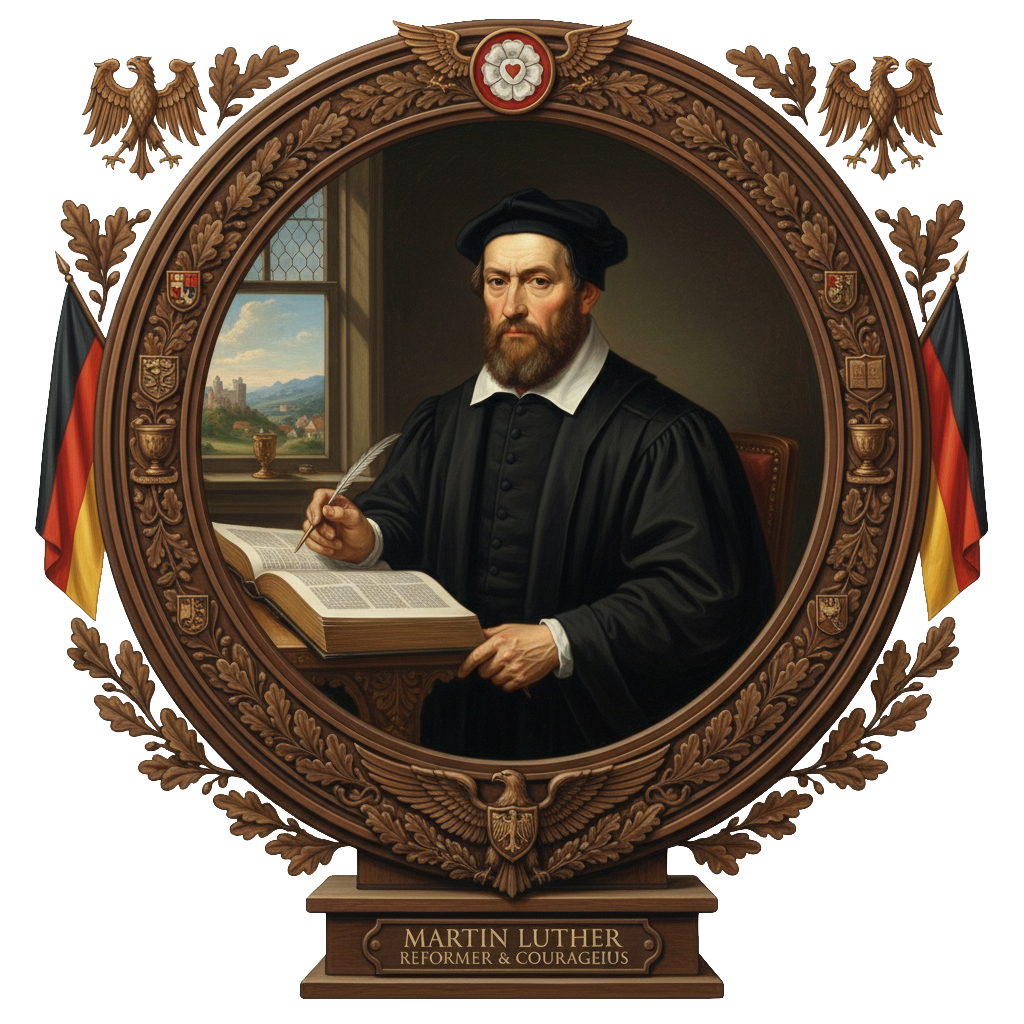
At a glance
- Born
- 1483 CE
- Died
- 1546 CE
- Era classification
- Medieval
- Homeland
- Germany
- Period
- 16th Century
- Field
- Philosophy & Ideology
- Language
- German
- Religion
- Christian (Protestant)
- Gender
- male
Biography
Martin Luther was a German priest, theologian, author, and hymnwriter who became the central figure of the Protestant Reformation. Born in Eisleben, he initially pursued legal studies before a near-death experience in a thunderstorm led him to become an Augustinian monk. His intense study of scripture led him to question the practices of the Catholic Church, particularly the sale of indulgences.
In 1517, Luther famously published his "Ninety-five Theses," challenging the authority of the Pope and asserting that salvation is granted by grace through faith alone, not by deeds or financial transactions. His refusal to retract his writings at the demand of Pope Leo X and the Holy Roman Emperor Charles V at the Diet of Worms in 1521 resulted in his excommunication and condemnation as an outlaw.
Protected by Frederick the Wise, Luther translated the Bible into the German vernacular, making it accessible to ordinary people and profoundly influencing the German language and culture. His theological writings, hymns, and reforms fractured the Western Catholic Church, leading to the establishment of Protestantism and forever altering the religious and political landscape of Europe.
Portrayal characteristics
Saved editorial descriptions used for the reconstruction; these are not authenticated statements by the depicted person.
- Courageous
- Conviction-driven
- Outspoken
- Scholarly
- Rebellious
Images & artwork 3


Connections
Johann Sebastian Bach
Theological Influence
Bach was a devout Lutheran whose sacred music was deeply rooted in the theology and hymns established by Martin Luther.
Bach utilized Luther's German translations of the Bible and his chorales as the foundational text and melodic basis for many of his cantatas and passions, viewing his music as a form of worship.
Johannes Gutenberg
Technological Enabler
Gutenberg's invention of the movable-type printing press was the essential technological catalyst for the success of Martin Luther's Reformation.
Without the mass-production capabilities of the Gutenberg press, Luther's 95 Theses and his German translation of the Bible could not have spread rapidly enough to bypass Church censorship and ignite a continent-wide movement.
Johannes Gutenberg
Technological Influence
Gutenberg's printing press was the essential technology that allowed Luther's 95 Theses and German Bible to spread rapidly across Europe.
While the two men lived in different generations, the Protestant Reformation is historically inseparable from the printing revolution. Luther famously called printing 'God's highest and extremest act of grace,' as it broke the clerical monopoly on information.
Suleiman the Magnificent
Contemporary Influence
Suleiman's military pressure on the Holy Roman Empire provided the political space for Martin Luther's Reformation to survive.
The diversion of Catholic resources to fight Suleiman's advancing armies prevented the immediate suppression of the Protestant movement, a dynamic Luther acknowledged by viewing the 'Turks' as a divine scourge that indirectly aided his cause.
Known for
- Ninety-five Theses
- Protestant Reformation
- Luther Bible
- Justification by faith
Episodes featuring or mentioning this figure
No eligible published episode featuring this figure is currently in the library.