



Mulla Sadra
Safavid philosopher who founded Transcendent Theosophy, synthesizing Islamic metaphysics, theology, and mysticism.
At a glance
- Born
- c. 1571 CE
- Died
- 1640 CE
- Era classification
- Early Modern
- Occupation
- Philosopher
- Homeland
- Safavid Empire
- Period
- Safavid Era
- Field
- Philosophy & Ideology
- Language
- Persian
- Religion
- Islam (Shia)
- Gender
- male
Biography
Sadr al-Din Muhammad b. Ibrahim Shirazi, commonly known as Mulla Sadra, was born in Shiraz, Iran, around 1571 CE into a prominent aristocratic family. He pursued higher education in the Safavid intellectual centers of Qazvin and Isfahan, studying under renowned scholars including Mir Damad and Shaykh Baha'i. During these formative years, Sadra attained mastery across both transmitted religious sciences (manqulat) and rational disciplines (ma'qulat), particularly Peripatetic philosophy, Illuminationism, and Sufi metaphysics.
Faced with hostility from traditionalist scholars and literalist jurists who objected to his philosophical and mystical interpretations, Mulla Sadra withdrew to the remote village of Kahak near Qom. This period of ascetic retreat and contemplation lasted around a decade. Away from institutional politics, he underwent a series of profound intellectual developments, shifting fundamentally from Suhrawardi's essentialism to his own ground-breaking existential metaphysics.
Following his isolation, Sadra returned to Shiraz at the invitation of the governor of Fars to teach at the Madrasa-yi Khan. There, he authored his definitive masterwork, 'al-Hikmah al-Muta'aliyah fi al-Asfar al-Arba'ah al-'Aqliyyah' ('The Transcendent Theosophy in the Four Intellectual Journeys'). In this massive compendium, he unified Avicennian logic, Illuminationist illumination, the mystical cosmology of Ibn 'Arabi, and Shia scriptural traditions into a cohesive philosophical system.
Mulla Sadra passed away in 1640 CE in Basra while undertaking his seventh pilgrimage to Mecca on foot. His school of thought, Transcendent Theosophy (al-Hikmat al-Muta'aliyah), revolutionized post-classical Islamic intellectual history through landmark doctrines like the primacy of existence (asalat al-wujud) and substantial motion (al-harakah al-jawhariyyah), continuing to serve as the dominant philosophical framework in Shia seminaries.
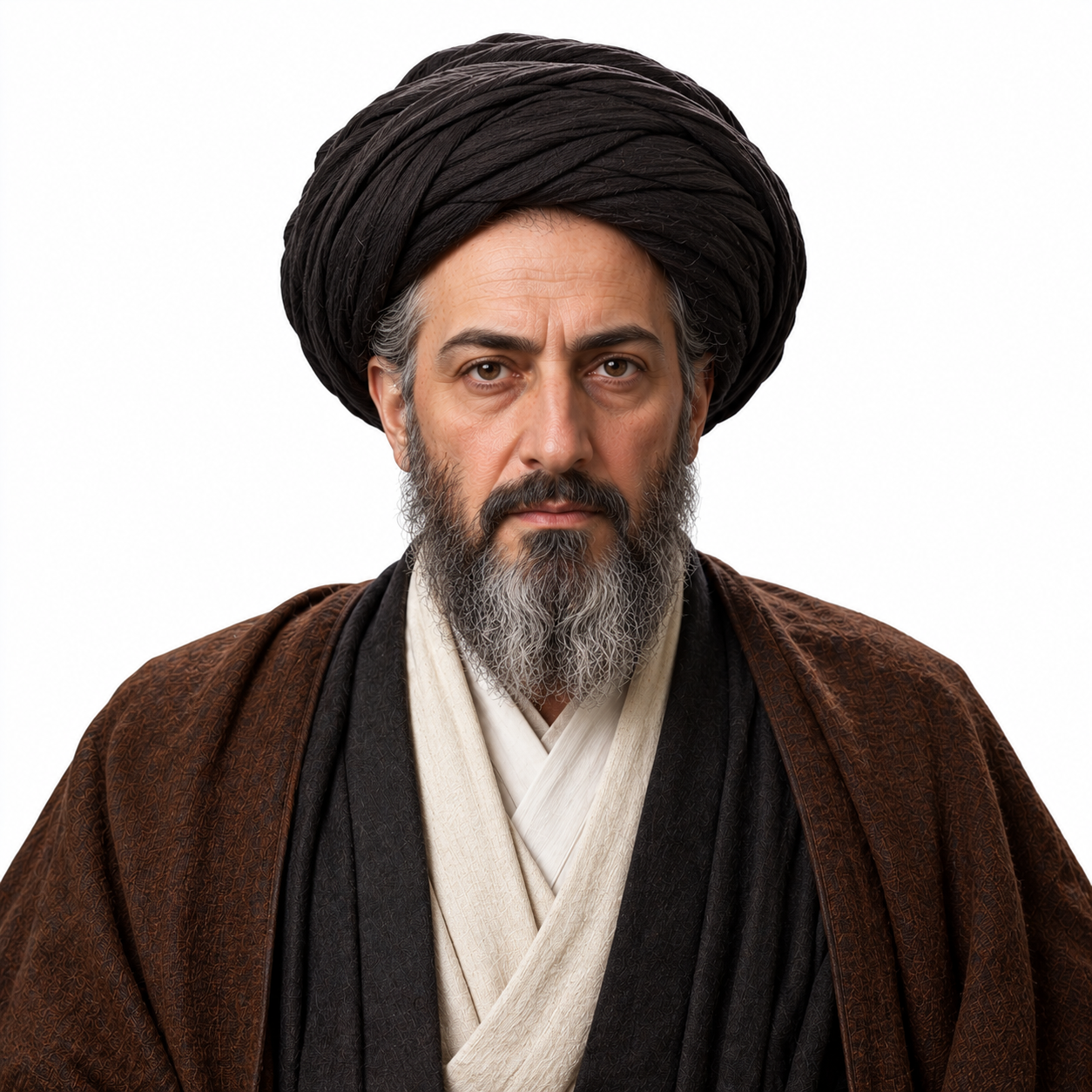
Portrayal characteristics
Saved editorial descriptions used for the reconstruction; these are not authenticated statements by the depicted person.
- Synthesizing
- Contemplative
- Rigorous
- Intellectually independent
- Mystical
Images & artwork 2

Known for
- Founding the School of Transcendent Theosophy (al-Hikmat al-Muta'aliyah)
- Formulating the doctrine of the Primacy of Existence (Asalat al-Wujud)
- Developing the theory of Substantial Motion (al-Harakah al-Jawhariyyah)
- Authoring 'The Four Journeys' (al-Asfar al-Arba'ah)
- Harmonizing rationalist philosophy, mysticism, and Shia scriptural hermeneutics
Episodes featuring or mentioning this figure
No eligible published episode featuring this figure is currently in the library.