



Suleiman the Magnificent
The longest-reigning Sultan of the Ottoman Empire, known for his legal reforms and military conquests.
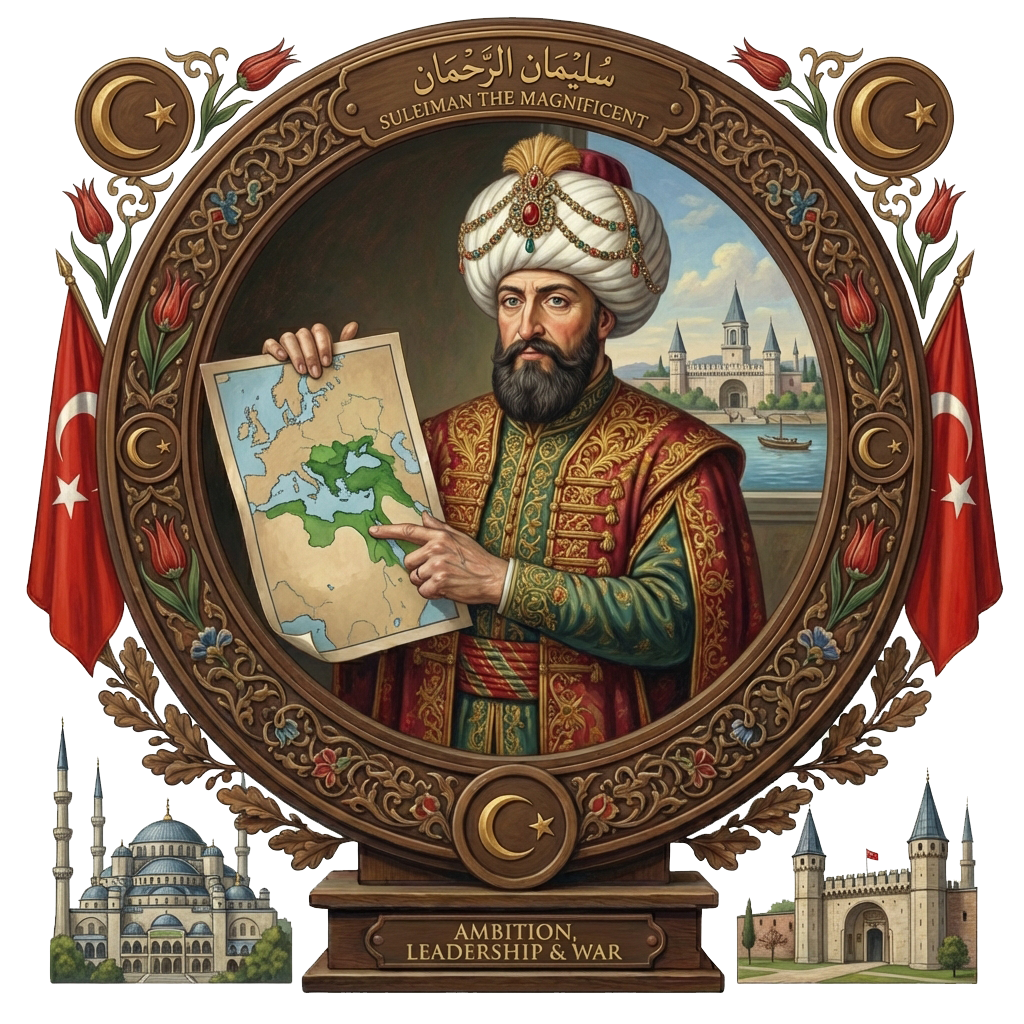
At a glance
- Born
- 1494 CE
- Died
- 1566 CE
- Era classification
- Modern
- Homeland
- Ottoman Empire
- Period
- 16th Century
- Field
- Politics, Leadership & War
- Language
- Ottoman Turkish
- Religion
- Islam
- Gender
- male
Biography
Suleiman I, commonly known as Suleiman the Magnificent in the West and Kanuni (the Lawgiver) in his realm, was the tenth and longest-reigning Sultan of the Ottoman Empire. Under his administration, the Ottoman state ruled over at least 25 million people and reached the zenith of its military, political, and economic power. His reign marked a golden age of Ottoman culture, with significant achievements in art, literature, and architecture.
He personally instituted major legislative changes relating to society, education, taxation, and criminal law. His canonical law fixed the form of the empire for centuries after his death. As a military leader, he led Ottoman armies in conquering the Christian strongholds of Belgrade and Rhodes, as well as most of Hungary, before his conquests were checked at the Siege of Vienna in 1529.
Beyond his military and political achievements, Suleiman was a distinguished poet and goldsmith. He became a great patron of culture, overseeing the 'Golden Age' of the Ottoman Empire in its artistic, literary, and architectural development. His enduring legacy is deeply intertwined with the architectural masterpieces that transformed the skyline of Istanbul and other major cities.
Portrayal characteristics
Saved editorial descriptions used for the reconstruction; these are not authenticated statements by the depicted person.
- Ambitious
- Just
- Cultured
- Strategic
- Authoritative
Images & artwork 3


Connections
Barbaros Hayreddin Pasha
Sovereign & Admiral
Barbaros served as the Grand Admiral (Kapudan Pasha) of the Ottoman Navy under Sultan Suleiman.
Suleiman the Magnificent recruited Barbaros to professionalize the Ottoman fleet. Together, they secured Ottoman naval supremacy in the Mediterranean, most notably through the victory at the Battle of Preveza in 1538.
Kösem Sultan
Dynastic Successor
Kösem Sultan was a powerful figure in the Ottoman dynasty established and expanded by Suleiman.
Kösem Sultan exercised power during the 'Sultanate of Women,' a period of female political influence that was largely initiated by Suleiman's wife, Hürrem Sultan, a century earlier.
Mehmed the Conqueror
Dynastic Predecessor
Mehmed II was the great-grandfather of Suleiman the Magnificent, establishing the imperial foundations Suleiman would later expand.
The administrative and military structures Mehmed created after 1453 provided the stability and resources that allowed Suleiman to lead the empire to its peak of power and cultural achievement.
Mimar Sinan
Chief Architect & Patron
Sinan served as the chief imperial architect for Suleiman, designing his most iconic monuments and mosques.
Under Suleiman's patronage, Sinan reached the peak of his career, constructing the Süleymaniye Mosque complex in Istanbul, which remains a masterpiece of Ottoman architecture and a symbol of the empire's Golden Age.
Osman I
Ancestor & Descendant
Osman I established the ruling house that reached its geopolitical and cultural zenith under Suleiman.
The legal and military traditions initiated by Osman provided the dynastic continuity that allowed Suleiman to rule as one of the most powerful monarchs in world history.
Piri Reis
Sovereign & Admiral
Piri Reis served as a high-ranking admiral in the Ottoman Navy during the height of Suleiman's reign.
Piri Reis dedicated his famous 'Kitab-ı Bahriye' (Book of Navigation) to Sultan Suleiman. Despite his contributions to Ottoman cartography and naval power, he was eventually executed in 1553 following a failed naval campaign against the Portuguese in the Persian Gulf.
Queen Elizabeth I
Diplomatic Allies
Elizabeth I sought an alliance and trade agreements with the Ottoman Empire to counter the power of Catholic Spain.
The two monarchs were contemporaries for several years, and Elizabeth's court established the Levant Company to facilitate trade with the Ottomans, marking a period of Anglo-Ottoman cooperation against the Habsburgs.
Barbaros Hayreddin Pasha
Grand Admiral & Sovereign
Barbarossa served as the Kapudan Pasha (Grand Admiral) of the Ottoman Navy under Suleiman's command.
Their collaboration secured Ottoman naval supremacy in the Mediterranean, notably through the decisive victory at the Battle of Preveza in 1538, which expanded the empire's influence over maritime trade routes.
Mimar Sinan
Chief Architect & Patron
Sinan was the chief Ottoman architect under Suleiman, responsible for the empire's most iconic and enduring structures.
Suleiman commissioned Sinan to design the Süleymaniye Mosque in Istanbul, a masterpiece of Islamic architecture that served as a monument to the Sultan's power and the empire's cultural peak.
Piri Reis
Admiral & Sovereign
Piri Reis was a renowned navigator and cartographer who served in the Ottoman Navy during Suleiman's reign.
While Piri Reis provided the Sultan with invaluable maps and the 'Book of Navigation,' their relationship ended tragically when Suleiman ordered his execution following a failed naval campaign against the Portuguese in the Persian Gulf.
Queen Elizabeth I
Diplomatic Allies
Elizabeth I and Suleiman (and his immediate successors) shared a mutual enmity toward the Spanish Empire, leading to diplomatic correspondence.
The two powers explored a 'Protestant-Islamic' alliance against Catholic Spain, facilitating trade and political cooperation that helped both nations resist Habsburg hegemony in Europe.
Martin Luther
Contemporary Influence
Suleiman's military pressure on the Holy Roman Empire provided the political space for Martin Luther's Reformation to survive.
The diversion of Catholic resources to fight Suleiman's advancing armies prevented the immediate suppression of the Protestant movement, a dynamic Luther acknowledged by viewing the 'Turks' as a divine scourge that indirectly aided his cause.
Known for
- Expanding the Ottoman Empire
- Reforming Ottoman law
- Patronage of the arts and architecture
- Siege of Vienna
Episodes featuring or mentioning this figure
No eligible published episode featuring this figure is currently in the library.