



Johannes Gutenberg
A German inventor who introduced letterpress printing to Europe with his movable type printing press.

At a glance
- Born
- 1400 CE
- Died
- 1468 CE
- Era classification
- Medieval
- Homeland
- Germany
- Period
- 15th Century
- Field
- Science & Innovation
- Language
- German
- Religion
- Catholic
- Gender
- male
Biography
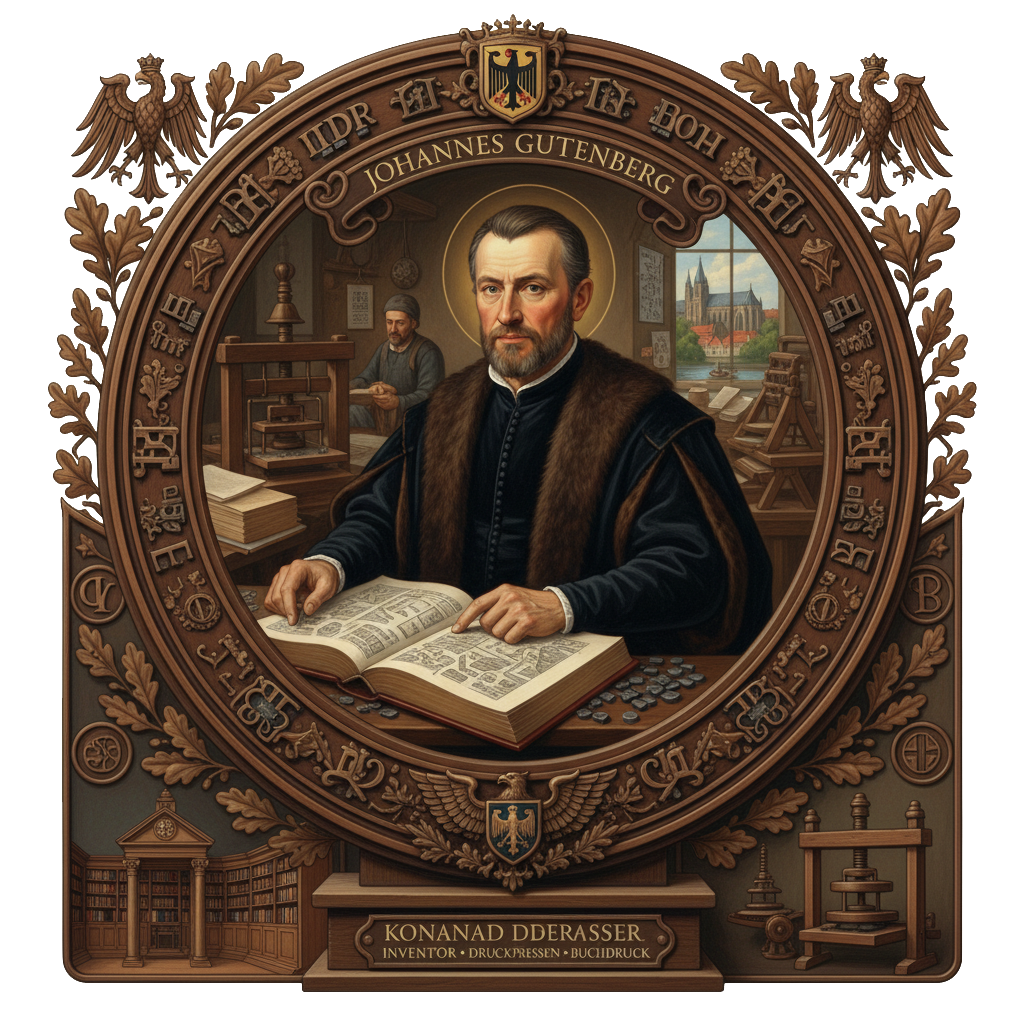
Johannes Gensfleisch zur Laden zum Gutenberg was a German inventor, printer, publisher, and goldsmith. Born in the city of Mainz, he is celebrated for introducing mechanical movable type printing to Europe. This invention sparked the Printing Revolution, a milestone of the second millennium that initiated the modern period of human history.
Gutenberg's genius lay not in inventing printing itself, but in creating a complete, mechanized system. He adapted existing technologies, such as the screw press used in winemaking, and combined them with his own innovations. His most crucial contribution was the development of a hand mould that allowed for the rapid and precise creation of metal movable type in large quantities, using an alloy of lead, tin, and antimony that is still used today.
His masterpiece, the Gutenberg Bible (also known as the 42-line Bible), was printed around 1455 and is acclaimed for its high aesthetic and technical quality. Although Gutenberg struggled financially and lost control of his printing business to creditors, his invention democratized knowledge, fueled the Renaissance, the Reformation, and the Scientific Revolution, and laid the material basis for the modern knowledge-based economy.
Portrayal characteristics
Saved editorial descriptions used for the reconstruction; these are not authenticated statements by the depicted person.
- Inventive
- Resourceful
- Meticulous
- Visionary
- Persistent
Images & artwork 4


Connections
Martin Luther
Technological Enabler
Gutenberg's invention of the movable-type printing press was the essential technological catalyst for the success of Martin Luther's Reformation.
Without the mass-production capabilities of the Gutenberg press, Luther's 95 Theses and his German translation of the Bible could not have spread rapidly enough to bypass Church censorship and ignite a continent-wide movement.
Martin Luther
Technological Influence
Gutenberg's printing press was the essential technology that allowed Luther's 95 Theses and German Bible to spread rapidly across Europe.
While the two men lived in different generations, the Protestant Reformation is historically inseparable from the printing revolution. Luther famously called printing 'God's highest and extremest act of grace,' as it broke the clerical monopoly on information.
Known for
- Movable type printing press
- Gutenberg Bible
- Printing Revolution
Episodes featuring or mentioning this figure
No eligible published episode featuring this figure is currently in the library.