



Johannes Kepler
A German astronomer and mathematician who formulated the laws of planetary motion.

At a glance
- Born
- 1571 CE
- Died
- 1630 CE
- Era classification
- Modern
- Homeland
- Germany
- Period
- Late 16th - Early 17th Century
- Field
- Science & Innovation
- Language
- German
- Religion
- Lutheran
- Gender
- male
Biography
Johannes Kepler was a German astronomer, mathematician, and astrologer who played a key role in the 17th-century Scientific Revolution. Born in Weil der Stadt, he studied theology and philosophy at the University of Tübingen, where he was introduced to the Copernican heliocentric system. He initially worked as a mathematics teacher in Graz before moving to Prague to become the assistant to the renowned Danish astronomer Tycho Brahe.
Following Brahe's death, Kepler inherited his extensive and highly accurate observational data. Through years of painstaking calculation, Kepler discovered that the planets do not move in perfect circles, as was previously believed, but in elliptical orbits with the Sun at one focus. This revelation became his First Law of Planetary Motion. He subsequently formulated two additional laws, which mathematically described the speeds and orbital periods of the planets.
Kepler's laws provided the crucial foundation for Isaac Newton's later theory of universal gravitation. In addition to his astronomical work, Kepler made significant contributions to the field of optics, inventing an improved version of the refracting telescope. Despite facing personal hardships, religious persecution, and financial difficulties during the turbulent Thirty Years' War, Kepler's unwavering pursuit of cosmic harmony forever changed humanity's understanding of the universe.
Portrayal characteristics
Saved editorial descriptions used for the reconstruction; these are not authenticated statements by the depicted person.
- Analytical
- Persistent
- Curious
- Mathematical
- Imaginative
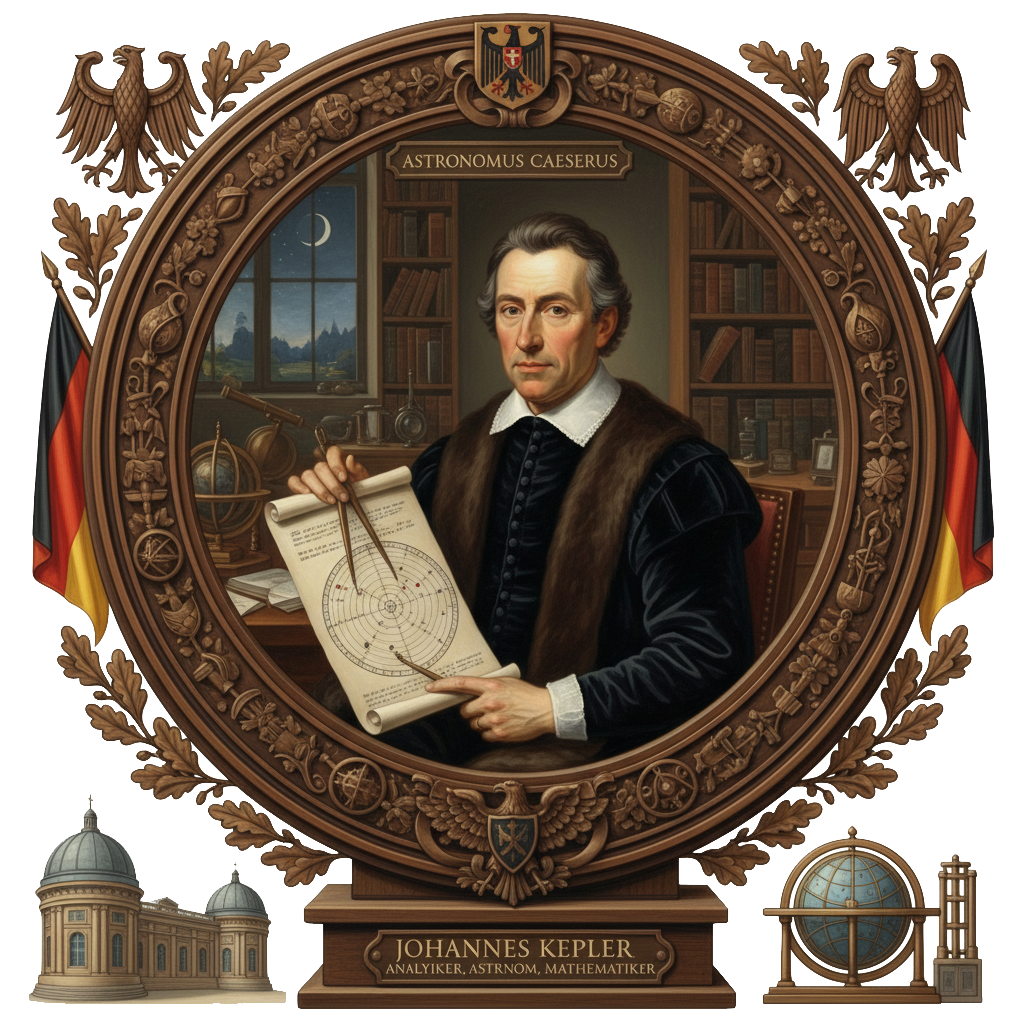
Images & artwork 5



Connections
Galileo Galilei
Contemporary Allies
Kepler and Galileo were the two most prominent defenders of the Copernican heliocentric system during the early 17th century.
The two scientists corresponded briefly; Kepler publicly supported Galileo's 'Sidereus Nuncius' and his telescopic discoveries. While Galileo largely ignored Kepler's discovery of elliptical orbits, their combined work provided the empirical and theoretical foundation for the Scientific Revolution.
Isaac Newton
Scientific Predecessor
Newton used his law of universal gravitation to mathematically prove and explain Kepler's laws of planetary motion.
By showing that the same force governing a falling apple also governed the orbits of planets, Newton unified terrestrial and celestial mechanics, validating Kepler's elliptical orbits.
Galileo Galilei
Scientific Correspondents
Kepler and Galileo were contemporaries who corresponded regarding their support for the Copernican heliocentric model.
Kepler was one of the few prominent scientists to publicly support Galileo's telescopic discoveries in his work 'Dissertatio cum Nuncio Sidereo,' though Galileo was often slow to reciprocate Kepler's enthusiasm for elliptical orbits.
Isaac Newton
Scientific Successor
Newton's law of universal gravitation provided the physical explanation for Kepler's three laws of planetary motion.
Newton used Kepler's empirical laws as the primary evidence for his inverse-square law of gravity, effectively unifying Kepler's celestial mechanics with terrestrial physics in the 'Principia Mathematica.'
René Descartes
Intellectual Contemporaries
Descartes was aware of and influenced by Kepler's groundbreaking work in optics.
Kepler's 'Astronomiae Pars Optica' laid the foundation for modern optics, which Descartes further developed in his own 'Dioptrique,' though they differed on the fundamental nature of light and motion.
Known for
- Laws of planetary motion
- Astronomia nova
- Harmonices Mundi
- Keplerian telescope
Episodes featuring or mentioning this figure
No eligible published episode featuring this figure is currently in the library.