



Nasir al-Din al-Tusi
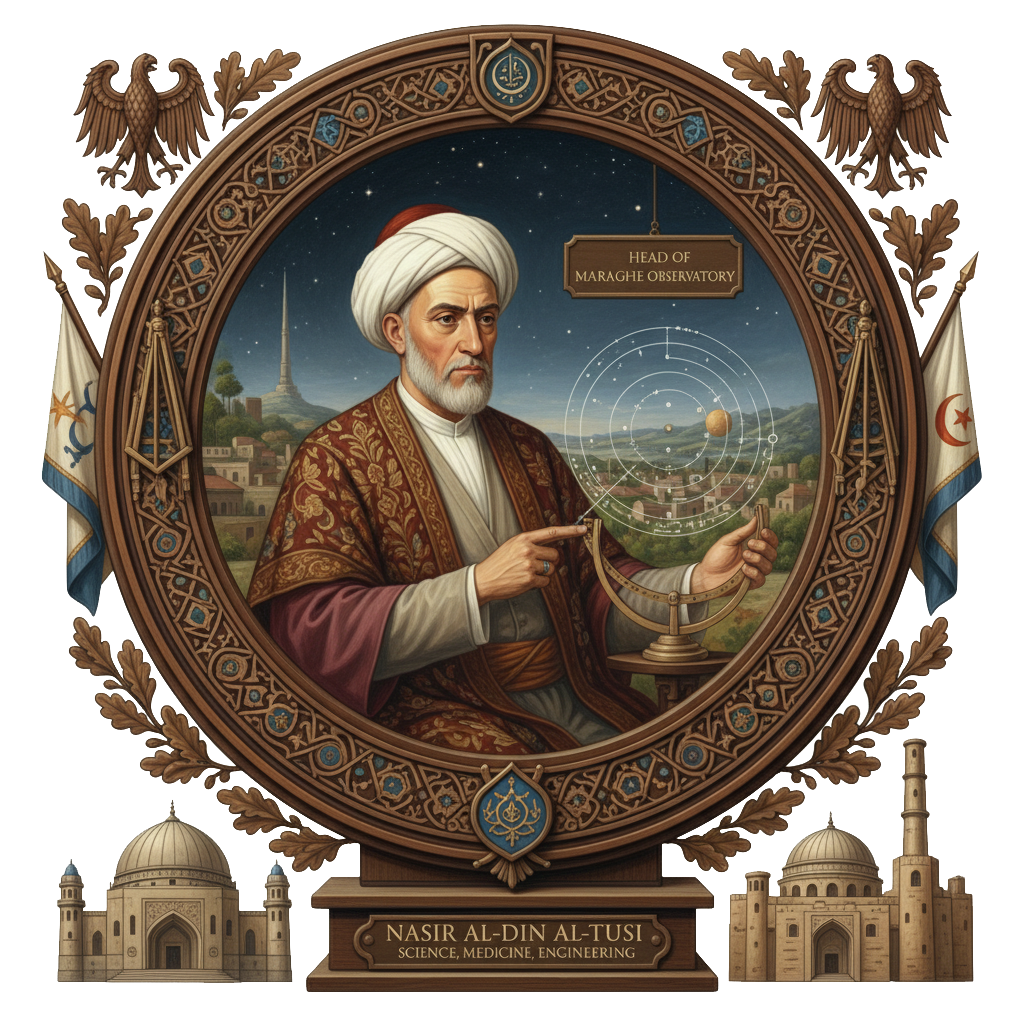
A brilliant Persian polymath, architect, philosopher, and astronomer who created the Maragheh observatory.
At a glance
- Born
- 1201 CE
- Died
- 1274 CE
- Era classification
- Medieval
- Homeland
- Iran
- Period
- Ilkhanate
- Field
- Science, Medicine & Engineering
- Language
- Farsi
- Religion
- Islam (Shia)
- Gender
- male
Biography
Nasir al-Din al-Tusi was one of the greatest scholars of the Islamic Golden Age, making groundbreaking contributions to astronomy, mathematics, philosophy, and theology. Born in Tus, Khorasan, he received a comprehensive education in the sciences and Islamic disciplines. During the turbulent period of the Mongol invasions, Tusi initially took refuge with the Ismaili Assassins in their mountain fortresses, where he wrote several important works, including his famous ethical treatise, 'Akhlaq-i Nasiri'.
When the Mongol warlord Hulagu Khan conquered the Ismaili strongholds, Tusi managed to save his own life by joining Hulagu's retinue as a scientific advisor. Recognizing Tusi's genius, Hulagu appointed him as a minister and funded the construction of the Maragheh Observatory in northwestern Iran. Under Tusi's direction, it became the most advanced scientific institution in the world, attracting scholars from across Asia and producing highly accurate astronomical tables.
Tusi's scientific legacy is monumental. In astronomy, he developed the 'Tusi couple', a mathematical device that resolved linear motion into the sum of two circular motions, which later influenced Nicolaus Copernicus. In mathematics, he was the first to treat trigonometry as an independent mathematical discipline rather than just a tool for astronomy. His ability to navigate the brutal politics of the Mongol era while preserving and advancing human knowledge marks him as a uniquely resilient and brilliant historical figure.
Portrayal characteristics
Saved editorial descriptions used for the reconstruction; these are not authenticated statements by the depicted person.
- Analytical
- Polymathic
- Adaptable
- Innovative
- Scholarly
Images & artwork 3


Connections
Abu Ali Sina (Avicenna)
Intellectual Successor
Al-Tusi was a major commentator and defender of Avicenna's philosophical and scientific works.
Centuries after Avicenna's death, Al-Tusi wrote 'Sharh al-Isharat', a definitive commentary defending Avicenna's 'Remarks and Admonitions' against the criticisms of Fakhr al-Din al-Razi. This work was crucial in preserving and revitalizing Avicennian thought in the later Islamic Golden Age.
Omar Khayyam
Influenced
Tusi was a later polymath who built upon Khayyam's pioneering work in mathematics and astronomy.
Tusi's work on the parallel postulate and his developments in trigonometry were deeply influenced by Khayyam's earlier critiques of Euclid's 'Elements' and his methods for solving cubic equations.
Abu Ali Sina (Avicenna)
Commentator & Defender
Tusi was a major proponent of Avicenna's philosophy and wrote a definitive defense of his work.
Tusi wrote 'Sharh al-Isharat' (Commentary on the Remarks), a detailed defense of Avicenna's philosophical system against the criticisms of Fakhr al-Din al-Razi. This work was instrumental in preserving and clarifying Avicennian thought for later generations.
Omar Khayyam
Scientific Successor
Tusi built upon the mathematical and astronomical foundations established by Omar Khayyam.
Tusi utilized Khayyam's work on the extraction of roots and the Jalali calendar. At the Maragheh Observatory, Tusi refined the planetary models and mathematical proofs that Khayyam had explored a century earlier.
Al-Khwarizmi
Mathematical Influence
Tusi's work in trigonometry and algebra was a direct evolution of the methods pioneered by Al-Khwarizmi.
Tusi is credited with treating trigonometry as an independent mathematical discipline rather than just a tool for astronomy, a significant advancement from the foundational algebraic principles established by Al-Khwarizmi.
Known for
- Maragheh observatory
- Tusi couple in astronomy
- Akhlaq-i Nasiri (ethics)
- Establishing trigonometry as a discipline
Episodes featuring or mentioning this figure
No eligible published episode featuring this figure is currently in the library.