



Hipparchus
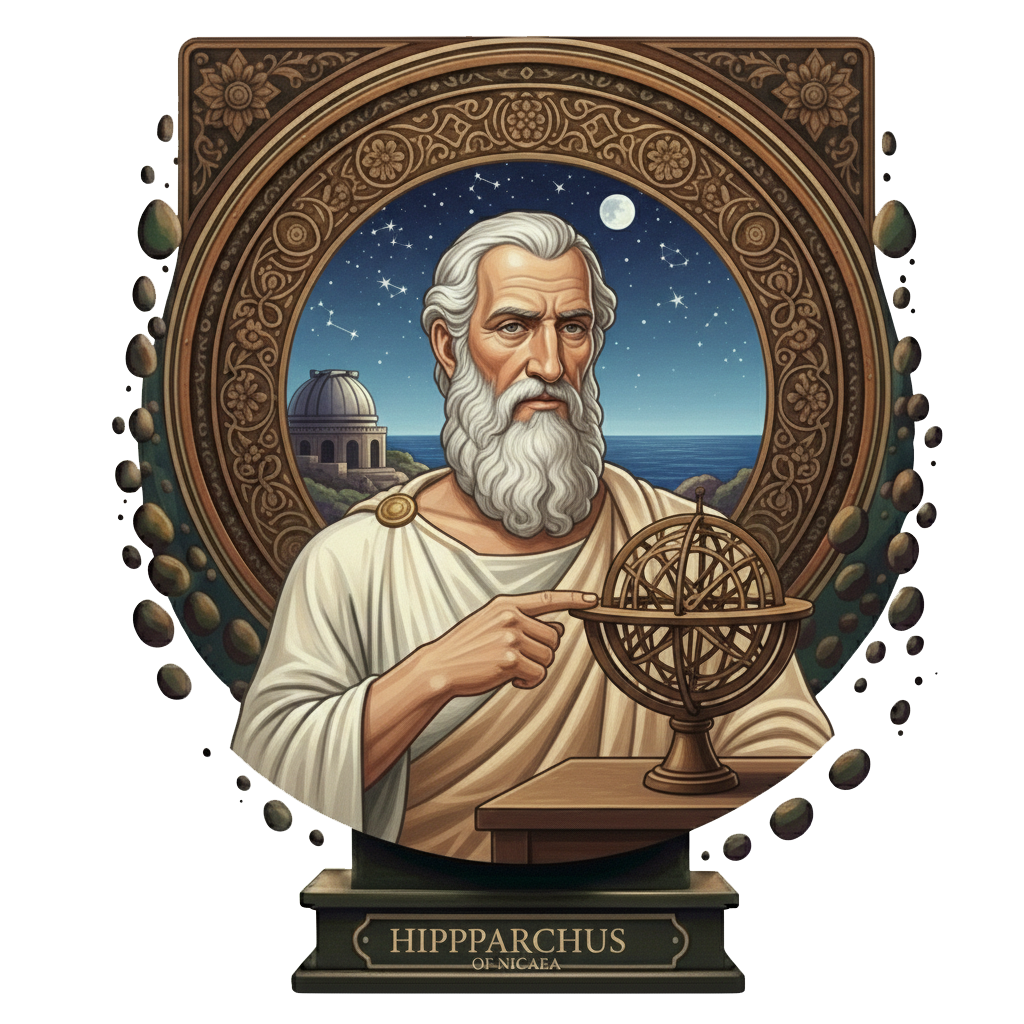
Ancient Greek astronomer and mathematician who founded trigonometry and discovered the precession of the equinoxes.
At a glance
- Born
- c. 190 BCE
- Died
- c. 120 BCE
- Era classification
- c. 70
- Homeland
- Ancient Greece (Nicaea, Bithynia)
- Period
- Hellenistic Period
- Field
- Science, Medicine & Engineering
- Language
- Ancient Greek
- Religion
- Ancient Greek religion
- Gender
- male
Biography
Hipparchus of Nicaea was a Greek astronomer, geographer, and mathematician who lived during the Hellenistic period. Born in Nicaea, Bithynia (modern-day Iznik, Turkey), he spent much of his active life observing the heavens from the island of Rhodes. He is widely considered the greatest astronomical observer of antiquity, and by many historians, the greatest overall astronomer of the ancient world.
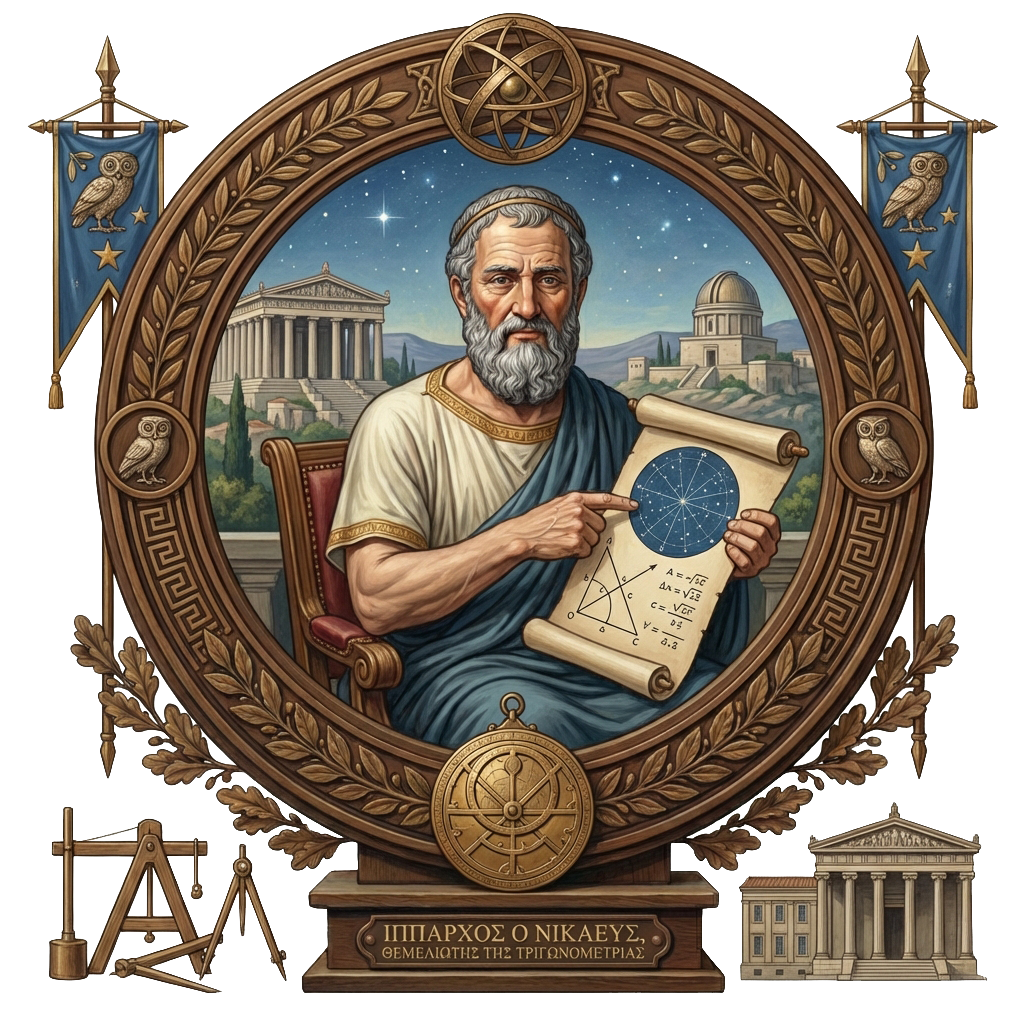
His most enduring mathematical legacy is the founding of trigonometry. Hipparchus developed the first known trigonometric table—a table of chords—which allowed him to solve complex problems in spherical trigonometry. This mathematical breakthrough provided the necessary tools to accurately predict solar and lunar eclipses, a monumental achievement that shifted astronomy from a purely theoretical philosophy into a predictive, quantitative science.
Through meticulous observation and the comparison of his own data with that of earlier Babylonian and Greek astronomers, Hipparchus discovered the precession of the equinoxes. He also compiled the first comprehensive star catalog in the Western world, documenting the positions of over 850 stars. To organize this catalog, he introduced the stellar magnitude system, classifying stars based on their apparent brightness—a foundational concept that astronomers still use today.
Although almost all of his original writings have been lost to history, his discoveries were preserved, heavily utilized, and expanded upon by Ptolemy in his seminal work, the 'Almagest', three centuries later. Hipparchus is also credited with inventing or significantly improving critical astronomical instruments, such as the astrolabe and the armillary sphere, forever changing humanity's understanding of the cosmos.
Portrayal characteristics
Saved editorial descriptions used for the reconstruction; these are not authenticated statements by the depicted person.
- Meticulous
- Analytical
- Innovative
- Observant
- Rigorous
Images & artwork 4


Connections
Euclid of Alexandria
Scientific Successor
Hipparchus built upon the geometric foundations established by Euclid to develop trigonometry.
Hipparchus utilized Euclidean geometry to create the first known trigonometric tables, which allowed him to solve problems related to the movement of celestial bodies. His work effectively translated Euclid's abstract geometry into a practical tool for astronomy.
Pythagoras
Influenced By
Hipparchus applied Pythagorean mathematical principles to the study of the stars.
Hipparchus relied on the mathematical ratios and the theorem attributed to Pythagoras to calculate the distances and sizes of the Sun and Moon. This application of Greek mathematics to physical observation was a cornerstone of his scientific method.
Aristotle
Scientific Critic
Hipparchus refined and sometimes challenged the cosmological models proposed by Aristotle.
While Hipparchus operated within a broadly Aristotelian geocentric framework, his discovery of the precession of the equinoxes and his use of epicycles provided a more mathematically rigorous model than Aristotle's simpler concentric spheres.
Known for
- Founder of trigonometry
- Discovery of the precession of the equinoxes
- First comprehensive Western star catalog
- Stellar magnitude brightness system
- Invention of the astrolabe
Episodes featuring or mentioning this figure
No eligible published episode featuring this figure is currently in the library.