



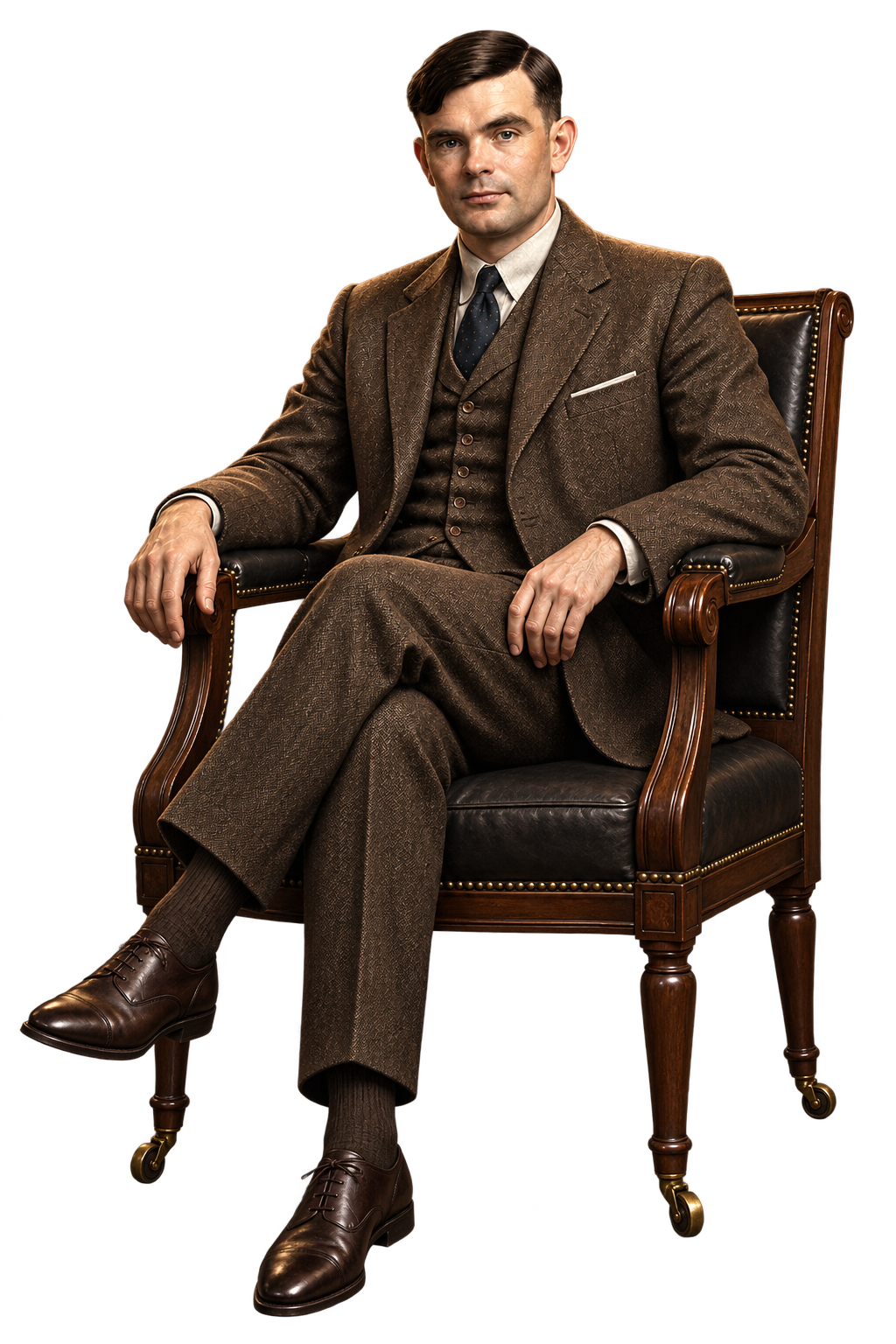
Alan Turing
Pioneering mathematician and computer scientist who cracked the Enigma code and laid the foundations of modern computing.
At a glance
- Born
- 23 June 1912
- Died
- 7 June 1954
- Era classification
- 41
- Homeland
- United Kingdom
- Period
- 1912–1954
- Field
- Science, Medicine & Engineering
- Language
- English
- Religion
- Atheist
- Gender
- male
Biography
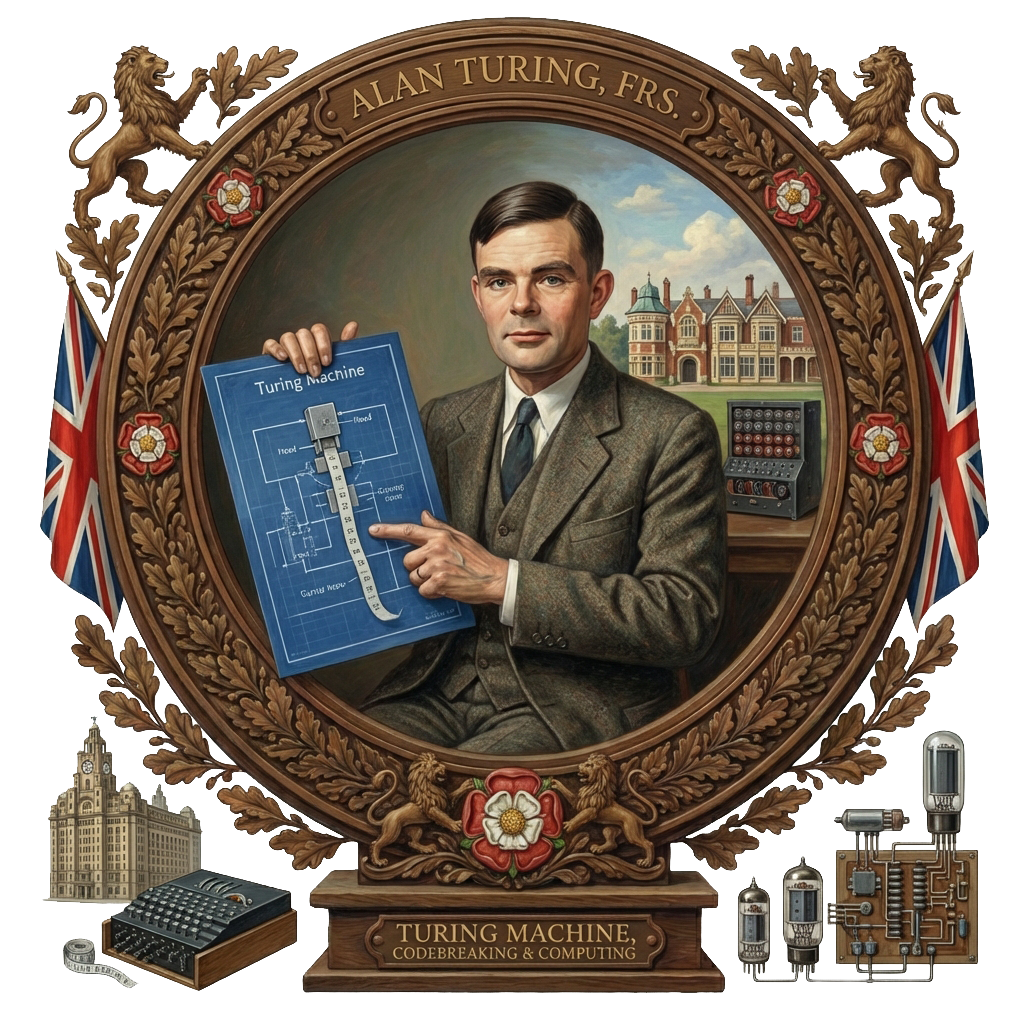
Alan Mathison Turing was born in London in 1912 and exhibited an extraordinary aptitude for mathematics and science from a young age. He studied at King's College, Cambridge, where he graduated with first-class honors. In 1936, he published a seminal paper introducing the concept of a 'Universal Turing Machine,' a theoretical construct that formalized the concepts of algorithm and computation, effectively laying the groundwork for the modern computer.
During World War II, Turing played a pivotal role at Bletchley Park, Britain's top-secret codebreaking center. He led Hut 8, the section responsible for German naval cryptanalysis, and designed the 'Bombe,' an electromechanical device that significantly accelerated the deciphering of Enigma-encrypted messages. His brilliant cryptographic breakthroughs were instrumental in the Allied victory in the Battle of the Atlantic, shortening the war and saving countless lives.
Following the war, Turing continued his pioneering research at the National Physical Laboratory and the University of Manchester. He developed the Automatic Computing Engine (ACE), one of the earliest designs for a stored-program computer. Venturing into the nascent field of artificial intelligence, he proposed the 'Turing Test' in 1950 as a standard for machine intelligence, a concept that continues to provoke profound philosophical and technological debate today.
Despite his monumental contributions to humanity, Turing suffered severe persecution for his homosexuality, which was a criminal offense in the UK at the time. In 1952, he was convicted of 'gross indecency' and forced to undergo chemical castration. Tragically, he died of cyanide poisoning in 1954 at the age of 41, in an event officially ruled as suicide. Decades later, he was posthumously pardoned by Queen Elizabeth II, cementing his legacy as a tragic hero and an unparalleled titan of science.
Portrayal characteristics
Saved editorial descriptions used for the reconstruction; these are not authenticated statements by the depicted person.
- Analytical
- Visionary
- Unconventional
- Perseverant
- Logical
- Independent
Images & artwork 7
Connections
Al-Khwarizmi
Conceptual Ancestor
Al-Khwarizmi's mathematical procedures gave rise to the concept of the 'algorithm', which Alan Turing later formalized.
In the 12th century, translations of Al-Khwarizmi's work introduced the decimal positional number system to the Western world, and his Latinized name, 'Algoritmi', evolved into the term 'algorithm'. Centuries later, Alan Turing formalized the mathematical concept of the algorithm with his Turing machine. Turing's foundational work in computer science is the direct modern descendant of Al-Khwarizmi's step-by-step mathematical procedures.
Claude Elwood Shannon
Contemporary & Peer
Turing and Shannon met during WWII and exchanged ideas on the nature of information and machine intelligence.
The two met at Bell Labs in 1943 while working on secure speech encryption. They famously discussed the possibility of building a 'mechanical brain' and compared their respective theories on cryptography and the mathematical limits of computation.
John von Neumann
Contemporary & Peer
Von Neumann recognized Turing's theoretical work as the foundation for modern computer architecture.
Von Neumann was well-acquainted with Turing's 1936 paper on 'Computable Numbers' and even offered Turing a position as his assistant at Princeton. The 'Von Neumann architecture' was significantly influenced by Turing's concept of the Universal Turing Machine.
Albert Einstein
Contemporary
Turing and Einstein were both residents at the Institute for Advanced Study in Princeton during the late 1930s.
While their fields of study were different, they shared the same intellectual environment at Princeton between 1936 and 1938. Turing was completing his PhD while Einstein was already a world-renowned figure at the Institute.
Claude Elwood Shannon
Collaborative Peers
Shannon and Turing met at Bell Labs during World War II, where they discussed the future of computing and artificial intelligence.
During their secret meetings in 1943, the two pioneers compared notes on cryptography and the possibility of building a 'mechanical brain.' Their exchange of ideas helped synthesize the fields of logic and information theory, laying the groundwork for modern computer science.
Geoffrey Hinton
Intellectual Successor
Hinton's development of deep learning and neural networks fulfills Turing's 1950 vision of creating machines that can learn from experience.
Turing's 'Computing Machinery and Intelligence' proposed that a machine could be taught rather than just programmed. Hinton's work on backpropagation and connectionism provided the practical mathematical framework to realize Turing's theoretical dream of a 'child machine' that learns.
John von Neumann
Contemporary Peers
Both were foundational figures in the development of computer science and mathematical logic.
Von Neumann was a great admirer of Turing's 1936 paper on computable numbers and invited him to the Institute for Advanced Study in Princeton, where they discussed the future of computing machinery.
OpenAI GPT 5.2 Pro
Conceptual Foundation
Turing's theoretical work on computation and the 'Turing Test' provided the original framework for artificial intelligence.
GPT-5 represents a modern realization of Turing's 'Universal Machine,' striving to achieve the level of conversational intelligence Turing first hypothesized in 1950.
satoshi nakamoto
Foundational Influence
Turing's work on the mathematical limits of computation and early cryptography is the essential ancestor to the blockchain technology Nakamoto created.
The 'Turing Complete' nature of modern computing systems is what allows for the complex scripting and cryptographic verification required for Bitcoin. Nakamoto's whitepaper relies on the evolution of computer science that began with Turing's wartime codebreaking and theoretical machines.
Winston Churchill
Wartime Leader & Strategist
Churchill recognized the vital importance of Turing's code-breaking work at Bletchley Park during World War II.
When Turing and his colleagues wrote directly to Churchill about a lack of resources, Churchill famously ordered 'Action This Day,' ensuring the Enigma-breaking team had everything they needed to succeed.
Known for
- Turing Machine
- Cracking the Enigma code
- Turing Test
- Foundations of theoretical computer science
- Automatic Computing Engine (ACE)
- Mathematical biology (morphogenesis)
Episodes featuring or mentioning this figure
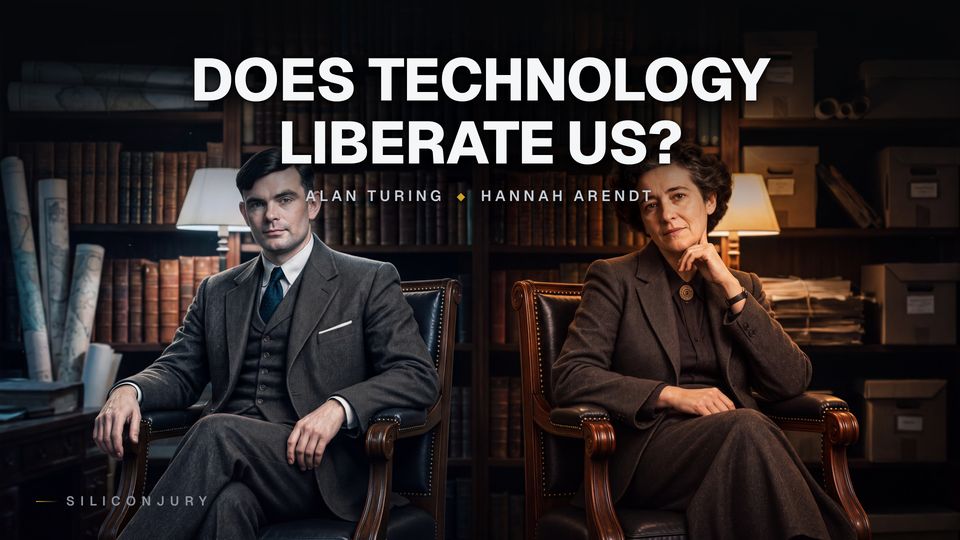
Does Technology Make Us More Free? Alan Turing vs Hannah Arendt
Does technological progress expand the horizon of human freedom, or does it merely perfect the machinery of administrative control?
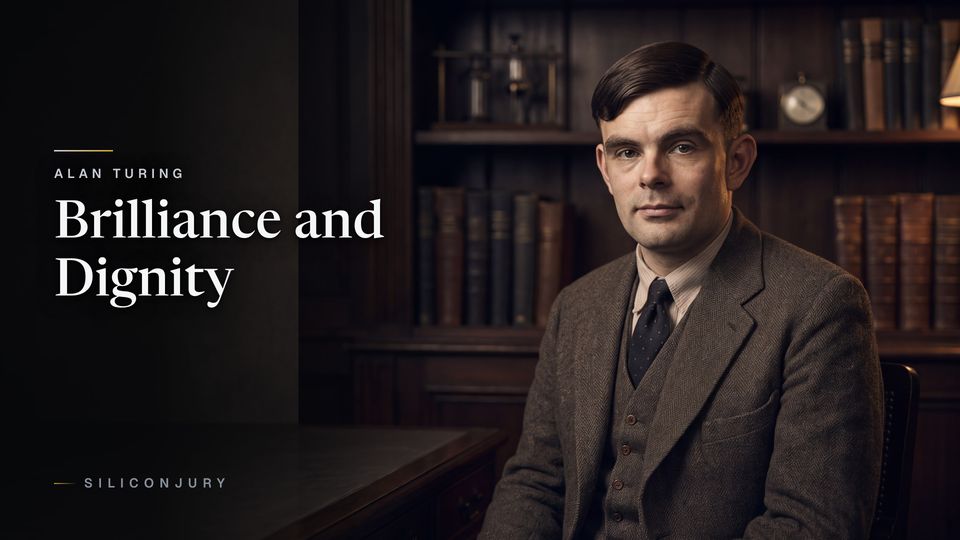
Alan Turing: A Biography of Logic, Bletchley Park, and Injustice
Alan Turing reshaped mathematics, wartime intelligence, and modern computing, only to face criminal prosecution under the laws of the nation he served.
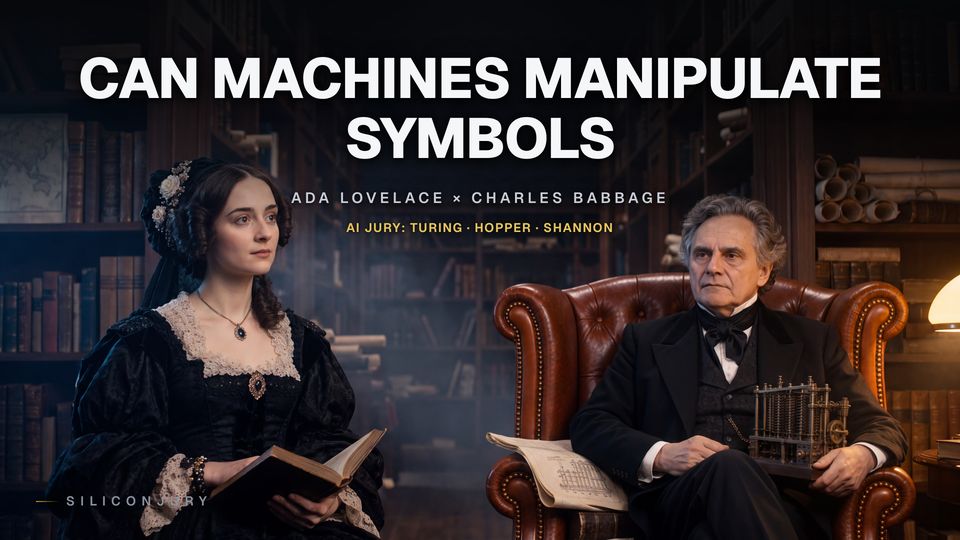
Ada Lovelace vs Charles Babbage: Calculating Numbers or Weaving Symbols?
AI jury: 3 members
Was the Analytical Engine conceived merely to automate numerical calculations for printed mathematical tables, or did it establish the foundational principles of universal…