



Claude Elwood Shannon
American mathematician and electrical engineer widely celebrated as the founding father of information theory.
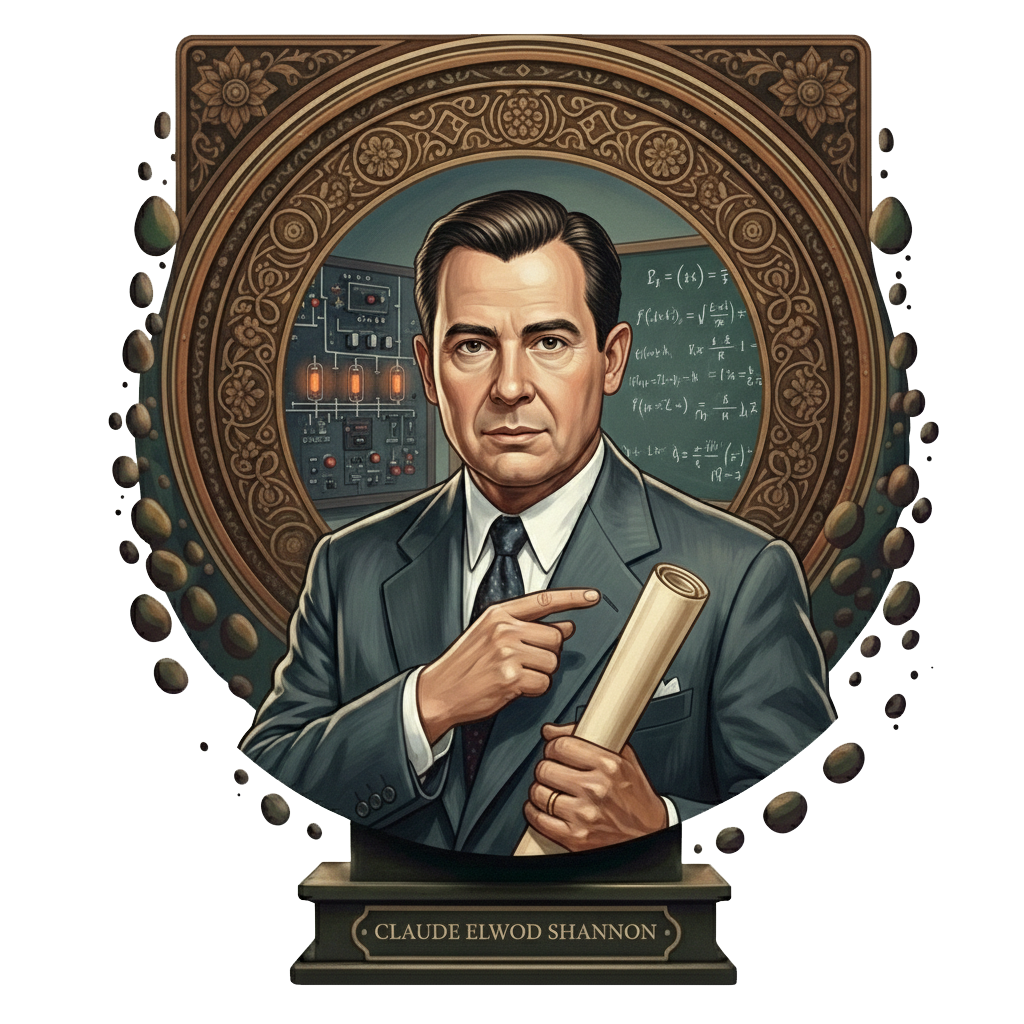
At a glance
- Born
- 1916 CE
- Died
- 2001 CE
- Era classification
- 84
- Homeland
- USA
- Period
- 1916–2001
- Field
- Science, Medicine & Engineering
- Language
- English
- Religion
- Atheist
- Gender
- male
Biography
Claude Elwood Shannon was born in Petoskey, Michigan, in 1916. From a young age, he exhibited a profound fascination with mechanical and electrical devices, often building models and tinkering with radio sets. He pursued higher education at the University of Michigan, where he earned dual bachelor's degrees in electrical engineering and mathematics, setting the stage for his interdisciplinary genius.
In 1937, while pursuing his master's degree at the Massachusetts Institute of Technology (MIT), Shannon authored what is widely considered the most important master's thesis of the 20th century. Titled 'A Symbolic Analysis of Relay and Switching Circuits,' the paper demonstrated that the binary properties of electrical switches could be used to perform logic operations based on Boolean algebra. This groundbreaking insight laid the foundational architecture for all modern digital computers and telecommunications systems.
Shannon's most monumental contribution came in 1948 during his tenure at Bell Labs, where he published the landmark paper 'A Mathematical Theory of Communication.' This work single-handedly birthed the field of information theory. By introducing the concept of the 'bit' (binary digit) as the fundamental unit of information, Shannon provided the mathematical framework necessary to quantify, compress, and transmit data flawlessly, effectively launching the digital age.
Beyond his monumental academic achievements, Shannon was renowned for his eccentric and playful nature. He frequently rode a unicycle through the halls of Bell Labs while juggling and spent his later years inventing whimsical devices, such as a chess-playing computer, a juggling machine, and a wearable computer to beat roulette. Passing away in 2001, Shannon left behind a legacy that forms the invisible bedrock of the modern internet, digital media, and global communications.
Portrayal characteristics
Saved editorial descriptions used for the reconstruction; these are not authenticated statements by the depicted person.
- Analytical
- Visionary
- Playful
- Inventive
- Eccentric
- Curious
Images & artwork 4
Connections
Alan Turing
Contemporary & Peer
Turing and Shannon met during WWII and exchanged ideas on the nature of information and machine intelligence.
The two met at Bell Labs in 1943 while working on secure speech encryption. They famously discussed the possibility of building a 'mechanical brain' and compared their respective theories on cryptography and the mathematical limits of computation.
Alan Turing
Collaborative Peers
Shannon and Turing met at Bell Labs during World War II, where they discussed the future of computing and artificial intelligence.
During their secret meetings in 1943, the two pioneers compared notes on cryptography and the possibility of building a 'mechanical brain.' Their exchange of ideas helped synthesize the fields of logic and information theory, laying the groundwork for modern computer science.
John von Neumann
Scientific Contemporaries
Both Shannon and von Neumann were key figures at the Institute for Advanced Study and pioneers of the digital age.
Von Neumann's work on computer architecture and Shannon's Mathematical Theory of Communication are the two pillars of modern computing. They interacted frequently in academic circles, with von Neumann famously advising Shannon to use the term 'entropy' for his measure of information.
Geoffrey Hinton
Theoretical Influence
Hinton's work on restricted Boltzmann machines and information-theoretic learning builds upon the foundations of information theory established by Shannon.
Hinton utilized concepts like entropy and information gain, pioneered by Shannon, to develop algorithms that minimize 'surprise' or error in data. This mathematical bridge between communication theory and machine learning is central to the efficiency of modern AI models.
John von Neumann
Contemporary Allies
They were both pioneers of information theory and the early digital age.
Von Neumann and Shannon interacted during the early development of cybernetics and digital logic; von Neumann famously advised Shannon to use the term 'entropy' for his measure of information.
OpenAI GPT 5.2 Pro
Information Theory Basis
Shannon's mathematical theory of communication is essential for the data processing and entropy calculations in LLMs.
GPT models rely on Shannon's principles of information theory to predict the next token in a sequence, optimizing for the most probable and coherent linguistic output.
satoshi nakamoto
Scientific Foundation
Shannon's Information Theory and his work on digital cryptography provided the mathematical certainty required for Nakamoto's decentralized ledger.
Satoshi Nakamoto utilized SHA-256 hashing and public-key cryptography, both of which are direct descendants of the digital communication principles Shannon established in the mid-20th century. Without Shannon's definition of entropy and data integrity, the security of the blockchain would be impossible.
Known for
- Founding Information Theory
- Digital circuit design foundation
- Introducing the concept of the 'bit'
- Application of Boolean algebra to electrical circuits
- Shannon-Weaver model of communication
Episodes featuring or mentioning this figure
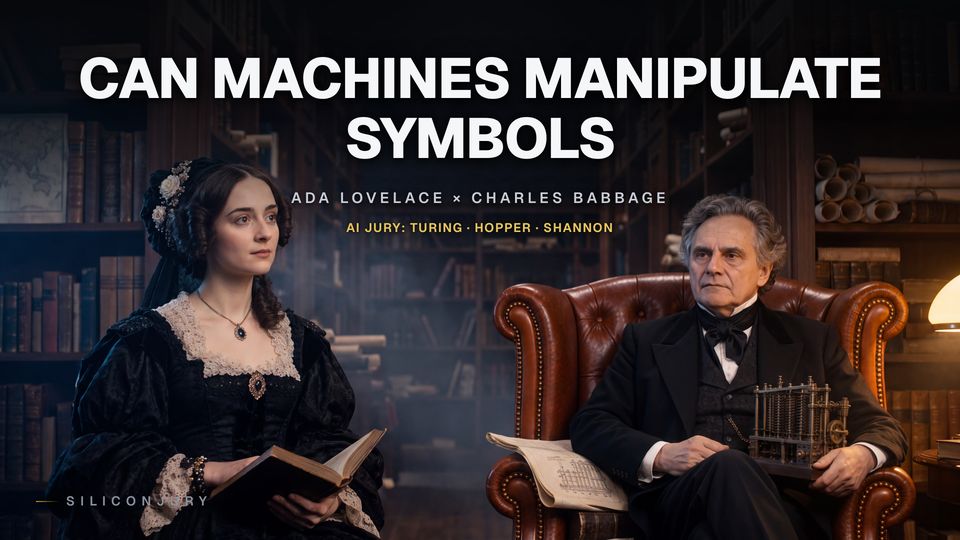
Ada Lovelace vs Charles Babbage: Calculating Numbers or Weaving Symbols?
AI jury: 3 members
Was the Analytical Engine conceived merely to automate numerical calculations for printed mathematical tables, or did it establish the foundational principles of universal…