



Andreas Vesalius
A pioneering 16th-century anatomist who revolutionized medicine by establishing the foundations of modern human anatomy.
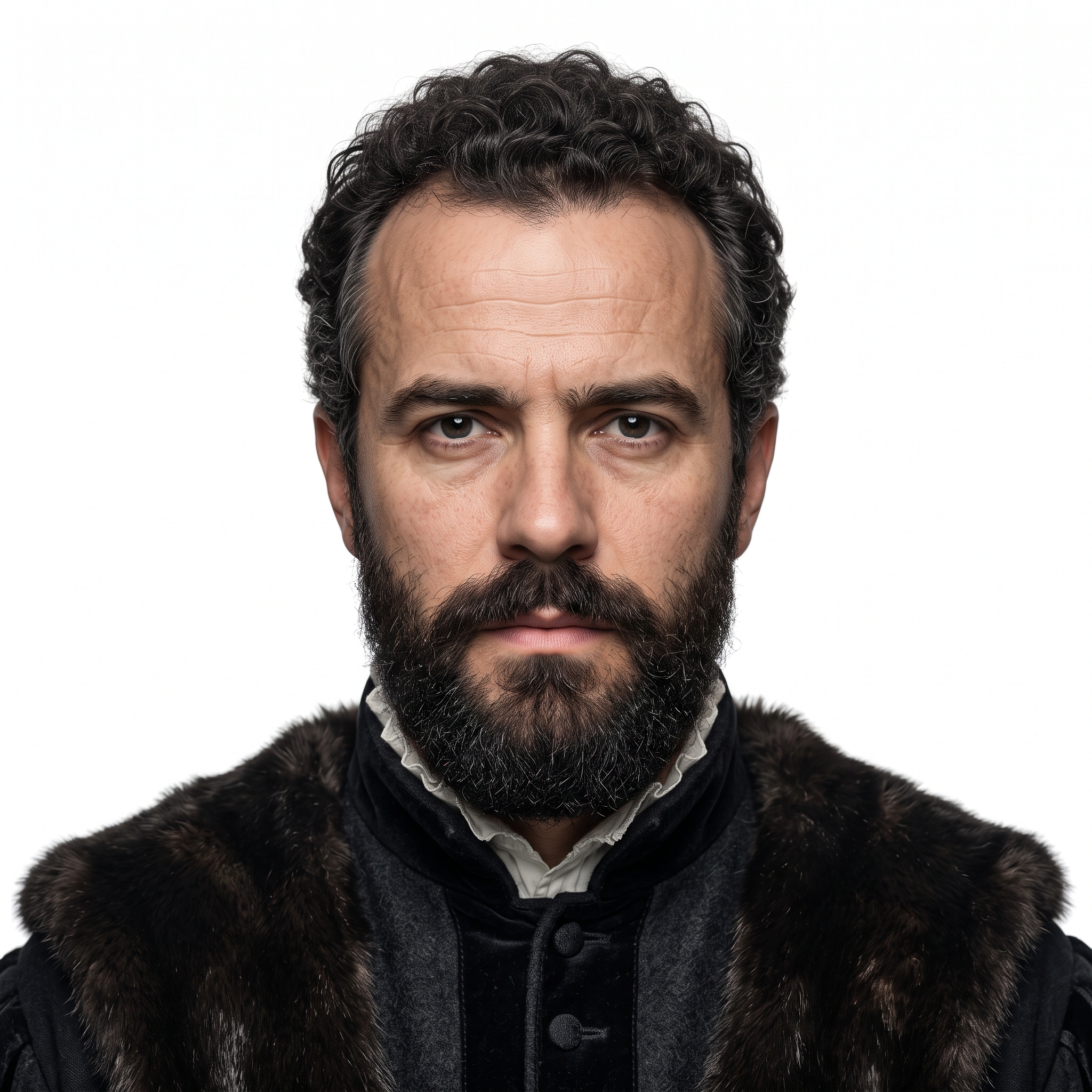
At a glance
- Born
- 1514 CE
- Died
- 1564 CE
- Era classification
- 49
- Homeland
- Habsburg Netherlands (Modern Belgium)
- Period
- 1514–1564 CE
- Field
- Science, Medicine & Engineering
- Language
- Latin
- Religion
- Catholic
- Gender
- male
Biography
Andreas Vesalius was born in Brussels, then part of the Habsburg Netherlands, into a prominent family of physicians and apothecaries. He received his early education at the University of Leuven before moving to the University of Paris to study medicine. In Paris, he was trained in the traditional Galenic medical doctrines, which had dominated European medicine for over a millennium. However, Vesalius quickly grew frustrated with the prevailing academic practice of relying on ancient texts rather than direct observation, particularly since Galen's anatomical findings were largely based on animal rather than human dissections.
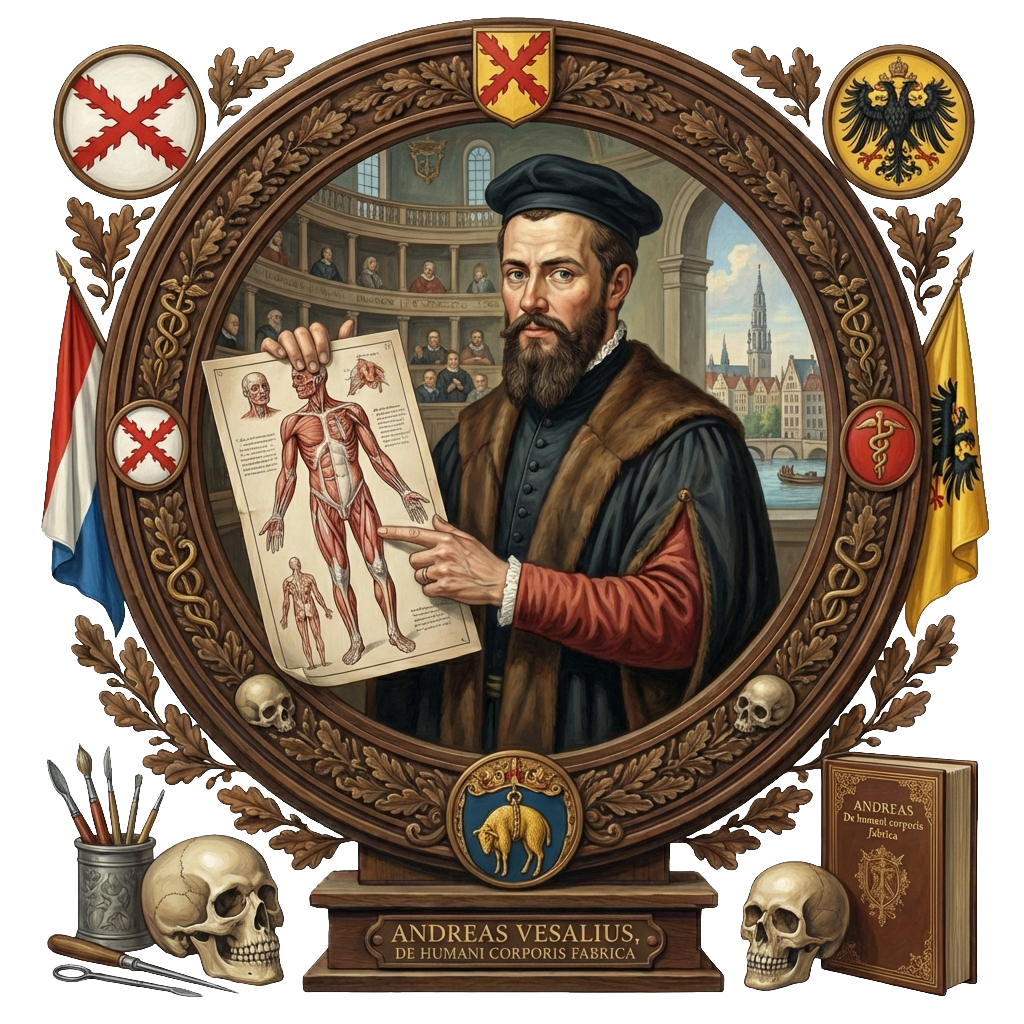
Seeking a more progressive academic environment, Vesalius relocated to the University of Padua in Italy, where he earned his medical degree and was promptly appointed as a professor of surgery and anatomy. It was here that he revolutionized medical education by personally performing dissections while lecturing, a stark departure from the tradition where a professor read from a text while an assistant cut. In 1543, at the age of 28, he published his magnum opus, 'De humani corporis fabrica' (On the Fabric of the Human Body). This monumental seven-volume work featured unprecedentedly detailed and accurate anatomical illustrations, many attributed to the studio of the Renaissance artist Titian.
'De humani corporis fabrica' fundamentally transformed medical science by correcting over 200 of Galen's errors and establishing empirical observation as the basis of anatomical study. Despite facing backlash from traditionalists who fiercely defended Galen, Vesalius's methods eventually became the new standard. He later left academia to serve as the imperial physician to Holy Roman Emperor Charles V and subsequently to King Philip II of Spain. Vesalius died in 1564 on the Greek island of Zakynthos following a shipwreck during his return voyage from a pilgrimage to Jerusalem, leaving behind a legacy as the founder of modern human anatomy.
Portrayal characteristics
Saved editorial descriptions used for the reconstruction; these are not authenticated statements by the depicted person.
- Empirical
- Meticulous
- Innovative
- Iconoclastic
- Observant
Images & artwork 4


Connections
Abu Ali Sina (Avicenna)
Scientific Successor
Vesalius eventually challenged the long-standing medical dominance of Avicenna's 'Canon' during the Renaissance.
For centuries, Avicenna's texts were the absolute authority in European medical schools. Vesalius, through direct human dissection, began to point out errors in the Galenic-Avicennian tradition, marking the transition from medieval scholastic medicine to modern anatomy.
Galen
Scientific Challenger
Vesalius's work 'De humani corporis fabrica' systematically corrected hundreds of anatomical errors found in the works of Galen.
By performing his own dissections, Vesalius proved that Galen's observations were often based on animal rather than human anatomy, sparking a revolution in medical science.
Leonardo da Vinci
Contemporary Anatomists
Both men revolutionized the study of the human body through direct observation and highly detailed anatomical illustration.
While Leonardo's anatomical notebooks remained unpublished for centuries, both figures represent the Renaissance shift toward empirical study and the marriage of art and science.
Hippocrates
Successor in Medicine
Vesalius operated within the long tradition of Western medicine established by Hippocrates but moved it toward a more physical, observational basis.
Vesalius's insistence on 'autopsia' (seeing for oneself) was an evolution of the Hippocratic focus on clinical observation, moving from the bedside to the dissection table.
Galen
Scientific Challenger
Vesalius revolutionized anatomy by proving that many of Galen's descriptions, based on animal dissection, were inaccurate for human biology.
In his 1543 work 'De humani corporis fabrica', Vesalius performed direct human dissections to challenge Galen's errors, which had resulted from Galen's reliance on Barbary macaques and pigs. This confrontation marked the beginning of modern observational anatomy and the decline of Galenic authority.
Known for
- De humani corporis fabrica
- Founding modern human anatomy
- Pioneering direct human dissection
- Correcting Galen's anatomical errors
- Serving as imperial physician to Charles V
Episodes featuring or mentioning this figure
No eligible published episode featuring this figure is currently in the library.