



Susan B. Anthony
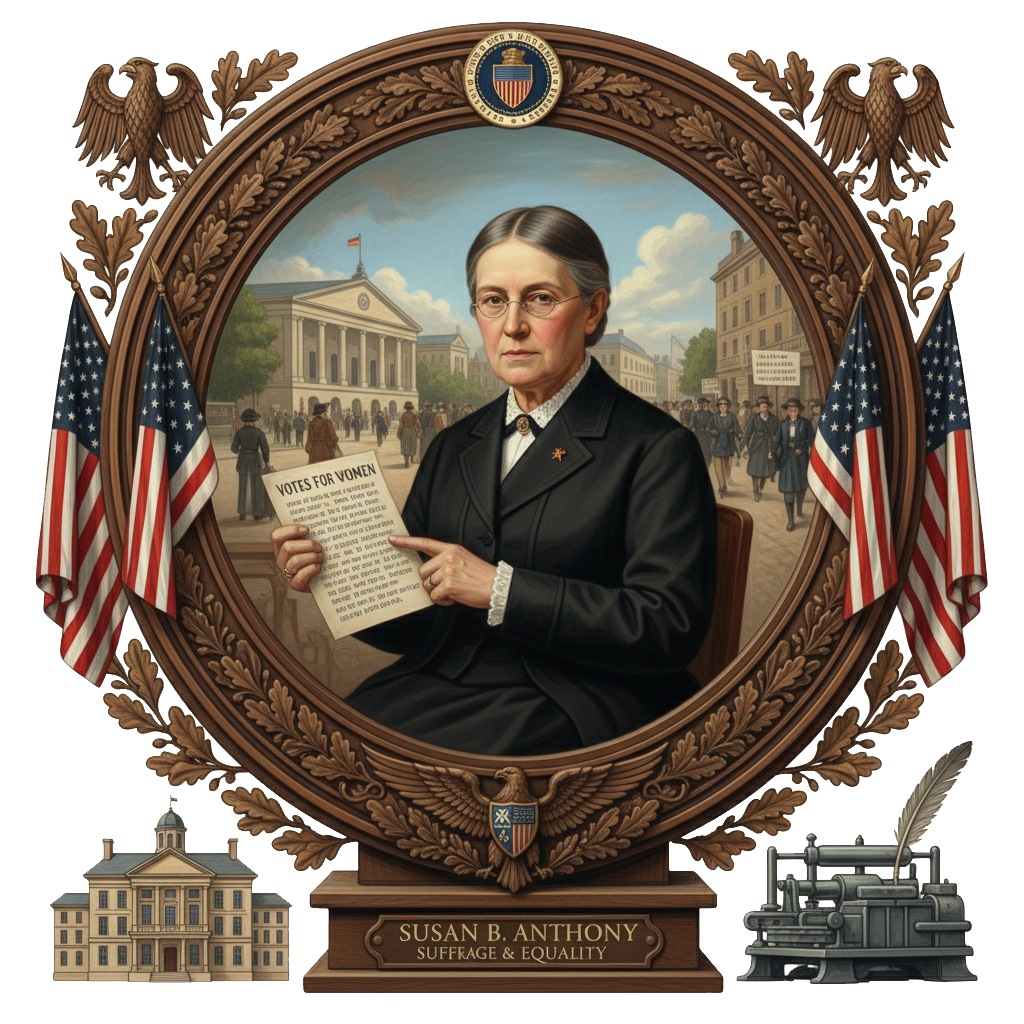
A pioneering American social reformer and women's rights activist who played a pivotal role in the suffrage movement.
At a glance
- Born
- 1820 CE
- Died
- 1906 CE
- Era classification
- Modern
- Homeland
- United States
- Period
- 19th Century
- Field
- Ethics & Culture
- Language
- English
- Religion
- Quaker
- Gender
- female
Biography
Susan B. Anthony was born in Massachusetts into a Quaker family with strong traditions of social equality and moral reform. She began her activist career in the abolitionist and temperance movements, where she frequently faced discrimination because she was a woman, which ignited her passion for women's rights.
Partnering with Elizabeth Cady Stanton, Anthony dedicated her life to the women's suffrage movement. They co-founded the National Woman Suffrage Association and published a women's rights newspaper called 'The Revolution'. Anthony traveled extensively, delivering speeches and gathering petitions to demand the right to vote for women.
In 1872, Anthony famously voted in the presidential election illegally, leading to her arrest and a highly publicized trial that brought national attention to the suffrage cause. Although she died 14 years before the 19th Amendment granted women the right to vote, the amendment was widely known as the 'Susan B. Anthony Amendment' in her honor.
Portrayal characteristics
Saved editorial descriptions used for the reconstruction; these are not authenticated statements by the depicted person.
- Tenacious
- Principled
- Outspoken
- Dedicated
- Fearless
Images & artwork 3
Connections
Frederick Douglass
Civil Rights Allies
They were long-time collaborators in the movements for both abolition and women's suffrage.
Douglass was the only African American to attend the Seneca Falls Convention in 1848, where he supported Anthony's demand for the right to vote. Though they split over the 15th Amendment's exclusion of women, they reconciled later in life and continued to support each other's causes.
Harriet Tubman
Suffragist Allies
In her later years, Tubman worked closely with Susan B. Anthony in the fight for women's suffrage.
Tubman frequently spoke at suffrage conventions alongside Anthony, linking the struggle for racial equality with the struggle for women's rights. Anthony famously helped Tubman with her finances and supported her efforts to establish a home for the elderly.
Frederick Douglass
Abolitionist Allies
Anthony and Douglass were close friends and long-time collaborators in the movements for abolition and women's suffrage.
Despite a temporary rift over the 15th Amendment, which granted voting rights to Black men but not women, they remained lifelong allies in the fight for universal civil rights and human dignity.
Abraham Lincoln
Political Lobbyist & President
Anthony worked to pressure Lincoln toward the total abolition of slavery during the American Civil War.
She helped organize the Women's Loyal National League, which collected nearly 400,000 signatures to support the passage of the 13th Amendment, directly influencing Lincoln's legislative agenda.
Harriet Tubman
Suffrage Comrades
Tubman worked alongside Anthony in the later years of her life to advocate for women's right to vote.
Anthony hosted Tubman at her home in Rochester and they appeared together at several suffrage conventions, where Tubman was a celebrated speaker representing the intersection of racial and gender equality.
Known for
- Women's suffrage movement
- Co-founding the National Woman Suffrage Association
- Abolitionist efforts
Episodes featuring or mentioning this figure
No eligible published episode featuring this figure is currently in the library.