



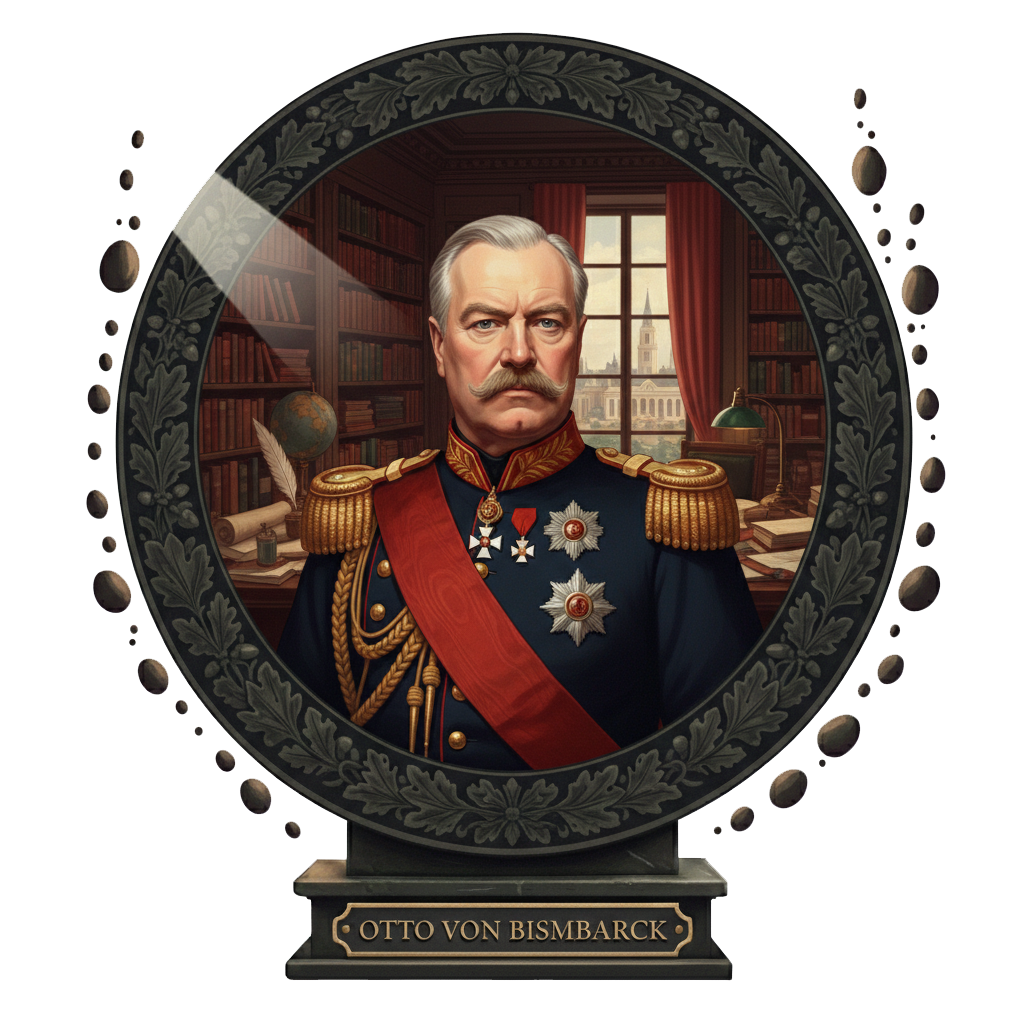
Otto von Bismarck
Mastermind of German unification and the first Chancellor of the German Empire, known for his Realpolitik diplomacy.
At a glance
- Born
- 1815 CE
- Died
- 1898 CE
- Era classification
- 83
- Homeland
- Germany (Prussia)
- Period
- 1815–1898 CE
- Field
- Politics, Leadership & War
- Language
- German
- Religion
- Lutheran
- Gender
- male
Biography
Otto von Bismarck was born in 1815 into a wealthy Junker family in Prussia. Educated in law, he initially served as a diplomat, representing Prussia in various European courts. During these formative years, he honed his acute understanding of international relations, power dynamics, and the conservative principles that would define his political career.
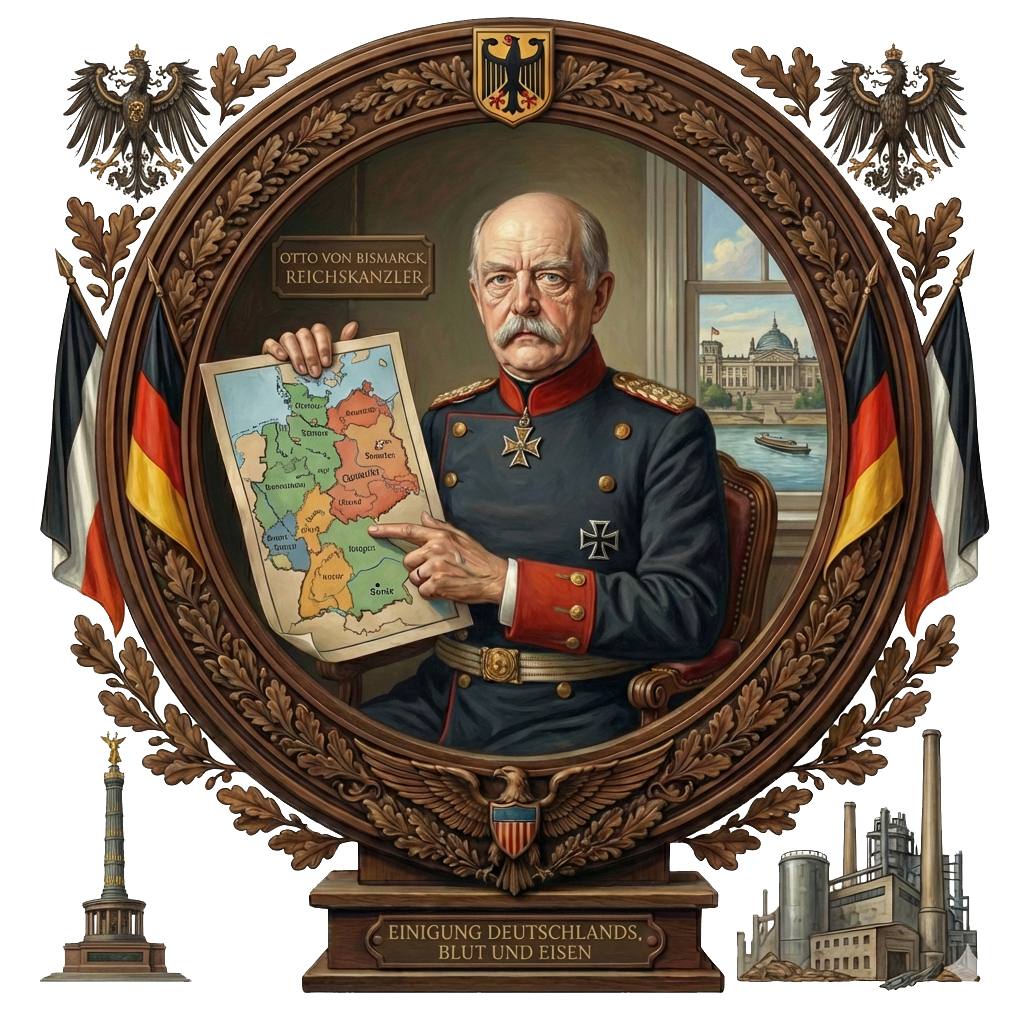
Appointed Minister President of Prussia in 1862 by King Wilhelm I, Bismarck famously declared that the great questions of the day would be decided by 'iron and blood.' Through a series of calculated, victorious wars against Denmark, Austria, and France, he successfully united the disparate German states into a single, powerful German Empire in 1871, fundamentally altering the balance of power in Europe.
As the first Chancellor of the new empire, Bismarck dominated European politics for two decades. He implemented a complex system of alliances to maintain peace in Europe and isolate France. Domestically, he pioneered the world's first modern welfare state—introducing health insurance, accident insurance, and old-age pensions—partly as a strategic move to undermine the growing socialist movement and secure the loyalty of the working class.
Forced to resign in 1890 by the young and ambitious Kaiser Wilhelm II, Bismarck spent his final years writing his memoirs. His legacy remains deeply debated; while he is revered as a brilliant statesman who forged a unified Germany, his authoritarian tendencies and militaristic foundations set precedents that heavily influenced the turbulent course of 20th-century German history.
Portrayal characteristics
Saved editorial descriptions used for the reconstruction; these are not authenticated statements by the depicted person.
- Pragmatic
- Authoritarian
- Calculating
- Diplomatic
- Resolute
- Conservative
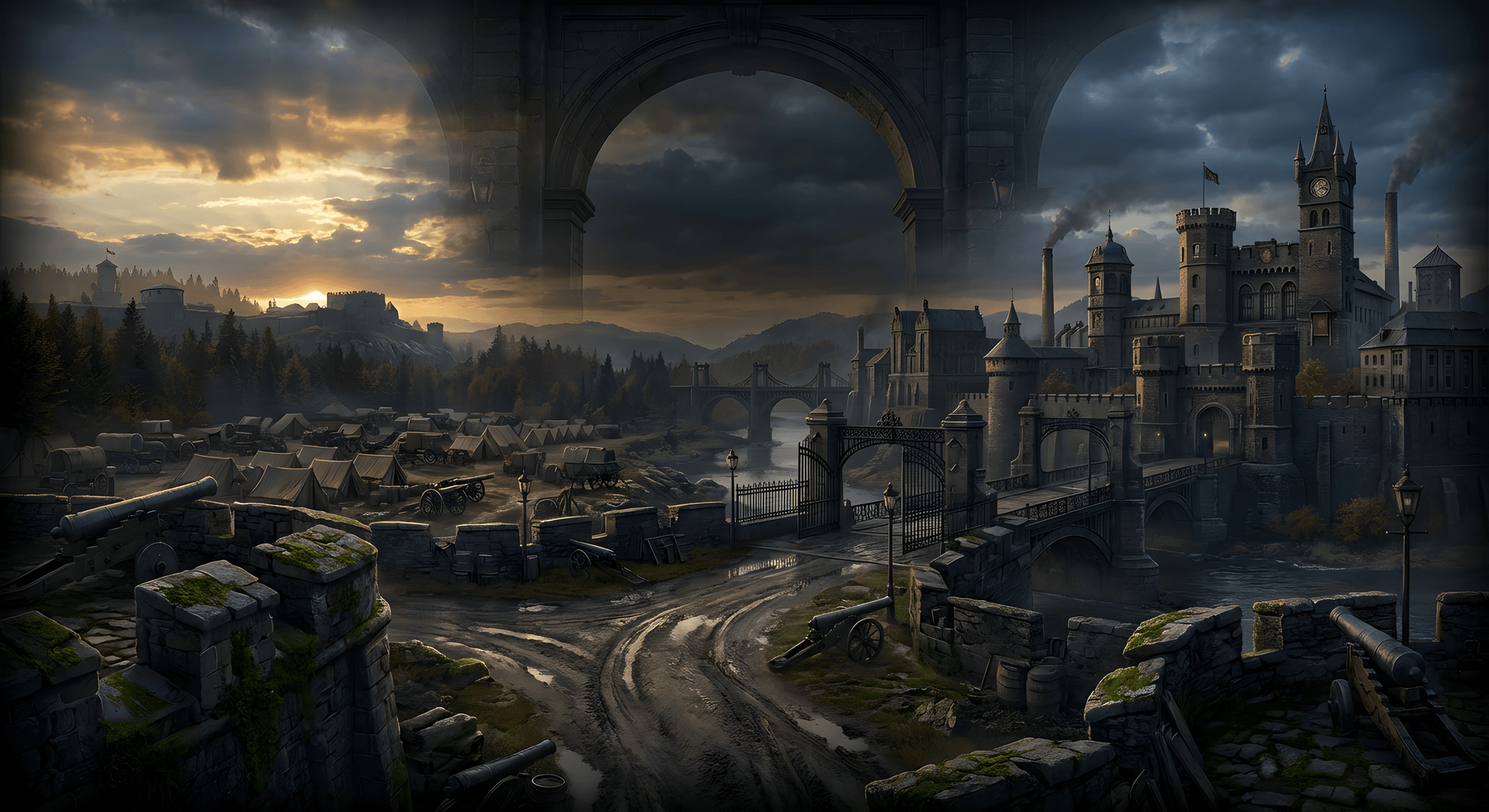
Images & artwork 5
Connections
Napoleon Bonaparte
Geopolitical Rivalry (Legacy)
Bismarck's unification of Germany was a direct response to the power vacuum and French dominance established by Napoleon I.
Bismarck utilized the memory of the Napoleonic Wars to stoke German nationalism, eventually defeating Napoleon III in the Franco-Prussian War to finalize German unification.
Karl Marx
Political Opponents
Bismarck implemented the world's first modern welfare state to neutralize the socialist movement led by Marx's followers.
Despite their ideological enmity, Bismarck's 'State Socialism' (health insurance and pensions) was a pragmatic strategy to prevent the proletarian revolution that Marx advocated.
Abraham Lincoln
Contemporary State-Builders
Both leaders were contemporaries who led their respective nations through wars of unification in the 1860s.
Bismarck closely observed the American Civil War, and the two leaders are often compared for their roles in centralizing federal power and overseeing rapid industrialization in Germany and the United States.
Charles de Gaulle
Historical Antagonist
De Gaulle's worldview and military career were fundamentally shaped by the geopolitical order established by Bismarck, specifically the trauma of the Franco-Prussian War and the loss of Alsace-Lorraine.
Charles de Gaulle was born in 1890 in Lille, a region deeply scarred by the legacy of Otto von Bismarck. Bismarck's orchestration of the Franco-Prussian War (1870-1871) resulted in the humiliating defeat of France, the unification of the German Empire, and the annexation of Alsace-Lorraine. De Gaulle was raised in a fiercely patriotic family that mourned this loss; his father was a veteran of the 1870 war. The desire to avenge Bismarck's victory and restore French honor was the defining animus of de Gaulle's generation, leading directly to his service in World War I. Throughout his life, de Gaulle viewed Germany through the lens of Bismarck's legacy—recognizing its inherent power and the necessity of containing it. When de Gaulle later championed Franco-German reconciliation in the 1960s, it was a conscious effort to finally close the chapter of European history that Bismarck's blood-and-iron unification had opened.
Known for
- Unification of Germany
- Realpolitik diplomacy
- First Chancellor of the German Empire
- Creation of the modern welfare state
- The 'Blood and Iron' speech
Episodes featuring or mentioning this figure
No eligible published episode featuring this figure is currently in the library.