



Charlemagne
King of the Franks who united much of Western Europe and became the first Holy Roman Emperor.
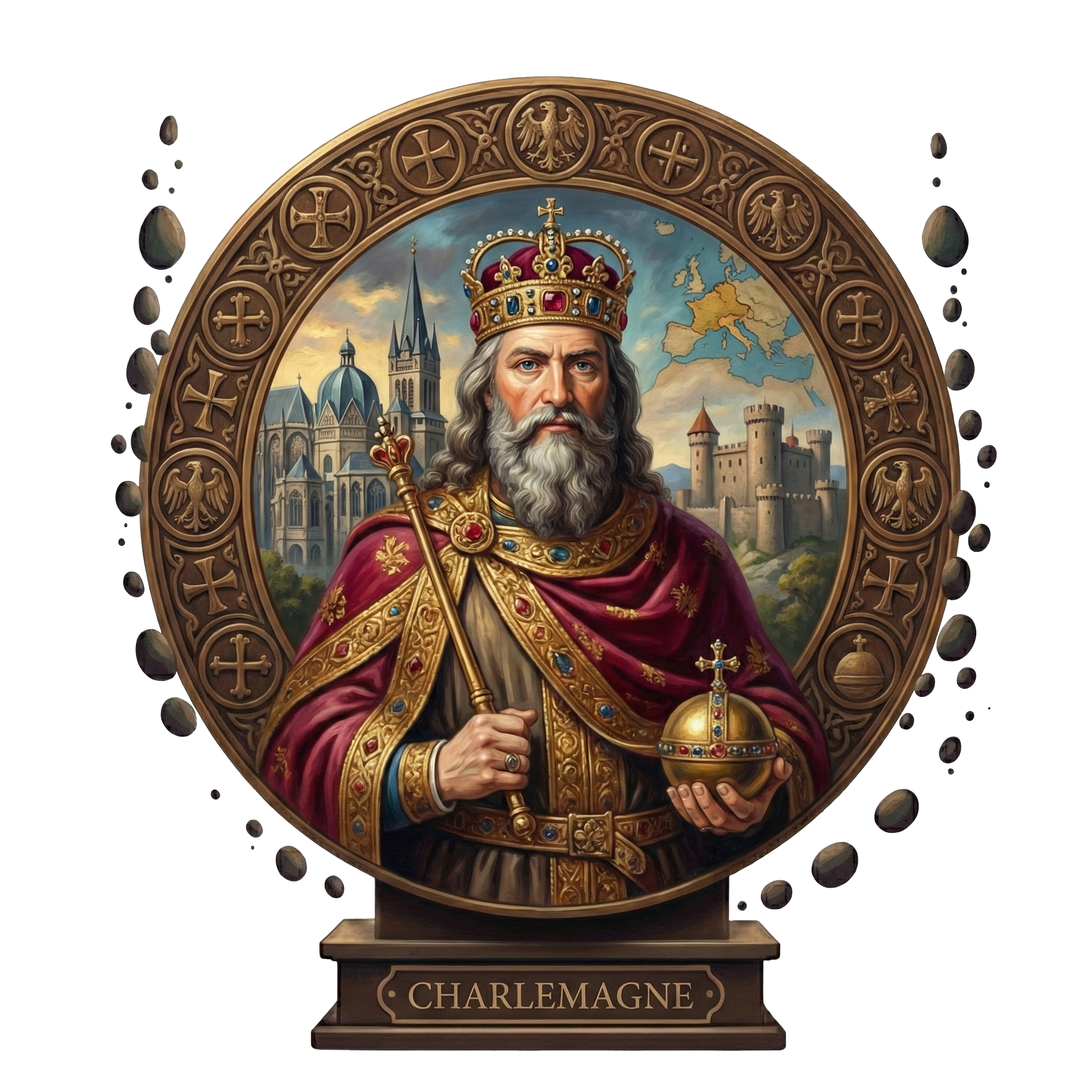
At a glance
- Born
- c. 742 CE
- Died
- 814 CE
- Era classification
- 71
- Homeland
- Francia
- Period
- 742–814 CE
- Field
- Politics, Leadership & War
- Language
- Frankish
- Religion
- Catholic
- Gender
- male
Biography
Charlemagne, also known as Charles the Great, was born around 742 CE to Pepin the Short and Bertrada of Laon. He became King of the Franks in 768 CE, initially co-ruling with his brother Carloman I until the latter's sudden death in 771 CE. As sole ruler, Charlemagne embarked on a relentless mission to unite all Germanic peoples into one kingdom and convert his subjects to Christianity.
He spent much of his reign engaged in warfare. His most famous and grueling conflict was the Saxon Wars, spanning over three decades, which resulted in the incorporation of Saxony into the Frankish realm and the forced conversion of the Saxons. He also campaigned in Italy, conquering the Lombards to protect the Papacy, and in Spain, establishing the Marca Hispanica as a buffer zone against the Moors.
On Christmas Day, 800 CE, Pope Leo III crowned Charlemagne Emperor of the Romans, reviving the imperial title in Western Europe for the first time since the fall of the Western Roman Empire. This historic act laid the foundation for what would eventually become the Holy Roman Empire. Domestically, Charlemagne spurred the Carolingian Renaissance, a period of energetic cultural and intellectual activity within the Western church that promoted education, literature, art, and administrative reform.
Charlemagne died in 814 CE in Aachen, his imperial capital, leaving his vast empire to his sole surviving legitimate son, Louis the Pious. Often referred to as the 'Father of Europe' (Pater Europae), Charlemagne's legacy endured for centuries, profoundly shaping the political, cultural, and religious landscape of the continent.
Portrayal characteristics
Saved editorial descriptions used for the reconstruction; these are not authenticated statements by the depicted person.
- Ambitious
- Pious
- Authoritative
- Visionary
- Relentless
- Charismatic
Images & artwork 4
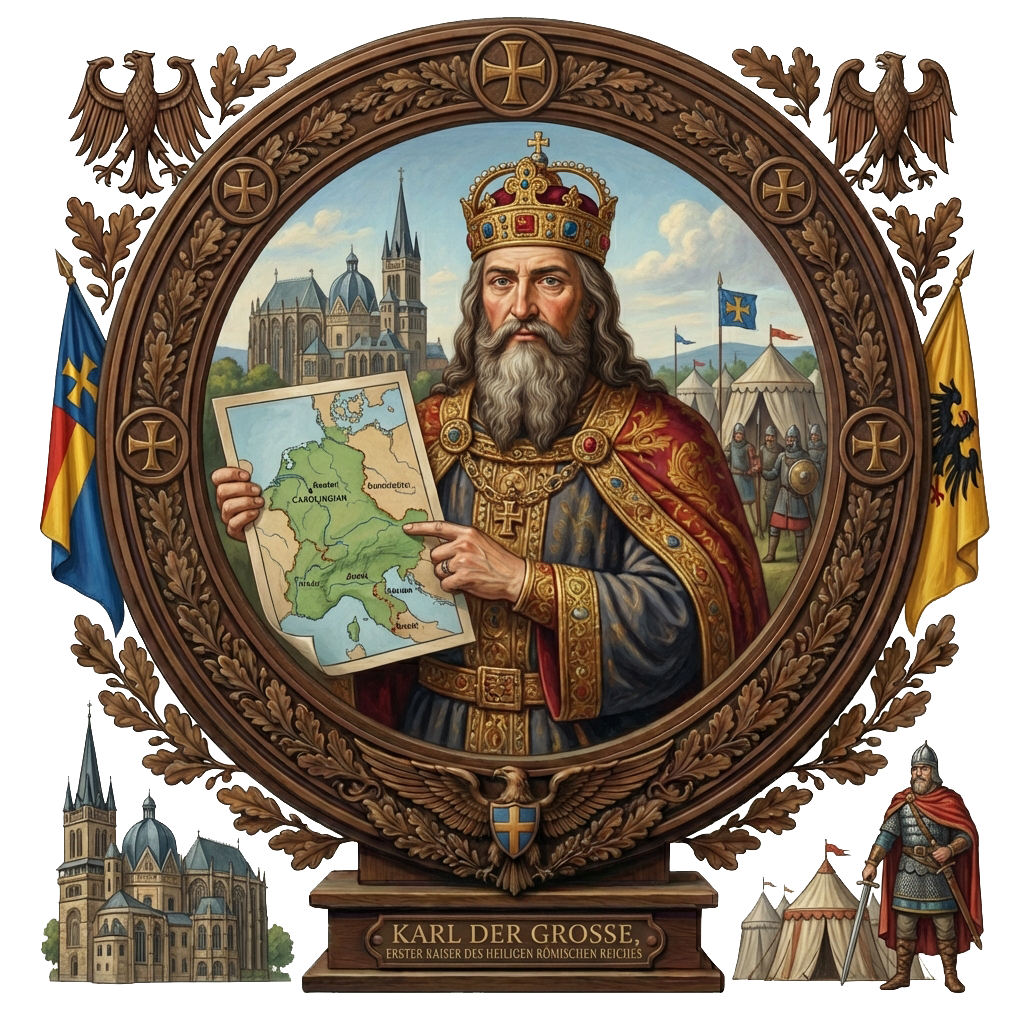
Connections
Napoleon Bonaparte
Historical Inspiration
Napoleon deeply admired Charlemagne and sought to recreate his pan-European empire.
Napoleon styled himself as a modern Charlemagne, even traveling to Aachen to pay respects at his tomb before his own imperial coronation. He viewed the Carolingian Empire as the blueprint for his own efforts to unify the European continent under a single legal and political system.
Napoleon Bonaparte
Political Successor
Napoleon saw himself as the restorer of the Frankish Empire and a modern-day Charlemagne.
Before his coronation in 1804, Napoleon visited Charlemagne's tomb in Aachen and used 'the crown of Charlemagne' during the ceremony. He aimed to unify Europe under a single legal and administrative system, much like the Carolingian Empire.
Charles de Gaulle
Historical Symbol of European Unity
De Gaulle frequently invoked the legacy of Charlemagne to conceptualize and promote Franco-German reconciliation as the engine of a unified, independent Europe.
In his post-WWII vision for Europe, Charles de Gaulle sought to end the centuries-old enmity between France and Germany. To provide a historical and cultural foundation for this new alliance, he frequently referenced Charlemagne, the 8th-century ruler who united much of Western Europe, encompassing both modern France and Germany. When de Gaulle and West German Chancellor Konrad Adenauer signed the Élysée Treaty in 1963, the symbolic resonance of the Carolingian Empire was palpable. Both leaders, devout Catholics with a deep sense of history, viewed their partnership as a restoration of the ancient unity of the Franks. De Gaulle used Charlemagne's legacy to advocate for a 'Europe of Nations' stretching 'from the Atlantic to the Urals,' independent of Anglo-American dominance, positioning the Franco-German core as the geopolitical successor to Charlemagne's empire.
Known for
- First Holy Roman Emperor
- Uniting Western Europe
- Carolingian Renaissance
- Conquest of the Saxons and Lombards
- Father of Europe (Pater Europae)
Episodes featuring or mentioning this figure
No eligible published episode featuring this figure is currently in the library.