



Cleopatra
The last active ruler of Ptolemaic Egypt, renowned for her intellect, political acumen, and alliances with Roman leaders.
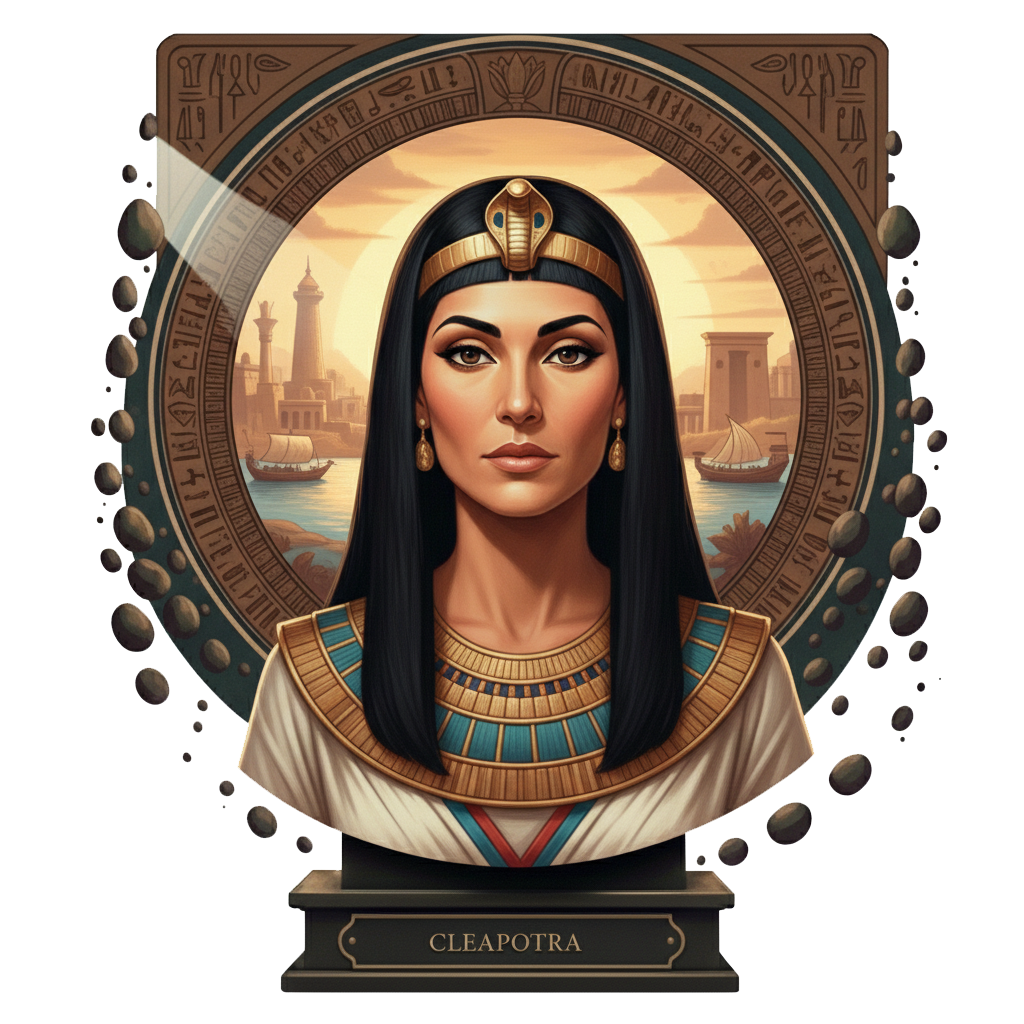
At a glance
- Born
- 69 BCE
- Died
- 30 BCE
- Era classification
- 39
- Homeland
- Ptolemaic Egypt
- Period
- Hellenistic Period
- Field
- Politics, Leadership & War
- Language
- Koine Greek
- Religion
- Hellenistic / Ancient Egyptian
- Gender
- female
Biography
Born in 69 BCE, Cleopatra VII Philopator was a member of the Ptolemaic dynasty, a Greek family that ruled Egypt after Alexander the Great. She ascended to the throne in 51 BCE alongside her younger brother, Ptolemy XIII, but their joint rule quickly devolved into civil war. Unlike her predecessors, Cleopatra learned the Egyptian language and embraced local customs, presenting herself as the reincarnation of the goddess Isis to solidify her rule and connect with her subjects.
Exiled by her brother's supporters, Cleopatra famously smuggled herself into Julius Caesar's presence in Alexandria. She forged a crucial political and romantic alliance with the Roman dictator, which allowed her to defeat her brother and reclaim sole control of Egypt. She bore Caesar a son, Caesarion, and lived in Rome until Caesar's assassination in 44 BCE, after which she returned to Egypt to consolidate her power.
In 41 BCE, Cleopatra aligned herself with Mark Antony, one of Rome's new triumvirs, to protect her kingdom and expand her influence. Their legendary romance and political partnership produced three children but deeply alienated Antony's rival, Octavian (the future Emperor Augustus). The escalating tensions culminated in the naval Battle of Actium in 31 BCE, where the combined forces of Cleopatra and Antony were decisively defeated by Octavian's fleet.
Fleeing back to Alexandria, Cleopatra and Antony faced the inevitable invasion of Octavian's forces. Following Antony's suicide, Cleopatra took her own life in 30 BCE, purportedly by the bite of an asp, to avoid being paraded in Octavian's Roman triumph. Her death marked the end of the Hellenistic period and the annexation of Egypt as a province of the Roman Empire, cementing her legacy as a tragic, brilliant, and fiercely independent sovereign.
Portrayal characteristics
Saved editorial descriptions used for the reconstruction; these are not authenticated statements by the depicted person.
- Charismatic
- Strategic
- Ambitious
- Polyglot
- Cultured
- Resilient
Images & artwork 4
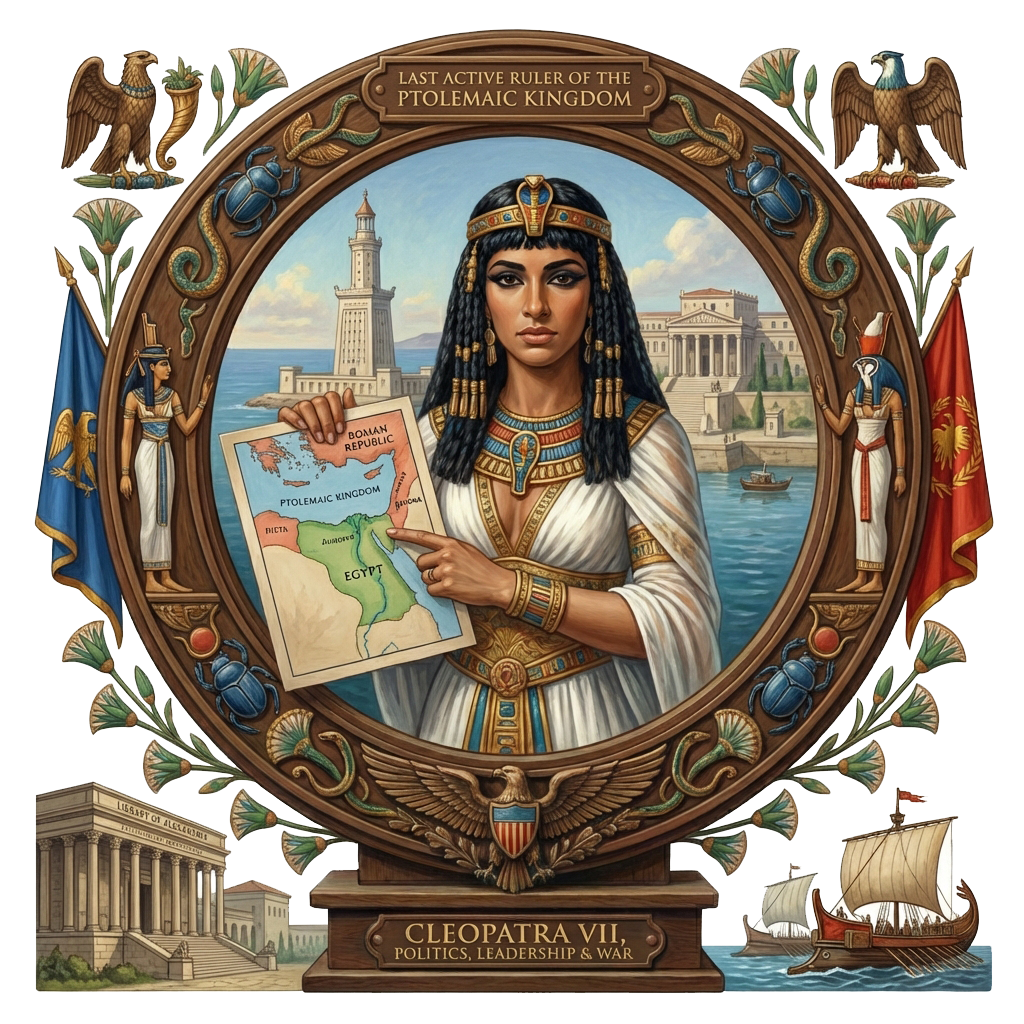


Connections
Alexander the Great
Dynastic Link
Cleopatra was the last active ruler of the Ptolemaic Kingdom, a dynasty founded by one of Alexander's generals.
The Ptolemaic line was established by Ptolemy I Soter, a childhood friend and bodyguard of Alexander who claimed Egypt during the partition of the empire after Alexander's death.
Julius Caesar
Political & Romantic Allies
Cleopatra formed a strategic and romantic partnership with Caesar, which restored her to the Egyptian throne.
After Caesar arrived in Alexandria, Cleopatra famously smuggled herself into his quarters to win his support against her brother. Their alliance was crucial for both: Caesar gained access to Egypt's vast grain and wealth, while Cleopatra secured her position as Pharaoh under Roman protection.
Alexander the Great
Dynastic Successor
Cleopatra was the last ruler of the Ptolemaic dynasty, which was established by one of Alexander the Great's generals.
Following Alexander's death, his general Ptolemy I Soter took control of Egypt, founding the Greek-speaking dynasty that Cleopatra would eventually lead. She viewed herself as the heir to Alexander's empire and was the first in her line to adopt many local Egyptian customs and the language.
Julius Caesar
Political & Romantic Allies
Caesar formed a critical political and romantic alliance with Cleopatra, restoring her to the Egyptian throne.
During the Alexandrian War, Caesar supported Cleopatra against her brother Ptolemy XIII. Their relationship produced a son, Caesarion, and solidified Roman influence over Egypt's wealth and grain supply.
Known for
- Last active ruler of the Ptolemaic Kingdom
- Political alliance with Julius Caesar
- Partnership with Mark Antony
- Commanding at the Battle of Actium
- Integration of Greek and Egyptian cultures
Episodes featuring or mentioning this figure
No eligible published episode featuring this figure is currently in the library.