



Jimmy Carter
39th U.S. President and Nobel laureate renowned for his lifelong dedication to human rights and global diplomacy.

At a glance
- Born
- October 1, 1924 CE
- Era classification
- 100
- Homeland
- USA
- Period
- 1924 CE–Present
- Field
- Politics, Leadership & War
- Language
- English
- Religion
- Baptist
- Gender
- male
Biography
James Earl Carter Jr. was born on October 1, 1924, in Plains, Georgia. Raised in a peanut-farming family, he graduated from the U.S. Naval Academy in 1946 and served as a submariner. Following his father's death in 1953, Carter returned to Georgia to manage the family business, eventually entering state politics. He served as a state senator and later as the Governor of Georgia, where he gained national attention for his moderate stance on civil rights and government reform.
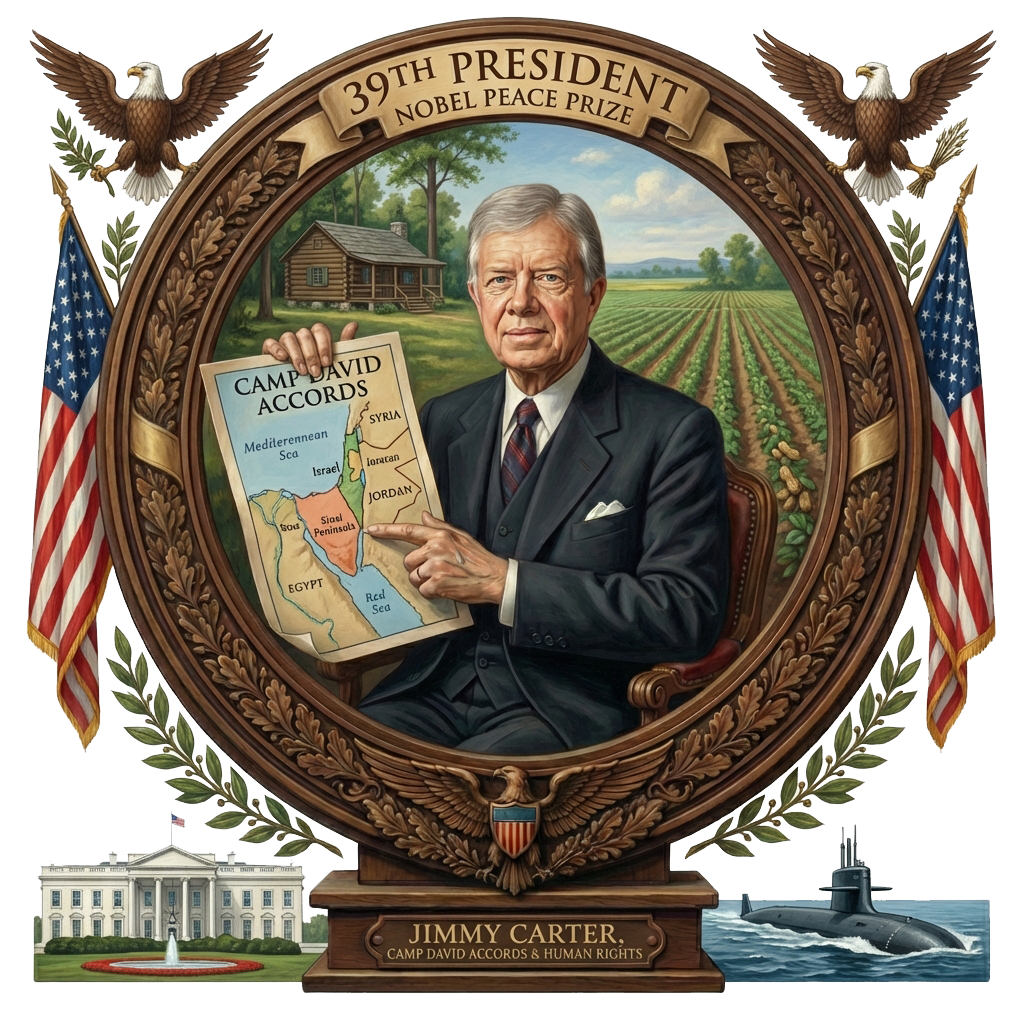
In 1976, running as a Washington outsider, Carter was elected the 39th President of the United States. His presidency (1977–1981) was marked by significant foreign policy achievements, most notably the 1978 Camp David Accords, which brokered a historic peace treaty between Israel and Egypt. He also championed human rights as a cornerstone of U.S. foreign policy, signed the Panama Canal Treaties, and established the Departments of Energy and Education. However, his administration struggled with severe domestic challenges, including high inflation, an energy crisis, and the 444-day Iran hostage crisis, which heavily contributed to his electoral defeat by Ronald Reagan in 1980.
Following his departure from the White House, Carter embarked on what is widely considered the most successful post-presidency in American history. In 1982, he and his wife Rosalynn founded The Carter Center to promote global health, resolve conflicts, and monitor elections worldwide. He also became a highly visible advocate and volunteer for Habitat for Humanity. In recognition of his decades of untiring effort to find peaceful solutions to international conflicts and advance democracy, Carter was awarded the Nobel Peace Prize in 2002.
Today, Jimmy Carter is the longest-living president in U.S. history. His legacy is defined not only by his time in the Oval Office but by his unwavering moral compass and lifelong commitment to public service. Despite facing significant political setbacks during his presidency, his extraordinary humanitarian contributions have cemented his reputation as a global champion of peace and human dignity.
Portrayal characteristics
Saved editorial descriptions used for the reconstruction; these are not authenticated statements by the depicted person.
- Principled
- Humanitarian
- Humble
- Diplomatic
- Resilient
- Moralistic
Images & artwork 4


Connections
Anwar El Sadat
Diplomatic Partners
President Carter was the primary mediator who brought Sadat and Menachem Begin together to sign the Camp David Accords.
The partnership between Sadat and Carter was essential for the 1979 Egypt-Israel Peace Treaty, which fundamentally altered the geopolitics of the Middle East and earned Sadat the Nobel Peace Prize.
Anwar El Sadat
Diplomatic Allies
Carter mediated the historic 1978 Camp David Accords between Sadat and Israeli Prime Minister Menachem Begin.
Carter's personal diplomacy was essential in bringing Sadat to the table, resulting in the first peace treaty between Israel and an Arab neighbor. This achievement remains the hallmark of Carter's foreign policy legacy.
Mohammad Reza Pahlavi
Political Allies & Crisis
The Iranian Revolution and the subsequent fall of the Shah's regime occurred during Carter's presidency.
Carter's decision to allow the exiled Shah into the United States for medical treatment triggered the 1979 Iran Hostage Crisis. This event dominated the final year of Carter's presidency and contributed significantly to his 1980 election defeat.
Nelson Mandela
Contemporary Allies
Carter was a vocal supporter of Mandela and the anti-apartheid movement, later serving with him in 'The Elders'.
After their respective presidencies, Carter and Mandela collaborated on global peace and human rights initiatives. Carter was invited by Mandela to join The Elders, an international non-governmental organization of public figures.
Mother Teresa
Contemporary Allies
President Jimmy Carter and Mother Teresa collaborated on humanitarian efforts and shared a mutual respect for their faith-based service.
During his presidency and through the Carter Center, Jimmy Carter supported Teresa's work. They met on several occasions, including at the White House, to discuss global poverty and health initiatives.
Mohammad Reza Pahlavi
Complex Diplomatic Relationship
US President Jimmy Carter's human rights policies inadvertently weakened the Shah's autocratic grip, contributing to the 1979 Islamic Revolution. Carter's later decision to admit the exiled Shah to the US for medical treatment triggered the Iran Hostage Crisis.
The relationship between Mohammad Reza Pahlavi and Jimmy Carter was fraught with contradiction and ultimately disastrous for both men. When Carter took office in 1977, his administration's emphasis on global human rights put pressure on the Shah to loosen political repression and curb the abuses of his secret police, SAVAK. The Shah, heavily dependent on US military support, reluctantly initiated a brief period of political liberalization, which inadvertently provided an opening for revolutionary forces to mobilize. Despite this friction, Carter visited Tehran on New Year's Eve 1977, famously toasting the Shah's Iran as an 'island of stability in one of the more troubled areas of the world.' As the Islamic Revolution escalated in 1978, the Carter administration sent mixed signals, oscillating between supporting the Shah and urging democratic reforms. After the Shah fled Iran in early 1979, Carter initially refused him entry to the US. However, in October 1979, Carter relented on humanitarian grounds, allowing the cancer-stricken Shah into New York for medical treatment. This decision enraged the new revolutionary government in Tehran, directly sparking the takeover of the US Embassy and the 444-day Iran Hostage Crisis, which doomed Carter's presidency.
Nelson Mandela
Diplomatic Allies
Jimmy Carter was a vocal supporter of Mandela and later worked closely with him on global humanitarian issues.
During and after his presidency, Carter advocated for Mandela's release from prison. In 2007, they both became founding members of 'The Elders,' an international non-governmental organization of public figures noted as elder statesmen and peace activists.
Known for
- Camp David Accords
- The Carter Center
- 2002 Nobel Peace Prize
- Habitat for Humanity advocacy
- Panama Canal Treaties
- Creation of the Department of Energy
Episodes featuring or mentioning this figure
No eligible published episode featuring this figure is currently in the library.