



Diego Rivera
A prominent Mexican painter and muralist who helped establish the Mexican mural movement.
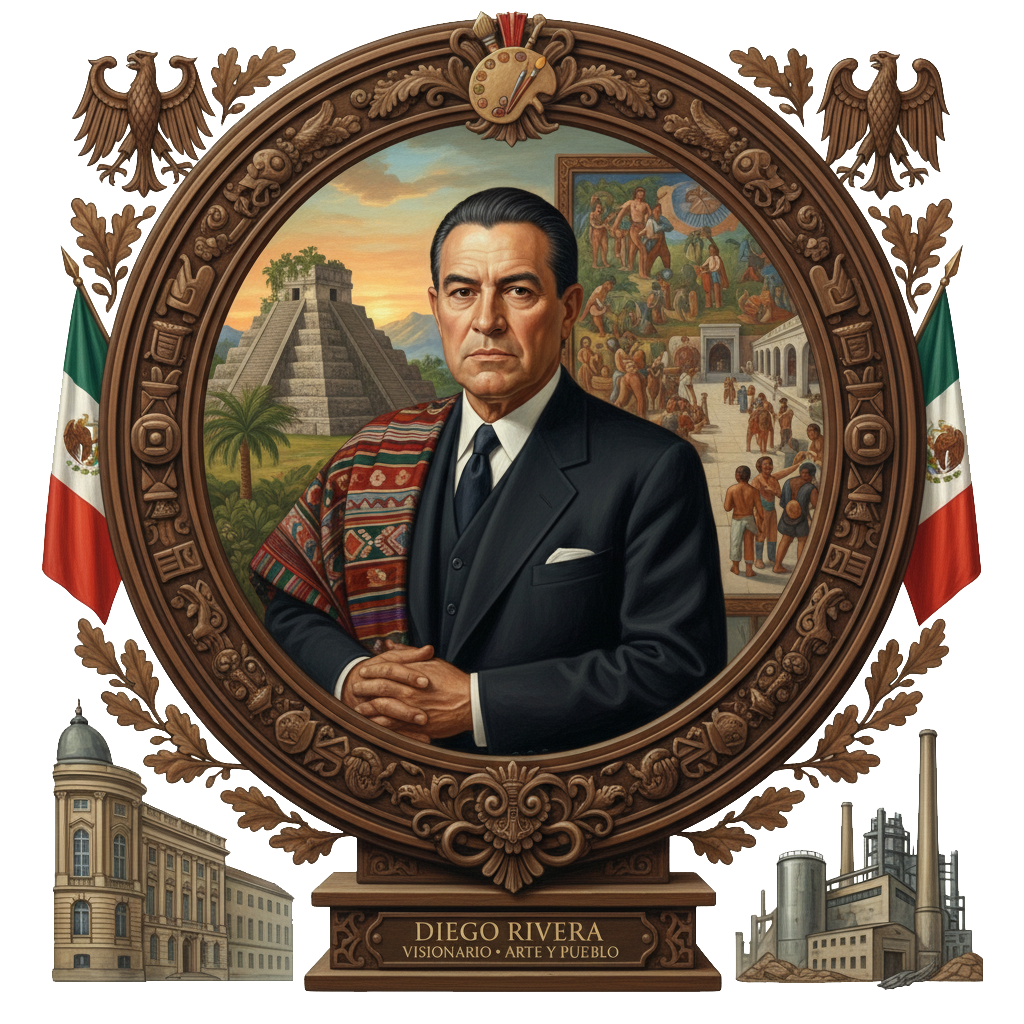
At a glance
- Born
- 1886 CE
- Died
- 1957 CE
- Era classification
- Modern
- Homeland
- Mexico
- Period
- 20th Century
- Field
- Arts & Architecture
- Language
- Spanish
- Religion
- Atheist
- Gender
- male
Biography
Diego María de la Concepción Juan Nepomuceno Estanislao de la Rivera y Barrientos Acosta y Rodríguez was a prominent Mexican painter. His large frescoes helped establish the Mexican mural movement in Mexican art. Between 1922 and 1953, Rivera painted murals in Mexico City, Chapingo, Cuernavaca, San Francisco, Detroit, and New York City.
Rivera's art reflected his Marxist political beliefs and his deep appreciation for Mexican history and culture. He sought to make art accessible to the masses, often depicting scenes of the working class, indigenous heritage, and the Mexican Revolution. His work was instrumental in shaping a new national identity for Mexico in the post-revolutionary period.
He had a volatile but passionate marriage to fellow Mexican artist Frida Kahlo. Despite controversies surrounding his political views and personal life, Rivera remains one of the most important figures in 20th-century art.
Portrayal characteristics
Saved editorial descriptions used for the reconstruction; these are not authenticated statements by the depicted person.
- Visionary
- Political
- Controversial
- Prolific
- Charismatic
Images & artwork 3


Connections
Frida Kahlo
Spouses & Artistic Collaborators
Rivera and Kahlo had a volatile and legendary marriage, deeply influencing each other's art and political activism.
The two artists married in 1929, divorced in 1939, and remarried in 1940. Their relationship was central to the Mexican muralism movement and the international Communist movement, with Rivera encouraging Kahlo's unique artistic voice.
Pablo Picasso
Artistic Contemporaries & Friends
Rivera and Picasso were colleagues in the Parisian avant-garde scene, where Rivera was a significant contributor to Cubism.
During his years in Europe, Rivera was close friends with Picasso and adopted the Cubist style for several years. Their relationship cooled after Rivera accused Picasso of plagiarizing his techniques, but they remained the two most influential figures in their respective artistic spheres.
Lázaro Cárdenas
Political Patron
Rivera was a prominent supporter of President Lázaro Cárdenas, whose socialist reforms aligned with Rivera's political murals.
During Cárdenas's presidency, Rivera received major government commissions to paint murals that celebrated Mexican history and labor. Rivera also used his influence with Cárdenas to secure political asylum for Leon Trotsky in Mexico.
Emiliano Zapata
Mural Subject & Ideological Hero
Rivera immortalized the revolutionary leader Emiliano Zapata in his murals, portraying him as the ultimate symbol of agrarian reform.
Zapata is a recurring figure in Rivera's work, most notably in the 'Agrarian Leader Zapata' fresco. Rivera's depictions helped cement Zapata's image in the Mexican national consciousness as a martyr for the rights of the peasantry.
Octavio Paz
Critic & Contemporary
The poet Octavio Paz wrote extensively about Rivera's art, analyzing its role in shaping Mexican identity and its relationship to the state.
While Paz was sometimes critical of the ideological rigidity of the muralists, he recognized Rivera as a titan of Mexican culture. His essays provide some of the most profound intellectual context for understanding Rivera's visual synthesis of Mexico's indigenous and colonial past.
Benito Juárez
Artistic Subject
Rivera prominently featured Juárez in his murals as a symbol of Mexican sovereignty.
In his famous mural 'Dream of a Sunday Afternoon in the Alameda Central,' Rivera depicts Juárez holding the Constitution of 1857. Rivera used Juárez's image to represent the triumph of the Republic and the foundational role of indigenous leadership in Mexican history.
Frida Kahlo
Spouses & Artistic Partners
Kahlo and Rivera had a volatile, world-famous marriage and were central figures in the Mexican Muralism movement.
Rivera was Kahlo's greatest supporter and critic, and their relationship deeply influenced the themes of pain and identity in her art. They shared a commitment to communism and the promotion of 'Mexicanidad,' a movement celebrating indigenous Mexican culture.
Emiliano Zapata
Artistic Legacy
Rivera immortalized Zapata as the central hero of the Mexican Revolution in his murals.
Rivera was a staunch supporter of Zapatismo and featured Zapata prominently in murals like 'The Agrarian Leader Zapata.' These works helped transform Zapata from a regional rebel into a national symbol of indigenous and peasant rights.
Lázaro Cárdenas
Political Patron & Ally
Cárdenas supported the Mexican muralist movement, of which Rivera was a leading figure, as part of his cultural and educational reforms.
During his presidency, Cárdenas provided state support for public art that reflected the ideals of the Mexican Revolution. Rivera was a primary beneficiary of this patronage, and his work helped legitimize the administration's nationalist and socialist-leaning policies.
Octavio Paz
Contemporary Intellectuals
Paz and Rivera were central figures in the 20th-century Mexican cultural renaissance, though they often held differing political views.
As a leading poet and essayist, Paz frequently engaged with the visual legacy of the Mexican muralists, including Rivera. While Paz eventually distanced himself from the staunch Marxism of Rivera's circle, he recognized Rivera's role in defining modern Mexican identity.
Pablo Picasso
Contemporary Rivals
Picasso and Rivera were close friends and artistic rivals in Paris during the early 20th century.
During his 'Cubist period' in Paris, Rivera was deeply influenced by Picasso's innovations. Their relationship was marked by mutual respect and occasional friction as Rivera eventually moved toward Muralism while Picasso continued to redefine European modernism.
Known for
- Mexican muralism
- Detroit Industry Murals
- Man at the Crossroads
- Promoting Marxist ideals in art
Episodes featuring or mentioning this figure
No eligible published episode featuring this figure is currently in the library.