



Arthur C. Clarke
British science fiction author and futurist who conceived the concept of geostationary satellite relays.
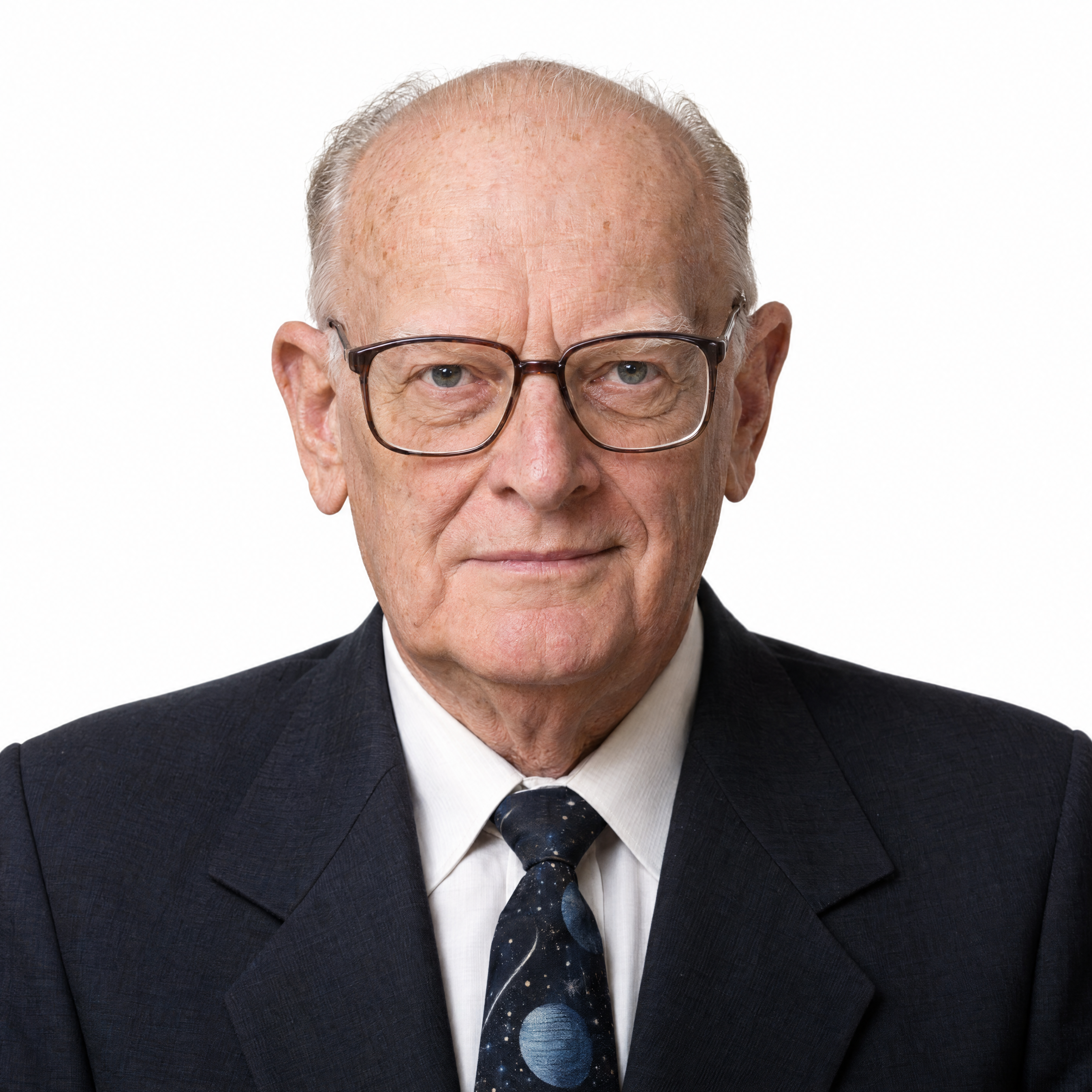
At a glance
- Born
- 1917 CE
- Died
- 2008 CE
- Era classification
- Modern
- Occupation
- Science Fiction Author & Futurist
- Homeland
- United Kingdom
- Period
- 20th–21st Century
- Field
- Science & Innovation
- Language
- English
- Religion
- Agnostic
- Gender
- male
Biography
Sir Arthur Charles Clarke was born in Minehead, Somerset, England, in 1917. Fascinated by science and astronomy from childhood, he joined the British Interplanetary Society in the 1930s. During the Second World War, he served in the Royal Air Force as a radar specialist and instructor, an experience that deepened his technical knowledge and inspired his interest in electronic communications and early warning systems.
In 1945, Clarke published a landmark technical paper titled "Extra-Terrestrial Relays—Can Rocket Stations Give Worldwide Radio Coverage?" in the magazine Wireless World. In this article, he proposed that artificial satellites positioned in a circular equatorial orbit matching Earth's rotational period could provide global telecommunications coverage. This orbit, approximately 35,786 kilometers above Earth, became known as the geostationary orbit or Clarke Orbit. He subsequently completed degrees in mathematics and physics at King's College London in 1948 and served as chairman of the British Interplanetary Society from 1946 to 1947 and 1951 to 1953.
Clarke emerged as one of the preeminent figures of twentieth-century science fiction, forming alongside Isaac Asimov and Robert A. Heinlein the group popularly termed the "Big Three." His fiction was characterized by rigorous scientific realism paired with philosophical inquiry into humanity's place in the cosmos. His short story "The Sentinel" provided the foundation for his collaboration with director Stanley Kubrick on the 1968 film "2001: A Space Odyssey," alongside which Clarke wrote the companion novel. His other major literary works include "Childhood's End" (1953) and "Rendezvous with Rama" (1973).
In 1956, Clarke relocated to Ceylon (now Sri Lanka), where he pursued an active interest in scuba diving and marine archaeology. He remained a prominent commentator on science and space exploration throughout his life, co-hosting the Apollo 11 moon landing coverage for CBS television alongside Walter Cronkite. Clarke was knighted in 2000 for services to literature and continued writing and advocating for scientific inquiry until his death in Colombo in 2008.
Portrayal characteristics
Saved editorial descriptions used for the reconstruction; these are not authenticated statements by the depicted person.
- Visionary
- Analytical
- Technologically optimistic
- Inquisitive
- Articulate
Images & artwork 1
Known for
- Proposing the principle of geostationary communication satellites in 1945
- Co-writing the screenplay and novel for '2001: A Space Odyssey'
- Authoring seminal science fiction novels including 'Childhood's End' and 'Rendezvous with Rama'
- Formulating Clarke's Three Laws of prediction and technological development
- Extensive science popularization and commentary during the Space Race
Episodes featuring or mentioning this figure
No eligible published episode featuring this figure is currently in the library.