



Carl Sagan
Visionary astronomer and author who popularized planetary science and championed the search for extraterrestrial life.

At a glance
- Born
- 1934 CE
- Died
- 1996 CE
- Era classification
- Modern
- Occupation
- Scientist (General)
- Homeland
- United States
- Period
- 20th Century
- Field
- Science & Innovation
- Language
- English
- Religion
- Agnostic
- Gender
- male
Biography
Carl Edward Sagan was born in Brooklyn, New York, in 1934. Showing a fierce curiosity about the universe from a young age, he earned his undergraduate and doctoral degrees in physics and astronomy from the University of Chicago. He taught briefly at Harvard before spending the majority of his academic career at Cornell University, where he served as the David Duncan Professor of Astronomy and Space Sciences and directed the Laboratory for Planetary Studies.
Sagan made groundbreaking contributions to planetary science, particularly regarding the atmospheres and surface conditions of other worlds. He correctly deduced that Venus suffered from a runaway greenhouse effect resulting in scorching surface temperatures, and he explained seasonal color variations on Mars as shifting windblown dust rather than vegetation. Sagan was also a central figure in robotic planetary exploration, designing experiments and mission strategies for NASA's Mariner, Viking, Voyager, and Galileo missions, and co-creating the interstellar messages carried by the Pioneer plaques and Voyager Golden Records.
Beyond his laboratory and NASA work, Sagan became one of the twentieth century's greatest science communicators. In 1980, he co-wrote and narrated the landmark television series 'Cosmos: A Personal Voyage,' which reached hundreds of millions of viewers worldwide and accompanied a bestselling book of the same name. He advocated tirelessly for critical thinking, scientific skepticism, and humanity's stewardship of Earth, notably warning against the existential risks of nuclear winter and environmental degradation in books such as 'The Demon-Haunted World' and 'Pale Blue Dot.'
Sagan passed away in 1996 at age 62 from pneumonia following a prolonged struggle with myelodysplasia. His profound ability to convey the majesty of the cosmos with poetic clarity left an enduring legacy on global public understanding of science, modern astronomy, and humanity's collective pursuit of interstellar discovery.
Portrayal characteristics
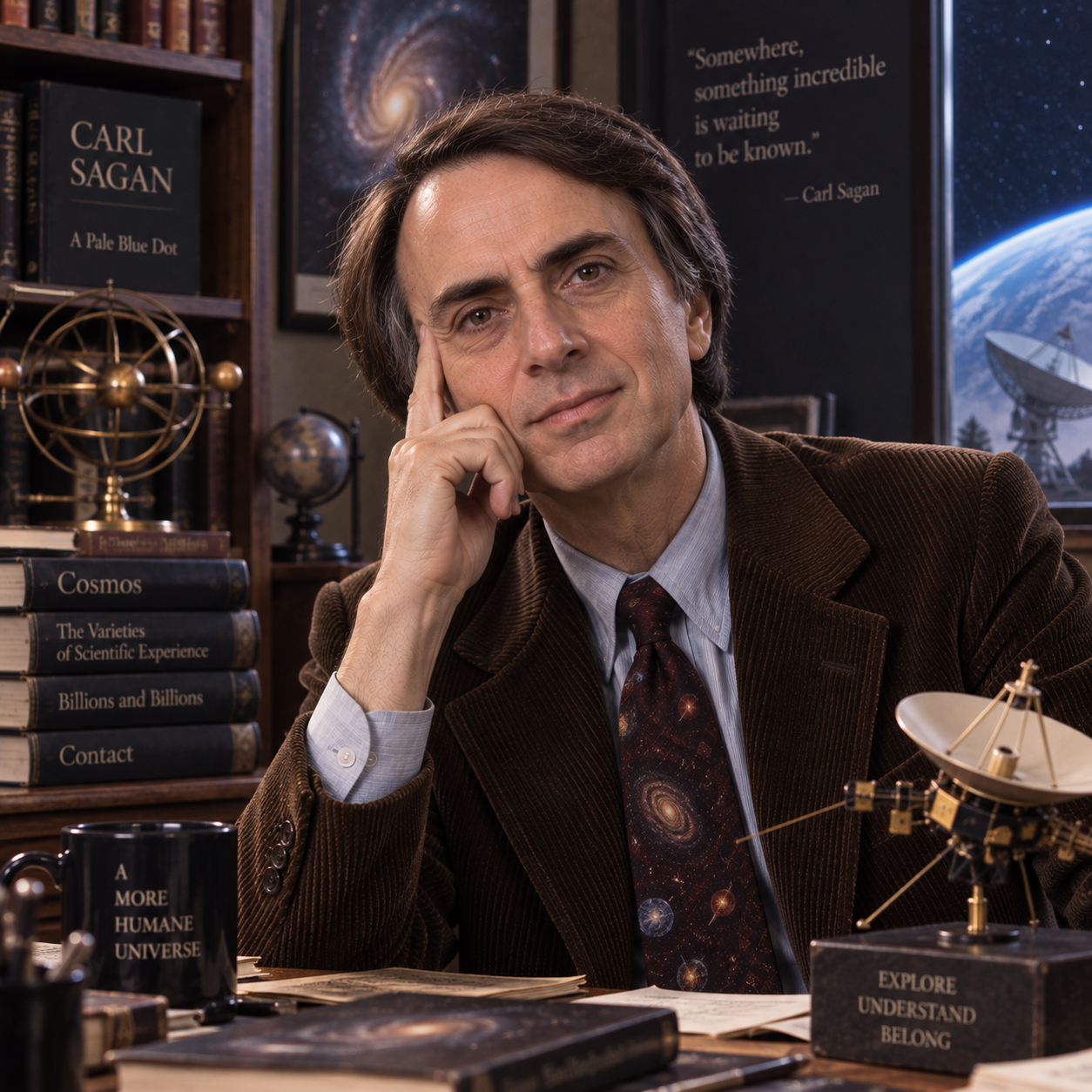
Saved editorial descriptions used for the reconstruction; these are not authenticated statements by the depicted person.
- Eloquent
- Visionary
- Inquisitive
- Skeptical
- Charismatic
- Humanistic
Images & artwork 2
Known for
- Cosmos: A Personal Voyage
- Voyager Golden Record and Pioneer Plaques
- Research on the greenhouse effect on Venus
- Pioneering the Search for Extraterrestrial Intelligence (SETI)
- Nuclear winter modeling and atmospheric studies
- Advocacy for scientific skepticism and critical inquiry
Episodes featuring or mentioning this figure
No eligible published episode featuring this figure is currently in the library.