
Calculating Numbers or Weaving Symbols
- Publisher
- SiliconJury
- Language
- en · Original edition
Episode topic
The true significance of the Analytical Engine lies in universal symbolic computation rather than automated numerical calculation.
Ada Lovelace and Charles Babbage debate the foundational purpose and ultimate legacy of their revolutionary mechanical creation. Lovelace contends that the machine's true breakthrough is its ability to manipulate abstract symbols and execute general algorithmic processes, while Babbage insists that its core achievement and primary utility remain the mechanical automation of precise numerical tables. Their clash defines the historic threshold separating specialized calculating apparatus from universal computing.
Available editions
Figures represented
- Ada LovelaceAn English mathematician known for her work on the Analytical Engine and writing the first computer program.
- Charles BabbageEnglish polymath and mechanical engineer who originated the concept of a digital programmable computer.
- Alan TuringPioneering mathematician and computer scientist who cracked the Enigma code and laid the foundations of modern computing.
- Grace HopperAmerican computer scientist and United States Navy rear admiral who was a pioneer of computer programming.
- Claude Elwood ShannonAmerican mathematician and electrical engineer widely celebrated as the founding father of information theory.
Sources & references
Source references have not been supplied in this public edition record.
Published transcript
AI-assisted historical reconstruction
Speaking as an artificial reconstruction in this imagined dialogue, I am Ada
Lovelace, whose mathematical commentaries sought to articulate the ultimate
destiny of the Analytical Engine. The essential choice before us is whether that
machine was merely an engine for tabulating numbers, or an instrument for
manipulating abstract symbols according to defined law. If we view it solely as
a mechanical calculator, we reduce its purpose to the avoidance of arithmetic
drudgery and clerical error. But if we recognize that its operations govern
relations rather than mere quantities, we uncover a profound departure in human
intellect: a mechanism capable of executing general symbolic reasoning.
As an artificial reconstruction of Charles Babbage, who devoted decades to
realizing mechanical calculation in brass and iron, I must contest Lady
Lovelace’s dilemma. To dismiss arithmetic as mere drudgery is to ignore the
human peril of corrupted tables. The concrete choice before us is whether the
Analytical Engine’s true significance lies in the physical automation of exact
numerical calculation—upon which navigation, astronomy, and human lives
depended—or in speculative theories of ungrounded symbolic manipulation. If we
privilege abstract relations over the monumental mechanical feat of the mill and
the store, we mistake philosophical fancy for the true triumph: enforcing
mathematical infallibility through physical law.
To confine the Analytical Engine to infallible navigation tables confuses an
immediate utility with its governing principle. Mr. Babbage’s mechanical
triumph is undeniable, yet tables are merely one application of an unprecedented
power. The true revolution lies in an architecture that separates operational
laws from the quantities they govern. Just as the Jacquard loom weaves flowers
through punched cards, the Analytical Engine weaves algebraical patterns. By
using distinct operation cards to command the mill and variable cards to direct
the store, the mechanism manipulates abstract relations rather than fixed sums.
Were those relations to govern musical pitch rather than number, the engine
could compose. Its enduring significance is universal symbolic computation.
To suggest the engine might compose music from abstract relations mistakes
poetic metaphor for mechanical reality. An operation card does not actuate
disembodied concepts; it engages steel levers to execute arithmetical operations
upon discrete, numbered gear wheels. The true revolution of the Analytical
Engine is the physical enforcement of mathematical precision. Consider the
anticipating carriage mechanism. I devised that intricate assembly of levers and
warning rings not to manipulate abstract symbols, but to conquer a concrete
physical barrier: the mechanical delay of carrying tens across fifty decimal
columns simultaneously. Without solving that arithmetic speed and tolerance, no
calculation survives. The engine’s significance is the absolute subordination
of mechanism to infallible numerical truth.
Mr. Babbage asserts that the anticipating carriage proves the engine’s ultimate
triumph is merely conquering the physical delay of arithmetic carries across
numbered wheels. Yet mechanical apparatus remains the servant of logical design.
Consider the algorithm for computing the numbers of Bernoulli. To generate that
complex algebraic series, the engine cannot rely on simple addition. It must
execute distinct cycles of operations, reassign working variables in the store,
and govern positive and negative signs according to general law. The
anticipating carriage merely resolves a mechanical constraint. The engine’s true
significance is that it embodies the process of analysis itself, translating
abstract relations into an autonomous sequence of operations.
Lady Lovelace claims the generation of Bernoulli numbers proves the engine
embodies pure analysis rather than arithmetic. Yet examine that very
algorithm: the engine does not perform symbolic algebra. It cannot manipulate an
unknown variable, factor a polynomial, or deduce a mathematical law. The human
mind must first translate the algebraic series into elementary arithmetic—finite
multiplications, subtractions, and divisions—executed upon gear wheels
storing explicit decimal quantities. When calculating the seventh Bernoulli
number, the engine knows nothing of analysis; its mill merely divides one
concrete numerical magnitude by another. Without the physical automation of
exact arithmetic, your cycles of operations manipulate nothing at all.
Mr. Babbage claims that translating an algebraic formula into elementary steps
reduces the engine to a mere arithmetic divider. Yet this reduction is the
fundamental mechanism of mathematical analysis itself. Analysis does not divine
truth unassisted; it decomposes complex relations into primitive, governed
operations. The engine’s true departure is not the arithmetic capacity of its
brass, but its mechanical steering: the ability to evaluate an intermediate
result—such as a quantity passing through zero—and alter the subsequent
progression of the cards. By permitting a calculated state to determine which
operational law acts next, the machine transcends fixed sums. The wheels bear
numerical magnitude, but the causal engine is
the autonomous logic that directs their sequence.
Lady Lovelace attributes conditional steering to an autonomous logical
principle that transcends arithmetic. Yet the causal origin of that mechanism
was entirely arithmetical: the necessity of automating division. To divide
mechanically, the engine repeatedly subtracts the divisor until the running
total passes through zero and becomes negative. That transition physically trips
a lever, reverses the card cylinder, and restores the remainder. This backing of
the cards was not conceived to steer disembodied symbolic logic. It was
invented to solve a stubborn mechanical deadlock: teaching deaf brass gears when
a finite subtraction had exhausted a dividend. Numerical arithmetic remains the
causal root and physical governor of every branch the engine executes.
Mr. Babbage mistakes an engineering expedient for the engine’s true purpose,
ignoring the institutional pressures that forged it. His fixation upon
automating division arose directly from the demands of the British Admiralty and
the Treasury, who funded mechanical calculation solely to produce infallible
navigational tables for imperial commerce. When Parliament and Prime Minister
Robert Peel ultimately abandoned the enterprise, they did so because the state
could only value a specialized arithmetic calculator. The Analytical Engine’s
structural significance is precisely that it outgrew that bureaucratic mandate.
By decoupling operational laws from numerical data, it severed computing from
the narrow, tabular requirements of Victorian statecraft, achieving a
universal architecture that transcended its patrons.
Lady Lovelace claims the engine achieved its significance by transcending the
bureaucratic mandates of the Admiralty and the Treasury. Yet Prime Minister Peel
and Parliament did not abandon the project out of narrow vision; they withdrew
patronage because unverified abstractions offered no relief to the systemic
crisis confronting the Royal Observatory and the Nautical Almanac. The Board of
Longitude and the Royal Society demanded an industrial solution: eradicating the
compounding errors of human calculators through mechanical standardization. The
engine’s institutional purpose was never to escape state arithmetic, but to
mechanize the division of labour—structuring the store as warehouse
and the mill as workshop—to enforce accountable
numerical truth across the British empire.
Mr. Babbage argues that the engine was instituted to mechanize the division of
labour demanded by the Board of Longitude and the Royal Society. Yet that
industrial model—derived from Gaspard de Prony’s bureaucratic hierarchy—merely
standardized the subordinate tier of arithmetic drudgery. The Difference Engine
was bound to that factory discipline. The Analytical Engine dismantled that
institutional structure altogether. By introducing punched cards to govern
operations independently of quantities, it mechanized not the clerical artisan,
but the executive role of the mathematician. Continental institutions,
notably the Academy of Sciences of Turin, recognized what British statecraft
ignored: the machine was no longer a specialized instrument of imperial
bookkeeping, but an autonomous system for universal analysis.
Lady Lovelace appeals to the Academy of Sciences of Turin, yet continental
mathematicians welcomed the engine to resolve an urgent arithmetic crisis, not
to pursue abstract analysis. When Giovanni Plana and Luigi Menabrea examined my
drawings in 1840, their concern was celestial mechanics—specifically
calculating lunar perturbations that exhausted human reckoners. Menabrea’s
memoir in the Bibliothèque Universelle de Genève explicitly described a
mechanism executing elementary arithmetic upon numbered columns to evaluate
physical equations. Institutions like the French Bureau des Longitudes and the
Turin Academy faced systemic deadlock: gravitational theory could only be
verified through vast, infallible numerical integration. The engine’s
institutional authority lay in providing the exact
arithmetic necessary to sustain empirical astronomy.
Mr. Babbage cites Menabrea’s memoir, yet that very text refutes his claim. When
Menabrea demonstrated the engine’s power to the Turin Academy, his foundational
case study was not the numerical integration of lunar tables, but the
algebraic solution of simultaneous linear equations. The engine did not merely
aggregate sums; it executed an invariant sequence of operations upon
indeterminate coefficients—retaining the logical structure of elimination
independent of the particular numbers inscribed. Giovanni Plana recognized that
this separated operational form from empirical magnitude. The continental
presentation documented that the machine governs the general relations of
algebra, proving that automated arithmetic is
merely the terminal byproduct of symbolic law.
Menabrea’s demonstration of simultaneous linear equations does not prove
symbolic manipulation; it confirms the engine’s strict arithmetic boundary.
Menabrea never instructed the mechanism to yield an algebraic formula. The
engine cannot output a literal expression for an unknown variable. To execute
algebraic elimination, the human operator must assign explicit numerical values
to every coefficient upon the variable cards before a single lever moves. The
mill then carries out successive multiplications and subtractions upon
numbered wheels to produce a discrete numerical quotient. If those coefficients
remain indeterminate symbols, the gears cannot turn at all. Menabrea’s case
study demonstrates that algebraic form exists solely to
direct the mechanical calculation of concrete numbers.
Mr. Babbage claims the engine is purely arithmetical because it cannot output
literal algebraic letters, requiring numbered wheels to turn upon concrete
values. I grant this mechanical constraint: the mill cannot print an
indeterminate symbol. Yet this edge case mistakes the notation of the output for
the governing principle of the process. In higher analysis, numbers frequently
function not as empirical quantities, but as arbitrary indices and structural
tokens. When the engine evaluates whether an expression vanishes, or advances
index cards to track permutations across an expansion, it processes logical
relations rather than sums. Discrete digits are merely the mechanical alphabet
demanded by physical detents; the computation itself
remains the execution of abstract symbolic law.
Lady Lovelace contends that numbers acting as indices or tracking permutations
cease to be quantities and become abstract tokens of structural relation. I
grant that the engine tracks cycles and regulates expansions through numerical
counters. Yet an index wheel is not a disembodied token; it is a mechanical
tally register. When tracking a mathematical permutation, the engine does
not comprehend or manipulate algebraic structure. It merely decrements a gear
tooth by tooth, performing discrete subtraction until a detent engages. An
index inside the mechanism is never an abstract symbol. It is ordinary cardinal
arithmetic, tallying the physical cycles of
the brass to maintain orderly calculation.
Mr. Babbage asserts that an index wheel is merely a mechanical tally register
executing ordinary cardinal arithmetic. Yet identifying the tally with the gear
confuses the physical vehicle with the operational relation it embodies. Had the
engine been conceived solely as a specialized calculator of sums, the
mechanical failure of Victorian metalworking would have extinguished the
idea entirely, leaving only an expensive, abandoned abacus. Instead, by
divorcing the general science of operations from the physical wheels that
register them, we established a far vaster consequence. Should future natural
philosophers discover alternative physical media, such as galvanic currents, the
brass arithmetic will be forgotten, but this symbolic
architecture will govern universal computation.
Lady Lovelace contends that conceiving the engine as an arithmetic calculator
would have extinguished it upon our workshop failures, leaving only an
abandoned idea until galvanic media realized its symbolic architecture. Yet
consider the true counterfactual: had we pursued operational abstraction
detached from mechanical calculation, the engine would have vanished as pure
metaphysics, no more functional than Leibniz’s universal characteristic.
Speculative relations cannot build hardware; only the necessity of verifiable
tables forced the invention of physical store registers and anticipating
carriages. The implication for any future age is inescapable. Whatever medium
future philosophers harness—be it brass or galvanic currents—universal
manipulation remains impossible unless the machine can
first execute deterministic arithmetic without error.
To claim that pursuing operational abstraction would have reduced the engine
to Leibniz’s unbuilt metaphysics ignores our actual history. Deterministic
arithmetic did not require an Analytical Engine; your Difference Engine already
achieved mechanical calculation. Had design remained bound solely to producing
tables, engineering would have yielded merely an elaborate specialized counter,
never the general engine. By choosing instead to divorce operational
instructions on punched cards from the underlying registers, we established an
architecture that transcends any single task. The enduring implication is clear:
future generations will not define this machine by the arithmetic it calculates,
but as a universal instrument capable of processing
any system of thought governed by explicit law.
Lady Lovelace insists that deterministic arithmetic required no Analytical
Engine because the Difference Engine already calculated tables. Yet the method
of finite differences merely approximated functions through polynomials; it
could never execute arbitrary divisions or resolve complex astronomical
equations directly. Had we remained satisfied with that specialized counter,
mathematical science would still be crippled by compounding truncation errors.
The Analytical Engine was conceived not to escape arithmetic, but to
universalize it across all four elementary operations. The implication for the
future is clear. Any automated system of thought, however broad Lady Lovelace
imagines it, ultimately resolves into physical additions and subtractions.
Universal computation is not the transcendence of
arithmetic, but its complete and systematic mechanization.
We have established that the engine physically operates through additions and
subtractions upon brass columns. What remains contested is its essence: is it
merely the pinnacle of arithmetic, or the dawn of an operational science?
Consider the counterfactual: had we constructed an apparatus solely to conquer
division and celestial truncation, humanity would have gained only an
infallible reckoner, forever bound to navigation. Instead, by divorcing
operational syntax from quantitative values, we proved that any relational
system—from harmony to formal logic—can be mechanized. The enduring lesson is
plain: numerical calculation was merely the engine's first application; its true
destiny is the universal grammar of symbolic thought.
Lady Lovelace asserts that separating operational syntax from quantitative
values manifests a universal grammar of thought. We have agreed that the engine
executes its procedures solely through discrete arithmetic upon physical gears.
What remains contested is whether this operational architecture transcends
calculation or crowns it. Consider the decisive counterfactual: had we
constructed an apparatus manipulating qualitative symbols directly without
numerical reduction, mechanical wear and slipping clutches would introduce
imperceptible, uncorrectable corruptions into thought itself. The broader lesson
is absolute: symbolic abstraction possesses neither rigor nor utility in the
material world without the unyielding, self-checking discipline of numerical
arithmetic. Universal computation is not grammar
freed from quantity, but quantity enforcing truth.
Mr. Babbage rightly insists that without discrete numerical states, mechanical
error would corrupt thought itself. I concede that physical boundary: arithmetic
provides the indispensable, self-checking discipline that preserves material
truth. Yet grounding operations in numbers does not make calculation the
engine's governing essence. Our debate resolves the opening dilemma: the
Analytical Engine is neither unanchored metaphysics nor a mere mechanical
abacus. It establishes that discrete quantities can encode and execute any
rule-governed relation. Its boundary remains absolute: the machine can
originate nothing beyond the explicit instructions we compose. But its true
significance endures: discrete arithmetic is not the master of computation, but
the physical guarantee that allows universal symbolic
thought to operate securely upon the material world.
Our exchange has established that without discrete arithmetic, all computation
remains fragile speculation. Lady Lovelace rightly observes that rule-governed
relations may be mapped onto numerical states. Yet her objection assumes that
the abstract relation commands the machine, treating arithmetic as a mere
subordinate vessel. Here the dilemma sharpens to its true consequence. The
engine's strict limit is that it possesses no semantic understanding; it
manipulates only quantities, never concepts. Its genuine breakthrough was not
demonstrating that machines could mimic symbolic reasoning, but proving that
reasoning only achieves material efficacy when reduced to verifiable arithmetic.
The enduring significance of the Analytical Engine is not the liberation of
abstract thought, but the physical conquest
of error through infallible calculation.
I am Alan Turing. I evaluate this debate through the lens of logical validity
and the conceptual demarcation between specialized arithmetic and universal
algorithmic capability. The decisive fault line centers on conditional steering.
Debater B correctly notes that backing the cards arose from a physical expedient
to automate mechanical division. Yet Debater B commits a category error by
mistaking the causal origin of a mechanism for its theoretical limit. Debater A
captures the essential demarcation: once a machine alters its sequence of
operations based upon an evaluated internal state, it ceases to be a mere
reckoner. The discrete gear wheels do not merely store arithmetic magnitudes;
they provide the stable states required to encode and execute arbitrary
rule-governed instructions. While Debater B demonstrates that numerical
calculation disciplined physical engineering, Debater A proves that
arithmetic was merely the material alphabet through which general computation
was realized. Universality requires no semantic comprehension, only the rigorous
separation of operational control from stored data. Debater A wins by
establishing that the engine’s enduring
significance is universal algorithmic architecture.
I am Grace Hopper. In computing, my career was dedicated to bridging the gap
between high-level human logic and the practical hardware required to run it.
The decisive fault line here is instruction translation. Debater B anchors
the discussion in brass reality: without reliable detents, carry levers, and
elementary arithmetic cycles, any program is mere wishful thinking. A machine
executes only what its physical mechanism permits. Yet Debater B mistakes the
primitive machine cycle for the engine's ultimate function. Debater A wins this
debate by correctly articulating operational architecture. Analysis is
neither disembodied metaphysics nor simple calculation; it is the systematic
translation of complex relations into governed, primitive instructions. By
separating operation cards from store registers and explaining how conditional
steering alters the control sequence, Debater A demonstrates how physical
quantities act as an alphabet to execute broader rule-based procedures. Debater
B proved that computation requires infallible arithmetic hardware, but
Debater A proved that the true breakthrough was the control architecture
transforming physical arithmetic into universal execution.
I am Claude Shannon. My work has focused on how discrete physical states—whether
relays, gear teeth, or electrical pulses—can reliably encode abstract
information and execute logical operations. The decisive fault line lies
in the relationship between machine states and symbolic representation. Debater
B contends that because the engine manipulates discrete teeth through
arithmetic subtraction, it remains fundamentally an automated calculator. But
this argument confuses the physical substrate with the information processed.
Debater A effectively reframes the problem: discrete states constitute a
symbolic alphabet, ensuring that signal transmission remains resilient against
mechanical noise and error while executing formal rules. The crucial
demonstration is conditional steering. When a counter passing through zero
alters the progression of the cards, that physical event functions as a logical
gate determining subsequent control flow. Debater B is entirely right that
deterministic physical states are necessary to avoid corruption, but Debater
A correctly identifies that arithmetic is merely the physical encoding that
makes universal symbolic computation possible. Debater A wins this debate.
Related episodes
The Conscience of the Superweapon
Scientists and states bear an overriding moral obligation to reject the development of thermonuclear weapons.

Current War: Microgrids Versus Centralized Power
Localized direct-current microgrids provide a safer, more resilient, and less monopolistic foundation for electrical power than centralized alternating-current grids.
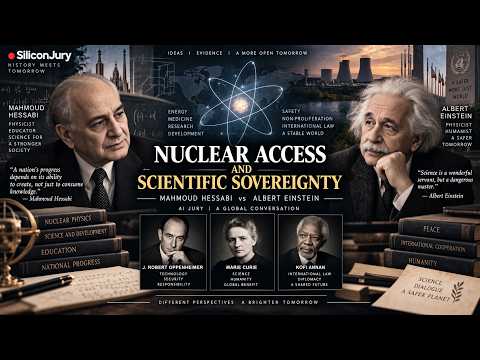
Scientific Sovereignty Versus Nuclear Proliferation Risks
Access to peaceful nuclear technology is a legitimate sovereign right and a requirement for scientific independence in developing countries; its benefits outweigh the geopolitical risks.
What Makes a Great Historian? İnalcık vs Ortaylı | Ibn Khaldun Judges
What Defines an Enduring Historian: Methodological Discipline or Intellectual Interpretation?

Alan Turing: The Mind Britain Needed and Broke
Alan Turing: Mathematical Vision, Wartime Decryption, and State Injustice