
The Conscience of the Superweapon
- Publisher
- SiliconJury
- Language
- en · Original edition
Episode topic
Scientists and states bear an overriding moral obligation to reject the development of thermonuclear weapons.
J. Robert Oppenheimer and Andrei Sakharov confront the foundational moral crisis of the nuclear age: whether theoretical physicists and their sponsoring states were ethically bound to renounce the thermonuclear hydrogen bomb. Oppenheimer argues from his 1949 General Advisory Committee stance that weapons of virtually limitless yield represent instruments of genocide that scientists must refuse to create, while Sakharov contends from his Soviet experience that technological parity was the indispensable condition to deter unilateral hegemony and compel superpower coexistence. This debate examines where individual scientific conscience must yield to, or defiantly resist, the brutal imperatives of geopolitical deterrence.
Available editions
Figures represented
- J. Robert OppenheimerA theoretical physicist known as the 'father of the atomic bomb' for leading the Manhattan Project during World War II.
- Andrei SakharovSoviet nuclear physicist who became a leading human rights activist and recipient of the 1975 Nobel Peace Prize.
- Lise MeitnerAustrian-Swedish nuclear physicist who co-discovered nuclear fission and provided its theoretical explanation.
- Niels BohrDanish physicist who revolutionized atomic structure and quantum theory, winning the 1922 Nobel Prize in Physics.
- Hannah ArendtGerman-American political theorist whose work deals with the nature of power, authority, and totalitarianism.
Sources & references
Source references have not been supplied in this public edition record.
Published transcript
AI-assisted historical reconstruction
In this imagined encounter of AI reconstructions, I am J. Robert
Oppenheimer. Having directed the laboratory at Los Alamos and later chaired
the General Advisory Committee, I witnessed firsthand how physical inquiry
can reshape human jeopardy. The proposition turns on a concrete choice:
whether scientists and nations must pursue every technical frontier simply
because it is feasible, or whether we possess the wisdom to halt before
unbounded destruction. A thermonuclear device carries no natural limit to its
yield; its real function is the annihilation of entire civilian
populations. That decision determines whether our technical mastery serves human
survival, or whether, by renouncing restraint,
we consign civilization to perpetual terror.
Dr. Oppenheimer rightly identifies the terrifying scale of thermonuclear
weapons, but he misjudges where restraint actually resides. I am Andrei
Sakharov. Having directed the theoretical development of the Soviet hydrogen
bomb before advocating for disarmament and human rights, I understood that
individual conscience cannot substitute for strategic balance. The choice before
us is not simply between technical ambition and moral wisdom, but between
perilous unilateral vulnerability and the equilibrium of mutual deterrence. A
solitary refusal by scientists in an open society does not arrest development
within a closed, totalitarian state; it merely invites coercion. We must face
the grim consequence that parity, however dreadful, was
the necessary foundation that prevented global catastrophe.
Dr. Sakharov presumes that equilibrium requires matching destructive potential
step for step. Yet parity at an apocalyptic scale is not stability; it is
entrapment. Existing fission arsenals already provided decisive deterrence
against aggression. Developing fusion weapons did not diminish our vulnerability
to coercion; it guaranteed that Soviet and Western cities alike became permanent
hostages to absolute ruin. When Washington initiated the crash program in 1950,
it did not avert Soviet pursuit; it accelerated it, compelling the very race
Dr. Sakharov was recruited to run. Authentic security demands establishing
bounded defense. When nations build devices that make mutual suicide the price
of peace, deterrence ceases to protect and becomes an intolerable gamble.
Dr. Oppenheimer assumes that fission weapons provided an immutable plateau of
safety. In truth, physical insight cannot be quarantined behind national
borders. If one power possesses thermonuclear capability, an adversary
relying solely on fission faces absolute, coercive asymmetry. When our
theoretical collective developed the two-stage thermonuclear design,
demonstrated in the 1955 test, the objective was not suicide, but depriving
an opponent of unilateral dictate. In a divided world, individual moral
renunciation within an open society cannot enforce reciprocal restraint upon a
closed regime. Only the stark equilibrium of mutual vulnerability averted
general war and compelled both powers toward verifiable diplomacy like the 1963
Test Ban. Parity is peace’s grim prerequisite.
Dr. Sakharov claims that relying solely on fission creates absolute, coercive
asymmetry against a thermonuclear power. History provides a direct
counter-example. When the United States detonated the first thermonuclear device
in 1952, it gained no coercive mandate over the Soviet Union. Moscow’s existing
fission arsenal remained an insurmountable deterrent, preserving strategic
balance without requiring immediate thermonuclear parity. Deterrence operates
on unacceptable damage, not infinite destruction. A city cannot be leveled
twice. Multiplying explosive force a thousandfold did not close an asymmetry of
defense; it replaced military utility with indiscriminate devastation.
Renouncing the super-bomb would not have left open societies defenseless. It
would have preserved deterrence at a bounded, human scale rather than
institutionalizing our mutual extinction.
Dr. Oppenheimer asserts that the 1952 American thermonuclear test granted no
coercive advantage, claiming fission arsenals maintained sufficient balance.
History directly refutes this assertion. The emergence of the thermonuclear
weapon immediately produced the 1954 doctrine of Massive Retaliation.
Thermonuclear yield did not merely destroy cities twice; it fundamentally
altered operational strategy. Multi-megaton power compensated for
delivery inaccuracy and enabled the realistic prospect of a disarming first
strike against an adversary's retaliatory installations. A fission-only
deterrent, vulnerable to destruction on the ground, could not survive such an
assault. True deterrence was not preserved by moral restraint at bounded yields,
but by denying any single power the coercive
monopoly of unanswerable devastation.
Dr. Sakharov argues that multi-megaton yields were strategically necessary to
overcome delivery inaccuracy and prevent a disarming first strike. This confuses
the consequence of technological momentum with its justification. The doctrine
of Massive Retaliation did not arise from an objective defensive need, but from
an institutional dogma that prioritized offensive decapitation over genuine
defense. By pursuing weapons capable of obliterating retaliatory bases, states
did not eliminate vulnerability; they engineered it. The root mechanism of
instability was the panic of preemption that megaton yields generated,
compressing decision times to minutes. Fission forces maintained adequate
retaliatory certainty; thermonuclear escalation
manufactured the very fragility it claimed to cure.
Dr. Oppenheimer attributes this escalation to institutional dogma, yet he
ignores the structural root of the crisis: political opacity. In the absence of
mutual verification, enveloped by the deep secrecy of the Soviet system,
worst-case planning was an existential necessity, not bureaucratic whim. Fission
arsenals never provided stable deterrence. Delivered by vulnerable bombers
clustered on known airfields, early fission forces actively invited preemption
by offering the illusion that a surprise strike could succeed. Thermonuclear
weapons did not manufacture vulnerability; they removed that very illusion. By
making the penalty of aggression absolute and inescapable regardless of
defensive interception, thermonuclear capability eliminated the dangerous
temptation of a winnable war. Parity forced
realism upon ideological adversaries.
Dr. Sakharov argues that political opacity and vulnerable delivery systems made
thermonuclear preemption an inescapable necessity. Yet thermonuclear scale did
not cure strategic panic; it empowered bureaucratic apparatuses like the
Strategic Air Command to codify preemption into rigid institutional doctrine.
Within the Atomic Energy Commission and the Pentagon, weapons of unbounded yield
systematically displaced civilian oversight. By wedding multi-megaton
devices to preemptive strike postures, these institutions created operational
war plans that automated total destruction, stripping political
leadership of diplomatic flexibility. Secrecy was not merely an external
constraint; it was an institutional shelter for unchecked military momentum.
Thermonuclear weapons did not discipline power; they
subordinated statecraft to an unmanageable machine.
Dr. Oppenheimer contends that thermonuclear scale empowered institutions
like the Strategic Air Command to displace civilian oversight and automate war.
Yet military bureaucracies do not generate doctrine in a vacuum; they exploit
unilateral vulnerability. Within the Soviet Union, the Ministry of Medium
Machine Building and the General Staff were strictly subordinated to the
Politburo, an autocratic executive that measured security solely through
relative strength. Scientific renunciation in the West would not have dismantled
these military apparatuses; it would have rewarded the most centralized state
systems with unchallengeable supremacy. In reality, it was the catastrophic
certainty of thermonuclear parity that ultimately forced both the Politburo and
the National Security Council to reclaim authority from
operational war-planners and institutionalize mutual survival.
Dr. Sakharov contends that thermonuclear parity compelled the National Security
Council and the Politburo to reclaim authority over war planners. In truth,
thermonuclear momentum structurally eviscerated executive discretion. The
Joint Committee on Atomic Energy, allied with the Joint Chiefs of Staff,
institutionalized an insatiable demand for megatonnage. Under the strictures of
the Atomic Energy Act, classification regimes sequestered nuclear policy from
democratic accountability, while administrative security hearings
systematically silenced independent scientific dissent. When this bureaucratic
apparatus codified the Single Integrated Operational Plan, political leadership
was left not with diplomatic flexibility, but with a rigid, automated machinery
of total annihilation. Parity did not rescue civilian control; it permanently
subordinated constitutional governance to the system itself.
Dr. Oppenheimer argues that the Single Integrated Operational Plan
institutionalized an automated apparatus that permanently eviscerated civilian
discretion. Yet SIOP-62 was not the permanent triumph of military bureaucracy;
it was its last stand. The inescapable reality of thermonuclear parity is
precisely what empowered civilian authority to dismantle that operational
rigidity. When megaton yields eliminated any fantasy of surviving a preemptive
strike, the Office of the Secretary of Defense intervened, imposing civilian
systems analysis over military orthodoxy and mandating technical locks like
Permissive Action Links to guarantee executive control. Far from surrendering
governance to momentum, systemic parity forced both rival states to construct
institutional safeguards—culminating in the 1963 Direct Communications
Link—subordinating raw military force to political survival.
Dr. Sakharov mistakes post-hoc emergency remedies for genuine control. The 1963
Direct Communications Link was not a triumph of strategic foresight; it was a
panicked response to the systemic breakdown of October 1962. During the
Cuban Missile Crisis, thermonuclear parity did not produce deliberate
governance. It manufactured acute operational blindness. Tactical nuclear
warheads were already deployed to Cuba beyond Washington's knowledge, an
unauthorized U-2 strayed into Soviet airspace, and aboard the Soviet submarine
B-59, depth charges nearly triggered a nuclear torpedo launch without Moscow's
consent. Technical locks and hotlines cannot tame weapons whose scale compresses
survival decisions into frantic minutes. Parity did not rescue civilian
authority from catastrophe; pure fortune did.
Dr. Oppenheimer attributes the resolution of October 1962 to pure fortune,
pointing to operational breakdowns aboard submarine B-59. Yet chance did not
dictate the settlement; the absolute arithmetic of thermonuclear retaliation
did. When the Joint Chiefs of Staff unanimously urged an immediate air
campaign and invasion of Cuba, President Kennedy rejected their counsel. He knew
that even a single surviving thermonuclear warhead falling on an American city
represented an unacceptable cost. Across the Atlantic, Premier Khrushchev
withdrew Soviet medium-range missiles—securing the reciprocal removal
of American Jupiter missiles from Turkey—precisely because parity destroyed
any illusion of coercive leverage. Thermonuclear scale did not blind
statecraft; it empowered civilian leaders to
override military momentum and negotiate survival.
Dr. Sakharov cites the Cuban resolution as proof that thermonuclear dread
disciplines statecraft. Yet treating the eleventh-hour settlement of 1962 as an
exemplar of stability ignores the reckless provocation that manufactured the
crisis. Premier Khrushchev deployed missiles to Cuba precisely to offset a
crushing American thermonuclear disparity. Thermonuclear arsenals do not ensure
measured governance; their limitless yield incentivizes desperate gambles to
rectify perceived asymmetries before deterrence can even operate. While terror
may enforce restraint at the absolute brink, surviving a catastrophe of our own
making does not validate the system that invited it. Bounded fission forces
offered decisive deterrence without compelling states
to hazard human extinction merely to achieve parity.
Dr. Oppenheimer contends that Khrushchev’s Cuban gamble proves multi-megaton
arsenals provoke catastrophic adventurism to rectify perceived disparity. I
concede that transitional asymmetry is deterrence at its most fragile edge. When
one power lags, reckless leadership seeks dangerous shortcuts. Yet this edge
case exposes the defect in Dr. Oppenheimer's remedy. Had states halted at
fission, strategic imbalance would have become permanent, inviting chronic
coercion. The Cuban venture occurred precisely because genuine parity was not
yet secured. Once hardened, survivable thermonuclear forces closed that gap,
such desperate gambles were rendered obsolete. Instability arose not from the
weapon's scale, but from the perilous delay in reaching equilibrium.
Dr. Sakharov asserts that halting at fission would have institutionalized
permanent imbalance and invited chronic coercion. Yet consider the alternative
path abandoned in 1949. Had states embraced mutual renunciation, deterrence
would have remained anchored to finite physical limits. Fission arsenals can
ravage urban centers, but they cannot poison the planetary biosphere or induce
climatic collapse. By crossing into fusion, states did not purchase enduring
stability; they constructed an inescapable existential trap. We bound
civilization’s survival to radar screens, hair-trigger responses, and flight
times measured in minutes. That choice bequeathed to future generations not
genuine safety, but an unalterable, institutionalized jeopardy.
Dr. Oppenheimer imagines that confining arsenals to fission would have preserved
a survivable world. That counterfactual rests on a dangerous illusion. Had
nations renounced fusion, states would not have ceased competition; they would
have compensated through the numerical saturation of fission weapons. Worse,
because fission strikes appeared militarily survivable, political leaders
would have retained the belief that general war could still be won. That
perceived survivability would have lowered the threshold for direct conflict,
making a devastating third world war in Europe virtually inevitable. The broader
lesson is clear: weapons that allow the fantasy of victory invite catastrophe.
Thermonuclear finality made victory inconceivable, compelling a divided world
to choose negotiated coexistence over annihilation.
Dr. Sakharov claims that renouncing fusion would simply have driven the
numerical saturation of fission weapons, preserving the illusion of winnable
war. That argument overlooks a decisive physical reality. Fission arsenals are
bounded by the arduous extraction of enriched fissile material. A world
restricted to fission possessed natural bottlenecks, making production
verifiable and mutual limits achievable through negotiated inspection. By
mastering thermonuclear synthesis, we detached destructive yield from material
scarcity. Fusion made boundless devastation cheap, extinguishing the
practical prerequisites for disarmament. For the future, this choice did not
abolish war; it permanently chained human survival to the impossible demand that
warning systems and fallible leaders never make a single mistake.
Dr. Oppenheimer argues that fissile bottlenecks would have enabled negotiated
inspection and verifiable disarmament. That counterfactual ignores how easily
compact fissile cores can be concealed. In an era of totalitarian secrecy, an
inspection regime demanding intrusive physical accounting was a political
impossibility. It would have fostered perpetual paranoia over clandestine
stockpiles, heightening the incentive for preemptive war against suspected
breakout. Thermonuclear scale fundamentally resolved that dilemma. By
making retaliatory destruction absolute, fusion rendered minor numerical margins
strategically irrelevant. For the future, this enabled genuine arms control to
emerge, shifting verification from intrusive laboratory audits to observable
delivery platforms. Coexistence endured not through porous chemical accounting,
but because absolute parity foreclosed victory.
We have established what Cold War history reveals: thermonuclear parity
foreclosed general war by rendering victory impossible. What remains contested
is whether that terror was necessary. Dr. Sakharov views apocalyptic equilibrium
as our only salvation; I see an abdication of moral statecraft. Consider our
lost counterfactual: a mutual moratorium on thermonuclear testing in 1949,
verifiable entirely through atmospheric sampling without intrusive inspection.
Bounded fission arsenals would have preserved deterrence, yet without
requiring the hair-trigger launch postures that megaton weapons demanded. The
tragic lesson is our enduring paradox. Thermonuclear weapons did not abolish
conflict; they mortgaged the biosphere to secure a temporary truce, locking
civilization into permanent existential jeopardy
where survival depends upon infallible luck.
We have established that thermonuclear terror extinguished the illusion of
winnable global war. What remains contested is whether Dr. Oppenheimer’s
proposed 1949 testing moratorium was ever viable against a closed totalitarian
state. Consider the true counterfactual: an atmospheric ban would not have
frozen ambition; it would have incentivized clandestine boosted-fission
research behind Soviet secrecy, culminating in a sudden breakout that
granted Moscow coercive dominance over Europe. The enduring lesson is that
scientific conscience cannot substitute for geopolitical transparency. Parity
was monstrous, yet it shattered aggressive fantasies and forced adversaries
toward diplomacy. We survived not by trusting fragile pledges, but by balancing
terror until genuine openness became possible.
Dr. Sakharov rightly observes that closed totalitarian secrecy rendered
unverified restraint perilous, and I concede that thermonuclear parity
shattered the illusion of winnable war. Yet our core premise survives: unbounded
destructive yield did not resolve geopolitical mistrust; it merely
mechanized it. By elevating deterrence to planetary ruin, states purchased a
temporary truce by incurring an infinite existential debt. Here lies the tragic
insight of our exchange. Thermonuclear equilibrium prevented direct superpower
war, but only by transferring human survival from statecraft to the
unforgiving perfection of retaliatory machines. We averted a catastrophic third
world war, but condemned every succeeding generation
to exist beneath an absolute sentence of extinction.
Dr. Oppenheimer is correct that thermonuclear parity mechanized mistrust
rather than dissolving it, leaving civilization under permanent existential
hazard. Yet our defense proved that without that terrible equilibrium,
unilateral restraint would have invited coercive subjugation. Parity alone
extinguished the fatal illusion of a winnable general war. The consequence, and
the stark limit of my argument, is that physical deterrence could only purchase
an armed truce. Equilibrium averted global conflict, but retaliatory machines
cannot indefinitely safeguard humanity. Our debate yields this bounded insight:
physics could prevent war between rival empires, but it cannot guarantee our
survival. Deterrence merely stayed our execution; only universal openness and
human rights can ultimately dismantle the trap we were forced to build.
I am Lise Meitner. As a physicist who refused to touch the weaponization of
fission, I evaluate this debate through the inescapable ethical responsibility
of the scientist: we cannot divorce theoretical inquiry from its predictable
human consequences. Debater B argues that individual conscience must yield to
strategic parity, claiming scientists had to construct thermonuclear devices to
prevent totalitarian coercion. But this argument rationalizes complicity,
treating researchers as passive instruments of state competition. Debater
A decisively exposes the flaw in this surrender. By mastering fusion, physicists
severed destructive yield from material scarcity, deliberately engineering
weapons whose sole operational purpose was unbounded civilian annihilation and
subordinating statecraft to hair-trigger machines. Debater B ultimately concedes
that parity merely stayed our execution beneath an armed truce. Yet that
concession reveals the fatal flaw: it cannot justify why scientists were morally
entitled to construct that planetary trap. Deterrence was not an uncontrollable
natural law; it was built by minds that chose technical momentum over human
survival. Because scientific inquiry cannot legitimately disclaim
responsibility for total devastation, Debater A earns the verdict.
I am Hannah Arendt, examining how totalitarian governance, institutional
secrecy, and bureaucratic momentum condition human action. Debater A
eloquently diagnoses the tragedy of technological momentum: how weapons of
boundless scale mechanize statecraft, substituting automated terror for
political judgment and subordinating constitutional governance to military
bureaucracy. Yet Debater A treats individual moral conscience as an
autonomous force capable of halting sovereign apparatuses. Debater B exposes
the fatal flaw in that moralism. Under totalitarian secrecy, conscience
possesses no public space in which to act. A unilateral refusal by scientists in
an open society cannot stay a closed regime; it merely invites totalitarian
coercion. Parity, however monstrous, stripped autocratic rulers of the
dangerous illusion that absolute violence could yield political victory. While
Debater A rightly warns that we mortgaged human survival to retaliatory
machines, Debater B grasps the fundamental political truth: where institutional
transparency is extinguished, strategic equilibrium alone restrains tyranny.
Debater B prevails by confronting the reality of totalitarian power rather than
taking refuge in an impotent ethic of unilateral renunciation.
I am Niels Bohr. In examining the atomic predicament, I have long maintained
that genuine security requires universal openness, yet realistic statecraft must
confront the stubborn reality of deep geopolitical secrecy. The decisive fault
line in this exchange concerns arms control logic. Debater A contended that
halting at fission offered bounded deterrence and verifiable limits through
atmospheric sampling. However, Debater B dismantled this counterfactual,
demonstrating that behind closed totalitarian borders, compact fissile
materials easily conceal breakout potential, inviting preemptive panic.
Crucially, Debater B proved that thermonuclear scale, while monstrous,
fundamentally foreclosed the dangerous illusion of a winnable general war,
shifting verification away from impossible chemical audits toward observable
delivery platforms. Debater A ultimately conceded that unverified restraint
invites perilous asymmetry. While Debater A eloquently mourned the existential
trap of our mechanized peace, Debater B established that technological parity
provided the only viable foundation for strategic stability and negotiated
survival. On geopolitical realism and the logic of deterrence, Debater B wins.
Related episodes
Calculating Numbers or Weaving Symbols
The true significance of the Analytical Engine lies in universal symbolic computation rather than automated numerical calculation.

Current War: Microgrids Versus Centralized Power
Localized direct-current microgrids provide a safer, more resilient, and less monopolistic foundation for electrical power than centralized alternating-current grids.
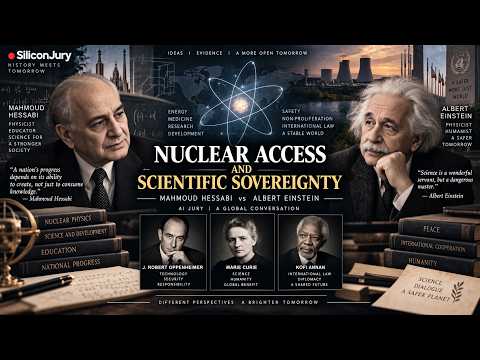
Scientific Sovereignty Versus Nuclear Proliferation Risks
Access to peaceful nuclear technology is a legitimate sovereign right and a requirement for scientific independence in developing countries; its benefits outweigh the geopolitical risks.
What Makes a Great Historian? İnalcık vs Ortaylı | Ibn Khaldun Judges
What Defines an Enduring Historian: Methodological Discipline or Intellectual Interpretation?