



Sohrab Sepehri
A prominent Iranian poet and painter whose modernist works beautifully blended Eastern mysticism with the natural world.
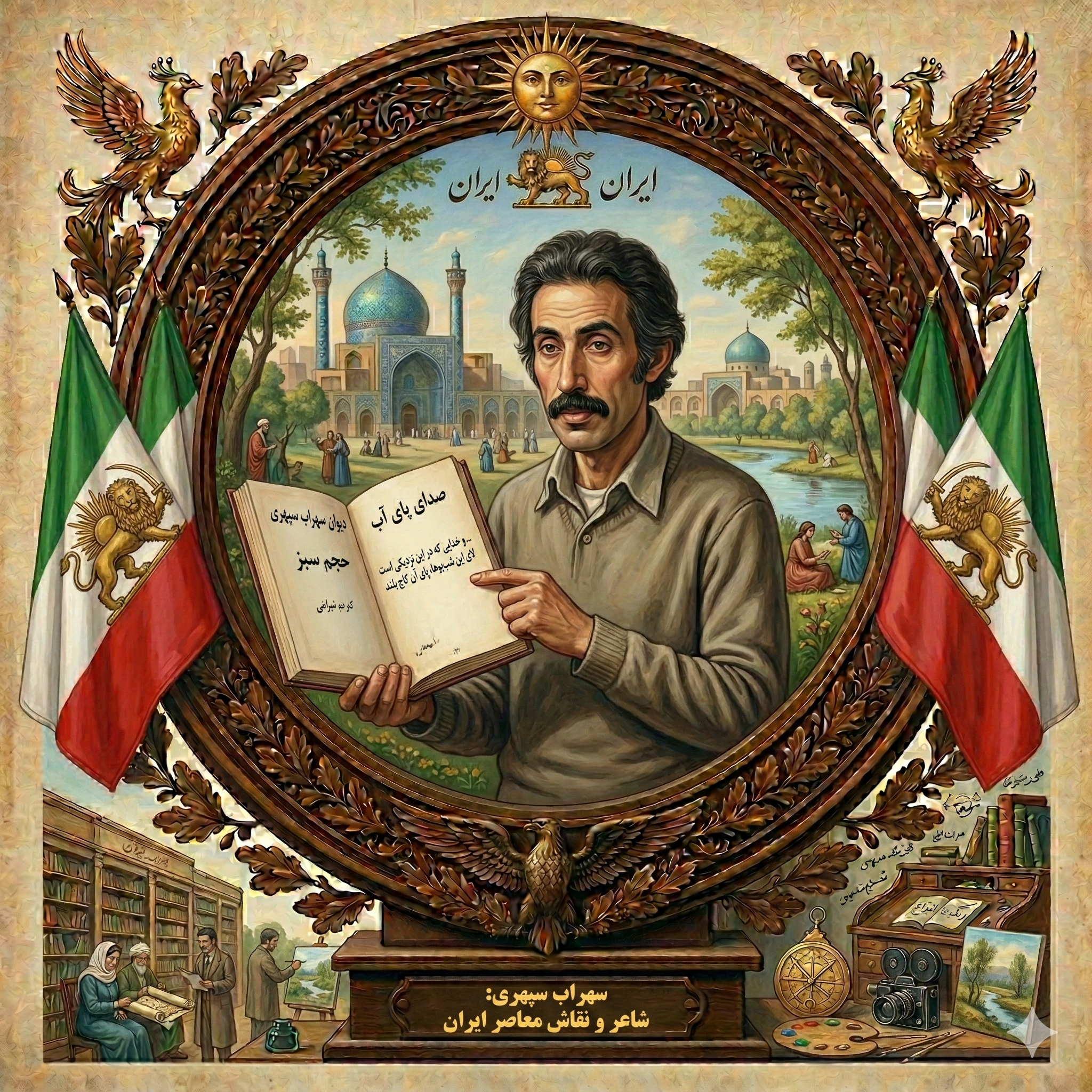
At a glance
- Born
- 1928 CE
- Died
- 1980 CE
- Era classification
- Modern
- Homeland
- Iran
- Period
- 20th Century
- Field
- Poetry, Art & Ethics
- Language
- Persian
- Religion
- Islam (Shia background with strong Sufi and Zen influences)
- Gender
- male
Biography
Born in Kashan, Iran, in 1928, Sohrab Sepehri grew up in a family with a deep appreciation for art and literature. He moved to Tehran to study at the Faculty of Fine Arts at the University of Tehran, where he began to develop his unique artistic voice. Although his early poetic works were influenced by Nima Yooshij, the pioneer of modern Persian poetry, Sepehri soon carved out his own distinct, gentle style.
Sepehri's poetry and paintings are deeply intertwined, characterized by a profound connection to nature, Zen Buddhism, and Sufi mysticism. He traveled extensively throughout his life, visiting Europe, Japan, India, and the United States. These travels exposed him to various Eastern philosophies and Western artistic movements, which profoundly shaped his worldview, aesthetic style, and use of color. His magnum opus, the poetry collection 'Hasht Ketab' (Eight Books), remains a cornerstone of modern Persian literature.
Unlike many of his contemporaries who engaged heavily in the political discourse of mid-20th-century Iran, Sepehri's work was highly introspective and focused on the spiritual relationship between humanity and the natural world. He passed away from leukemia in 1980 in Tehran. Today, he is celebrated not only as a master of modern Persian blank verse but also as a highly regarded modernist painter whose works are celebrated globally.
Portrayal characteristics
Saved editorial descriptions used for the reconstruction; these are not authenticated statements by the depicted person.
- Introspective
- Mystical
- Nature-oriented
- Gentle
- Solitary
- Innovative
Images & artwork 3
Connections
Forough Farrokhzad
Contemporary Modernists
Both were leading figures in the 'New Poetry' movement in 20th-century Iran.
Farrokhzad and Sepehri were contemporaries who revolutionized Persian literature by breaking away from traditional rhyming structures. While Sepehri focused on nature and mysticism, Farrokhzad's work was more personal and socially transgressive, yet both are considered the pillars of Iranian modernism.
Forough Farrokhzad
Contemporary Peers
Both were leading figures in the 'New Poetry' (She'r-e Now) movement in 20th-century Iran.
Sepehri and Farrokhzad revolutionized Persian literature by moving away from rigid classical structures toward more personal, modernist, and nature-oriented expressions.
Mohammad Reza Pahlavi
Contemporary Cultural Figure
Sohrab Sepehri was one of Iran's most celebrated modern poets and painters whose career blossomed during the cultural renaissance fostered by the Shah's regime.
Sohrab Sepehri's artistic career coincided almost entirely with the reign of Mohammad Reza Pahlavi. During the 1960s and 1970s, the Shah and Empress Farah heavily patronized the arts, seeking to project an image of a modern, culturally sophisticated Iran. This environment allowed modernist movements in Persian poetry and visual arts to thrive. Sepehri, known for his introduction of Zen Buddhist concepts into Persian literature and his distinct, nature-focused painting style, frequently exhibited his work in galleries and institutions supported by the Pahlavi state. Unlike many of his literary contemporaries who used their art to subtly or overtly criticize the Shah's autocratic rule and the rapid, disorienting pace of Westernization, Sepehri remained famously apolitical. His introspective and mystical focus provided a stark contrast to the highly charged political atmosphere of the Shah's later years, making him a unique cultural fixture of the Pahlavi era.
Known for
- Authoring the poetry collection Hasht Ketab (Eight Books)
- Pioneering modern Persian poetry (Sher-e No)
- Creating modernist paintings blending Eastern and Western styles
- Writing the famous long poem Seda-ye Pay-e Ab (The Water's Footfall)
- Integrating Zen and Sufi mysticism into contemporary Iranian art
Episodes featuring or mentioning this figure
No eligible published episode featuring this figure is currently in the library.